
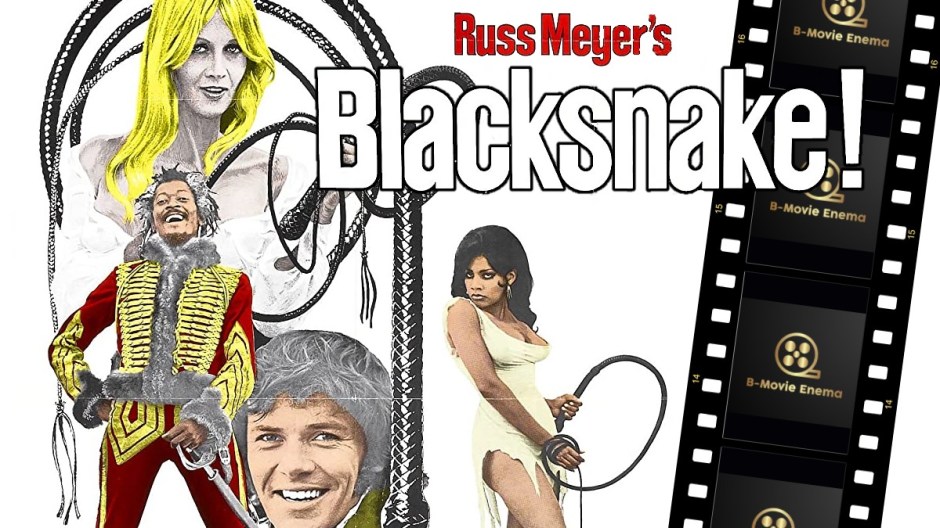
Welcome to the penultimate week of Russ Meyer Month II here at B-Movie Enema! We move from the 60s Russ Meyer sex comedies and romps to his 70s bigger budgeted and slightly more interesting films. This week, I’m reviewing 1973’s flop Black Snake.
This one is an interesting entry in Meyer’s filmography. I labeled it a flop. It was. Meyer was not unaccustomed to making a movie that wouldn’t perform well. Sure, maybe not all of his 60s films scored well with critics, but almost none of them were outright flops. As the 70s dawned, though, Meyer’s films would change. This would mostly be due to 20th Century Fox calling on Meyer to make actual studio-backed films. Beyond the Valley of the Dolls was the first and it was a hit – despite critics not really appreciating it. The next film for Fox was assigned to him after the original director had to back out. That film would be an adaptation of the book The Seven Minutes. Meyer’s friend, Roger Ebert, would write that the latter was not well-suited to Meyer’s affection toward eroticism. After all, it was a drama about law and freedom of speech. While the central thing in the movie did evolve around an erotic novel a teenager bought, it’s not really Meyer’s realm, even if the studio felt it was right for him based on the movies he made in the past and how he championed the abolishment of censorship.
The Seven Minutes was, by far, Meyer’s most expensive movie and it didn’t do well. In the end, it just didn’t work out. He would only complete one of the three films he was contracted to make for Fox after Beyond the Valley of the Dolls. The end was maybe on the horizon anyway. Black Snake would be his next movie and the first of the final five films he would ever make. While his next three would recoup some of his past magic, this film would prove to be a massive disappointment and bomb.
To really understand why this movie was Meyer’s next film, you have to also understand the landscape of film in the early 70s. His work with Fox was likely due to what’s referred to as the New Hollywood movement. That began in the late 60s and studios were finally thinking outside the box a little bit and bringing in fresh talent and more varied perspectives from filmmakers. It didn’t so much suit Meyer. When he would return to independent exploitation filmmaking, that’s where we see another hallmark of the early 70s – blaxploitation.
I’ve talked about this in the past, but, to refresh everyone’s memories, I freaking love blaxploitation movies. There’s a rawness to that genre that simply feels different than the stuff that Johnny White Boy would make. It also showed parts of a city that bigger budget films didn’t normally show unless it was a cop film or something that showed the inner-cities or mostly black neighborhoods as something “dangerous” and where criminals would hang out. What’s more, you see a sense of community in some of those films. I think of movies like Blacula and see how black folks are going out for entertainment at a nightclub or simply generally being in parts of Los Angeles we wouldn’t normally see and so forth and it feels like they built that together. I don’t really know how to explain it, but those films feel different. In a lot of ways, it is refreshing.
Russ Meyer probably felt the same way. So, in 1973, he released Black Snake. It was a movie that he hoped both whites and blacks would enjoy. It dealt with a plantation uprising. So, for black audiences, it showed slaves fighting back in the first half of the 19th century. For white audiences, it would have sexy ladies like New Zealand-born Anouska Hempel.
Now, history, and Meyer himself, would say this movie didn’t work. I’ll talk about that in a moment. I do want to quickly state that without knowing much of anything about this movie when picking what I would cover this month, I 100% chose this movie based on the title because… c’mon. Black Snake? That just sounds like a movie that likely has at least one dude’s giant cock. And he’s likely black. I was curious if Meyer would be that obvious.
Anyway, back to a more learned conversation about the movie. So, yeah, the movie would end up not doing well. Meyer would be honest in saying that the whole thing wasn’t working out from the start. All the main actors had accents. He said they were all British, but only some were. Some were from New Zealand. He looks at the film as a far weaker version of the film Mandingo which was critically panned originally but later received much more praise for being a pretty good depiction of race relations of that plantation era. Interestingly, Mandingo was directed by Richard Fleischer, the original director that dropped out of The Seven Minutes. Black Snake would face being retitled a couple times depending on the region it played or when it was sent to theaters. Meyer would admit he was out of his element for this movie and it was not at all the same experience for him that Fanny Hill was a decade earlier.
Meyer would also say that it would take seven years for the $200,000 budget to be recouped and for the film to break even.
But there was another thing Meyer said hurt the film, and it has something to do with him. Think back to last week when I covered Finders Keepers, Lovers Weepers! I want you to remember that I talked about the “typical Russ Meyer girl” and how they were usually brunette and busty and not exactly skinny by the true definition of the typical sex symbol of the era. Anne Chapman would be an excellent example of this and it bore true in that film. However, in Black Snake, the film was led by Kiwi Anouska Hempel. It’s not that Meyer didn’t like blondes. He had them in films all the time, but Hempel was blonde and, in Meyer’s words, skinny. She wasn’t his typical girl. It’s the very first thing he says is the problem with the movie. Meyer called her British (she wasn’t) which is also something else to consider about his leading ladies too. Some girls were exotic looking. Some girls had accents. However, aside from the central and northern European ladies he would cast, most girls were very much the types you’d find here in America. Aside from a white woman, he also liked having girls who were black, Mexican, or Latin American. Meyer certainly had an affection for girls with darker complexions and features – be it their skin tone or their hair color. Hempel simply wouldn’t fit that usual standard he buttered his bread with.
Damn, sometimes it feels good to be right about something like I was last week with Anne Chapman.
In the end, Meyer says he made a movie he hoped black folks would like. He claims he made a movie that both whites and blacks hated. He said the only place the movie did any business was, for some reason, Little Rock, Arkansas. However, this isn’t Meyer’s blog. It’s mine. I’ll be the one to make the determination on whether or not Black Snake is the disappointing bomb the likes of which half the internet says the last Indiana Jones movie was.
The movie opens and you can feel that there’s a larger scope or an attempt at a larger scope than most of Russ Meyer’s films. We’re treated to a large orchestral score as waves from the ocean come blasting along the coast and we see fields of what I have to assume is sugar cane. But then we learn about the Blackmoor Plantation there in the British West Indies in 1835. At this plantation, the rich and powerful owners deprive their slaves of the basic human right to freedom.
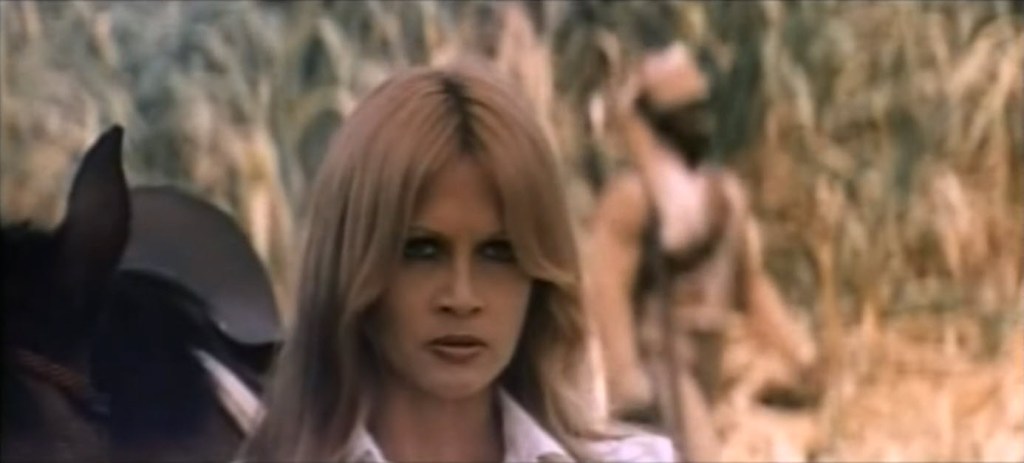
It quickly becomes a Russ Meyer movie when Blondie McSmokeyeyes above is shot from a low angle playing with a whip. It then leads into the credits. Now, do you know those times in movies when everyone basically gets a vanity card where it says their name and either shows a short, silent clip of them from the movie? Sometimes it’s a whole line from the movie. Sometimes it’s just a freeze frame picture. You know what I’m talking about? Yeah. Well, Russ puts that at the beginning of this film. It’s not giving you shots of each actor with their own name, but it’s playing clips from the movie we’re about to watch. And it’s some dicey stuff too. Someone uses the n-word. Someone uses the f-slur. The movie is playing all its cards right up front.
The music is good though.
During the course of these clips, we learn some things about the movie. First, the titular “black snake” is one guy’s name for his whip. That whip is used on the slaves on the plantation. That blonde girl above? Well, she’s Lady Susan. She’s… Well, let’s start by saying she is NOT at all the typical Meyer beauty. Pretty? Oh yeah, but she’s a piece of shit. Think of Ilsa, She-Wolf of the SS but during slave times. She’s cruel and she’s the one who uses the n-word multiple times during the course of the credits.
Listen, I had issues with Vixen despite its importance in the world of erotic cinema. I felt she was a racist turd too, but her cruelty was at the expense of her sensuality and sexual desire. She was a shitbag, but one that probably really does exist in the secluded part of Canada in which that movie took place. Here, we have Lady Susan, the cruel mistress of the plantation. That’s not ignorance she’s portraying, it’s bigotry.
We might be in for a rough ride, Enemaniacs.

The movie begins with riders coming into a parish on the morning of March 30, 1835. A man who was working on one of the buildings’ roofs is told to quickly get down and hide. Leading the riders on the first horse is, surprisingly, a black man. He cares not for the man sitting outside playing the recorder. He looks over the men in the town with a look that makes it seem like his shit don’t stink. Behind him is Lady Susan. When the uppity black dude orders a man, in French, to search the cabins, they hear things crash and bang about until the guy’s men toss the roof worker out of the cabin and onto the ground. Lady Susan uses her black snake on the man.
Back in England, we meet Charles Walker who beseeches his benefactor Lord Clive to write a letter of recommendation for him to go to Blackmoor plantation undercover as a bookkeeper named Sopwith. His plan is threefold. First, he wants to find proof that his brother was murdered. Second, that Lady Susan is a slaver when that has been abolished by England a couple years prior to this movie. Third, Lady Susan had something to do with his brother’s murder.

The dude in the fancy coat that led the search to find the guy in that parish earlier, is Lady Susan’s French teacher. His name is Captain Raymond Daladier. Captain Daladier is a gay man. Despite his insistence that he comes from a long line of warriors, Lady Susan sets him straight that his line has come to an end if he continues to only sleep with men.
I will say Bernard Bostan’s performance as Captain Daladier is pretty great. He’s fluent in French. He’s also got that uppity fancy pants air about him. He looks down on the people who, let’s be real, look an awful lot like him in order to serve his own needs to feel superior and, sometimes, inflict cruelty on the slaves owned by Lady Susan. It’s a fascinating performance and definitely feels like something that, with just a little bit more modernity to the character, would fit in at one of Z-Man’s parties in Beyond the Valley of the Dolls.

Okay, so there is a bit of a power struggle going on here at Blackmoor. Lady Susan has two main men she pays. Captain Daladier is security/police. He keeps the slaves watched and retrieves them if they run. The other is the boss of the fields, Joxer Tierney. Besides having a hell of a name, Joxer gets paid better than Daladier. As Lady Susan puts it, Joxer produces sugar cane. That doesn’t rankle Daladier that badly. Besides, considering his title and his ability to keep things in line, he figures when Lady Susan travels to Paris, he will be left in charge. Lady Susan doesn’t so much think that will fly with Joxer at all. She very nearly slips up and says that Joxer would never take orders from an n-word, but she backs off and softens her tone.
In response, Daladier has one of the greatest line deliveries of all time when he calls Joxer poor white trash.
It seems as though another day, another escape attempt happens in the fields. As Charles rides into the area of the plantation, the escapee crosses paths with him and his driver. They opt to follow Captain Daladier’s men who are in pursuit of the escaped slave. As the Captain’s men catch up to and circle the slave and whip him, another slave begs the rest of the slaves to rise up and use their numbers to overthrow the captives. They don’t follow him to save the escaped slave from his ultimate fate.
As Joxer and Charles arrive at the beach, they see the escaped slave trying to swim away from the beach as Daladier’s men shoot at him. Charles is disgusted by the men shooting at the slave. Joxer doesn’t want a worker worth 300 pounds to be killed unnecessarily. But it isn’t the bullets that ultimately kill the slave. It’s the shark that is swimming close by offshore.
I want to also point out something that made me giggle, was clearly kind of put in as a lark, but is very very dumb nonetheless. Whenever they show the shark underwater, you hear pings from a sonar. That’s really dumb.
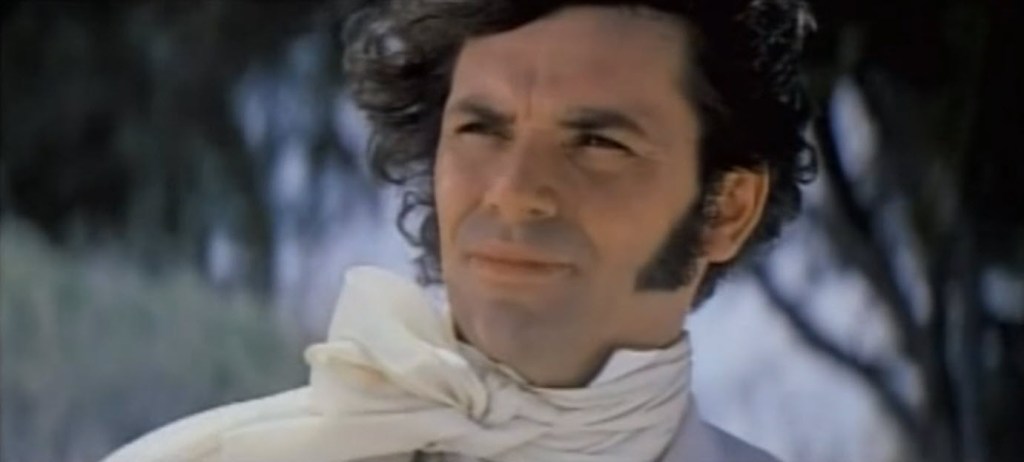
Anyway, Daladier and Lady Susan arrive on the beach to find out what happened. Daladier and Joxer have an exchange of words that Joxer gets scolded for. She sees Charles and is seemingly quite taken by him. Joxer asks for a private meeting tonight because “it’s been a while” if you know what I mean and I think you do. Apparently, Lady Susan would like to fuck Captain Daladier but he’s gay. So I guess she sleeps with Joxer because he’s the next most eligible bachelor?
But he’s gross. So… I dunno, Lady Susan. Just maybe fashion a piece of sugar cane into a dildo or something?
Joxer appears to be something of a jealous guy. He specifically asked for London to send an older, no-nonsense kind of guy. Not a guy who looks like David Warbeck. By the way, David Warbeck, who plays Charles, was seen on this very blog when I covered a duo of Lucio Fulci films – The Beyond and The Black Cat. What Joxer really doesn’t want is anyone who is taking Lady Susan’s eyes away from him. You know, because he’s such a bastion of studly manliness. He obviously feels no competition from Daladier due to his blackness and gayness. So, he figures he can worm his way into her ladyship the way she wormed her way into the lordship to receive her title. That lordship she let slip inside her ladyship was Jonathan – the missing brother of Charles.

Joxer isn’t entirely interested in making sure Charles doesn’t get laid. Oh no, far be it for him to deny a good-looking man the type of things a good-looking man should expect. So he sets Charles up with a slave who gets passed around from person to person like a used tissue. He’s introduced to Cleone, played by the lovely Vikki Richards. Charles is a little surprised that the very first thing Cleone ever says to him is if he wants to fuck now.
That night, the slave who was trying to start a rebellion, Joshua, tries again to rile up his fellow slaves. An older slave, who happens to be Joshua’s father, consistently pushes back on the idea of rebellion and uses scripture to try to do the whole “turn the other cheek” thing. Unluckily for Joshua, Daladier overhears the speech he’s making to the slaves. He issues a warning about a rebellion. He does seem to give them some sort of chance to not call the wrath of the masters of the plantation on them by not stoking the rebellion. He tries appealing to Joshua by way of their blackness.
Awesomely, though, when the old man again tries to speak the word of God about not using violence, Joshua says, “Your God is not my God, old man. My God has balls!” That’s a fucking great line.
Later that same night, Charles is having his usual nightly sex with Cleone and she might have some information about his brother, but they are interrupted by Daladier who delivers the invitation to Charles to go to the plantation house to take an audience with Lady Susan. Daladier, seeing him nude, figures that Susan would like him as is, but suggests an outfit to wear. I’m telling you, Bernard Boston’s performance in this movie is fantastic. He’s got timing. He’s got the accent. He’s got the mannerisms of someone who is gay but also possesses a tough streak in him.
Speaking of Daladier, while Lady Susan shows Charles around the house, Joxer comes to the gates but is turned back by Daladier. However, Joxer slips around the back and jumps the fence around the house. He then finds Lady Susan and Charles in bed together.

Joxer does say something pretty important. He tells Charles that if he’s not careful he will end up like her fourth husband. That husband was Jonathan. Drunk and jealous and pissed off, Joxer gets mad when Lady Susan makes fun of his limp dick. He rapes Lady Susan. The slave inside the house, Bottoms, takes a little pleasure in Lady Susan being abused. However, a very large man appears behind him and scares him off.
The grunting and hulking beast knocks Joxer out and tosses him aside. He then climbs on top of Lady Susan himself. Charles knocks the monster off her and when the large dude tries to throttle Charles, Charles recognizes him… This large beastie is none other than Jonathan. Instead of acting like the brother he always knew, Jonathan is more simple and looks like a caveman. When Charles calls out his name, Jonathan takes off running.
Jonathan is played by David Prowse. Prowse is probably best known as the man inside the Darth Vader suit in the Star Wars films. He’s also recognizable to many folks as the large Julian who looks after the old man that the droogs nearly beat to death in A Clockwork Orange. He even played the Frankenstein monster in a couple Hammer films.
When Charles tracks down the escaping Jonathan, he tries to talk to him to help him recognize who he is and where they’re from. Daladier, who seems to be an expert at always showing up where important conversations are happening, tells Charles this is a secret best kept between them. It’s like Daladier is the guy who picks up all the secrets and has all the information and will use it when it best suits him.

The old slave who tried to calm down the fiery leader of the would-be rebellion got injured while trying to use a machete. He’s back to work basically the very next day. Charles wants him to rest somewhere Joxer can’t see him. However, Joxer spots them and threatens to whip Charles. Soon, Lady Susan shows up to say no white man will get whipped unless she’s the one doing the whipping. So, she figures the best resolution to this is for Charles to whip the slave he himself was trying to help.
Eventually, Joshua steps up to say he will take the whippings, but Lady Susan thinks that maybe they both should just be whipped. When Charles tries to stop her, she turns her black snake toward him. That night, Lady Susan grills Charles about why he’s at Blackmoor. Daladier says that they are dealing with savages and they need to be shown who’s boss around here. It’s difficult seeing someone whipped for the first time, but it’s a natural part of their job.

Then, Lady Susan describes herself as once being a slave. She grew up poor in London. She had only one difference from the slaves she owns, she part of the oldest profession in history. Through prostitution, she could make men think she was whatever it was they wanted her to be. That led to her getting married four times and taking over Blackmoor plantation.
After her big revelation about her past, she gets into her bathtub only to find that Joshua has placed a snake in it to kill her. His punishment is to be crucified. When Charles discovers this is what’s happening to him, he begs Lady Susan to stop. If she won’t order them to stop, and if Daladier won’t call off his men, then he will stop this. Quickly, Charles is knocked out.

Once Charles is knocked out, we see the sugar cane fields burn with the tide roiling and so forth. But… this is so weird. The movie uses that as a way to progress what happened after they finished crucifying Joshua and what it inspired when Charles got involved. I don’t think it was a full uprising, but Joshua doesn’t die. He just becomes a living martyr for the other slaves. Charles tries again to free Joshua from his predicament. However, most of what we learn is told in a conversation between Joxer and Lady Susan. It’s simply a way to save money and time in the movie to just progress to the third act in a cheap way.
So now Charles is in a cell and I guess Joshua is still on the fuckin’ cross. Lady Susan goes to visit him and tells him what everyone has done and how Cleone even left him. She says that as long as he no longer screws his slave girl, she’ll share Blackmoor with him. She then reveals what she did to Jonathan. She had his tongue cut out and his balls cut off. She leaves Charles with Daladier to do as he pleases with him.

Feeling her gasp on the plantation slipping, Lady Susan asks Joxer to do her a little favor and let her watch him whip Joshua while he’s still crucified. Joxer, after being a pretty shitty dude, isn’t so sure he feels right about whipping him. He figures the poor dude is closer to dead than alive and he’s not even reacting to being whipped lately. Besides, he just thinks another younger person comes to the plantation to work for Lady Susan and she’ll toss him over the side again for that new young stud. She promises him that’s not going to happen again, so Joxer kind of thinks maybe it’s time to get to whippin’.
That’s when Joshua starts speaking. He basically prays. Then, Joshua dies. Lady Susan wants him to get to work but ultimately leaves him in the field with the dead Joshua whose status of a true martyr has been fulfilled. Isaiah, the old man slave who disagreed with his son Joshua’s techniques to try to create the rebellion, leads the slaves in revolt and they surround Joxer.
The next task for the rebellious slaves to do? Get rid of Daladier’s men. They do it in an awesome way too.
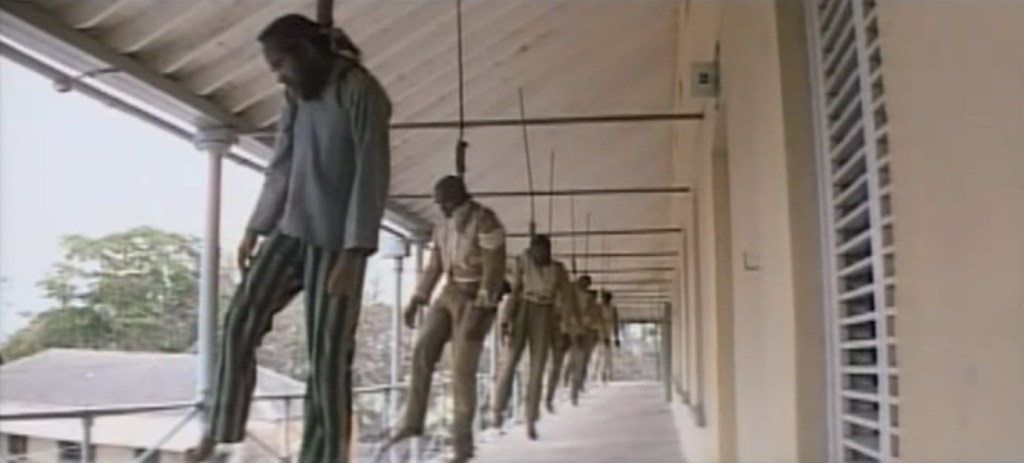
Daladier takes a gun from one of his hanging men. He tells Isaiah that he will die where he stands. Isaiah says God will protect him. Buuuut Isaiah helped God out by removing the bullets from the guns. The slaves slowly converge on Daladier with machetes and hack him to pieces.
Lady Susan tries to call Bottoms for something, but she finds him drunk on her wine. After he passes out, she orders Cleone to draw her a bath. Cleone does so but what Lady Susan finds in the tub is the hacked-up body of Daladier. She then hears the slaves taking turns one at a time whipping Joxer. Isaiah passes judgment on Lady Susan and says she is an abomination. He then orders the slaves to scale the gates and get her. They grab her and take her captive.

Meanwhile, in the house, Jonathan comes into the room Charles is currently handcuffed in and breaks him free. Jonathan runs off and starts playing with the hanging mercenary guys. Charles wants his brother to come with him, but he also can hear the rebellion taking place. Charles stops the slaves from continuously whipping Joxer. He says that if they keep making this a bloodbath, they will undo everything they’ve done to win their freedom. If they keep killing Lady Susan’s people, British soldiers will come and wipe them out.
Isaiah tells Charles he will be allowed to live. The other whites on the island are marked by Satan. Jonathan arrives and ultimately goes after Lady Susan. She shoots him and he dies. Charles gets pissed and attacks Susan, but the slaves come and take her away. Isaiah is left alone with ol’ Joxer who begs to be cut down from the gate and spared as an old man. Isaiah picks up a machete that was dropped at his feet and runs Joxer through to finish him off.
Despite Charles screaming in protest, Isaiah has Lady Susan crucified on the same structure Joshua was and they burn her alive for her crimes against them.

This movie is… something else. Let me be real honest here. I don’t think this movie has anything in it that is deserving of hatred. There are things in the movie that are uncomfortable. There are white characters saying really awful shit about black characters. So, while uncomfortable, I was REALLY looking forward to those people getting their comeuppance.
That said, there are problems with this movie. There are three primary issues that the movie has that derail it in the final act. The first issue is that Charles is absolutely given the White Savior role. It was bad enough that Joshua got crucified, but it seemed that because Charles defied Lady Susan and her team that it was wrong of them to do and that he tried to help free him and so on, then Isaiah got the gumption to take over his son’s position as a leader of a rebellion. Absolutely, it does take people across all lines of race to make true social change. Yet, the whole movie is headed toward a slave rebellion, and it does not really come from the slaves. It’s only when one white character stood up to other white characters that ultimately activated them. The slave characters are practically non-characters as a whole until that point.
The second issue is at the very end when the slaves do rebel, a mixed message comes up. They are doing things to the people we know we fucking hate in this movie. They get righteous revenge against their cruel enslavers. Great! Let them have their moment! But while they burn Lady Susan, we have Charles screaming at them about how this is a terrible injustice and how they will be hunted by the British government and they are now committing holy atrocities. Come on, dude. Let them kill these motherfuckers and give us the cathartic ending we need!
Then, the movie ends in a very bizarre way. It transitions to the present day to show farming taking the place of slavery and it plays “The Battle Hymn of the Republic” while a narrator talks about how the United States (eventually) abolished slavery (nearly 30 years after the UK did, mind you). It’s super patriotic and falls absolutely flat. But don’t worry, we see a white girl running topless while holding hands with a buck-naked black dude while a clothed white guy runs hand in hand with a topless black girl. Slavery is resolved, everyone!
The movie itself is fairly well made. Sure, there are points in which you can clearly see that they are using locations that are very 1973 and not 1835, but whatever. The movie has some good shots. The acting is pretty good. It looks somewhat sleek in how it’s pieced together. But it is the least Russ Meyer film I’ve ever seen. It does sort of feel like a for-hire type of film, but it wasn’t. This was his idea. It just doesn’t quite work and becomes a little boring and a little off the mark by the time we get to the crazy “The Battle Hymn of the Republic” conclusion.
Next week, we wrap things up for Russ Meyer Month II. We do things right by looking at the third, and final, collaboration with Roger Ebert. It also happens to be the final non-documentary feature film from Meyer too. Join me when we go Beneath the Valley of the Ultra-Vixens!
 bmovieenema.com