

Welcome to yet another B-Movie Enema, my dear Enemaniacs! This week, we’ve got ourselves a real adventure. In fact, the title says it begins here. What it doesn’t say is that it also ended here. That’s right, I’m going to be writing many, many words about 1985’s Remo Williams: The Adventure Begins!
Where to start? Well, let’s start with our titular hero. Remo Williams is the lead character in a series of pulp adventure novels that go back to 1971’s Created, The Destroyer. He was created by authors Warren Murphy and Richard Sapir. Sapir wrote a handful of other books, but none were as popular as his Remo Williams co-creation. Murphy, on the other hand, is a little more interesting.
Murphy wrote the screenplay for 1975’s The Eiger Sanction starring Clint Eastwood. In 1989, he worked on the story for Lethal Weapon 2 with Shane Black. The TV Series Murphy’s Law was also based on the Trace series of books that he also wrote. Most interestingly, Murphy would be married to Nancy Cartwright from 1988 to 2002, the pair having two children. Who is Nancy Cartwright, and why does that name sound so familiar?
She’s the voice of Bart Simpson.
Murphy and Sapir’s Remo Williams is an American government operative. He’s something of a James Bond type, having training in various martial arts, undercover work, expertise in several firearms, and close-quarters assassination. However, unlike Bond, Williams didn’t start out in military intelligence. Instead, Williams was a Newark, New Jersey cop who got framed and sentenced to death for a crime. His death was faked and he went off to work for the clandestine organization CURE. His training was mostly handled by his father figure Chiun.
Over 50 years, there have been 155 Destroyer books released. It’s kind of wild that there is not a single Wikipedia article for any single Destroyer book. Remo Williams has a page. Warren and Sapir each have a page. The movie has a page. The series has a page. But none of the books individually have a listing. Only the first 19 books have a date next to them. Beyond that, it’s not much more than a few notes on some books that were released with a new numbering system or from different publishers, etc.
It’s hard to say exactly how popular the series is. Granted, these are mostly pulp books so they likely aren’t that thick or exceptionally well-written with each entry. With how fast they have been released, and how many there are, there are very likely going to be more clunkers than gems. That said, beyond this 1985 film, there was a 1988 TV movie made as a pilot for a TV series that did not get picked up by the network. There were some rumblings around Shane Black, remember he knew and worked with Warren Murphy, wanting to adapt the first book of the series into a new film version of The Destroyer. That piece of news came from the official site of the Destroyer series, but that site does not look to have been updated in five years and links to buy books at various online retailers go to nothing.
Remo Williams, though, was popular enough to get a big-time movie made. That’s what we’re really here to talk about. Orion Pictures, being run at the time by former executives from United Artists, wanted a series that would be an American counterpart to James Bond. The official Bond films were distributed by UA back then. They were so devoted to that concept that they went out and hired Bond series veterans to work on the movie. They hired Christopher Wood, the writer of two of my favorite Roger Moore films (The Spy Who Loved Me and Moonraker), to write the screenplay. Wood would even go on to write a novelization of his script.
For the director, they went with someone who made a huge mark on the Bond series – Guy Hamilton. The first two films of the Bond series were directed by Terence Young, but when it was time to make the third film in the series, Young was not available due to him choosing another film over the next installment. So producers Albert Broccoli and Harry Saltzman brought in Guy Hamilton to make Goldfinger.
Now, I want to admit something. I’m a huge Bond fan, but Goldfinger is not one of my favorite films as it is so commonly selected by fans and others (like laypeople or critics). I just don’t like Sean Connery’s persona in the film whereas his performances in the three Terence Young films, Dr. No, From Russia with Love, and Thunderball, are what I think of when I think of Connery in the role. Still, without Goldfinger, there is no Bond series as a blockbuster franchise. It’s the perfect culmination of the traits the first two films sprinkled into the films to create a lasting set of hallmarks and traditions for the 22 films that followed it.
Hamilton also was called upon to make three more Bond films. In fact, he made three in a row – Diamonds Are Forever, Live and Let Die, and The Man with the Golden Gun. Live and Let Die was the first of the Roger Moore era, so he had a large task on his hands in ushering in the person who permanently replaced Sean Connery. He said he told Moore to not try to copy or impersonate Connery in his performance and just play it the way he wanted to play the part. That was good advice as an entire generation grew up watching those Moore entries. As for the immediate follow-up to that film, The Man with the Golden Gun, that is the only one of the four that Hamilton would say he regretted making. He’s right. It’s a very inferior entry despite having a wonderful lead villain played by Christopher Lee.
To play Remo Williams, Fred Ward was selected as the lead. Ward, of course, has been seen here at B-Movie Enema in the fun sci-fi western Timerider: The Adventure of Lyle Swann. Ward is a good actor. Christopher Wood agrees with that sentiment. Wood still believed that Ward was not the right guy. He wanted someone like Ed Harris, who was considered at one point. He felt maybe Harris would have been more appealing to audiences and that could have kept some people from going to see the movie. Additionally, Wood had written and planned for a big action sequence in the final act, but it was axed for budget reasons.
But… It’s about time to take a look at the movie itself. I do think there is a small audience for this movie. Much like Buckaroo Bonzai, every now and then you hear someone say, “Hey, have you seen Remo Williams? I always liked that movie!” Well, let’s see for ourselves, yeah?
I should point out real quick that this was one of those Dick Clark Production films. Dick Clark’s production company was mostly known for producing things like American Bandstand and other musical/variety shows. They produced a handful of movies too, but none of them were that big. Clark was listed as a producer on this film, as well as the Remo Williams TV pilot a few years later. As an interesting side note that also connects to Remo Williams and Dick Clark, Clark was also a producer on a movie that I always knew as Backtrack but also went by the title Catchfire. That starred Dennis Hopper and Jodie Foster. It also had Fred Ward in a role as well. Anyway, I wanted to bring this up because, in 2007, embattled businessman Daniel Snyder bought Dick Clark Productions. I only bring this up because, as a fan of the Washington Redskins/Football Team/Commanders, I cannot tell you how glad I am to be done with that dingleberry.

The movie opens in New York City. Our hero sits in his police car, listening to the Knicks game, and eating a sandwich. He’s got a pretty bitchin’ mustache. Anyway, he gets a call from dispatch. However, before he answers the call, he sees some people running by. First, it’s a black guy. Then, he’s followed by two white guys. He decides to investigate. When he catches up to the trio, the two white guys are beating the hell out of the black guy. The white guys take something from the black guy. I will call him Remo Williams here because that’s what he will become, but in his former life, he was known as Sam Makin. When he tosses the guys who were attacking the black guy against the wall to search them, the black guy ends up attacking Remo. This leads to Remo having to fight against all three guys.
He eventually gets the upper hand and beats the fuck out of these guys. Now… Granted, he was getting attacked, sure. However, I would expect nothing less from a NYC cop to beat the fuck out of some perps. Anyway, he incapacitates the guys and goes back to his car where a truck rear-ends him and pushes the car into the river with Remo inside. A couple people in the water with scuba gear and flashlights approach. We cut to… the funeral of Remo Williams.

Fuckin’ quick movie!
So, yes, in this movie, Sam Makin is not framed for murder, instead, his death is faked. The guy who drove into the back of his cruiser and pushed him into the East River recruited Makin for this clandestine organization. They performed some plastic surgery on him, gave him new fingerprints, and shaved his stache. They also give him the name Remo Williams. Now, if you think there’s some sort of classy or clever reasoning behind picking that name, you got another thing coming.
Think about that wonderful reveal at the end of The Usual Suspects when you find out how Kevin Spacey concocted the entire story he told the police. You find out how he used items around the room to aid in the story or details or the names of people, including his own alias. It’s a wonderful scene, right? Well… You got something like that here too, but instead of a detailed, and extremely well-laced series of words and associations with items around a room, this guy comes into the room, tells Remo he’s been recruited (against his will I might add), and he’s got a new face and identity. He picks up his hospital room bedpan and looks at the bottom to see it was made by Williams Mfg. Co. in Remo, Arkansas.

Oh, what a gift this movie has been in these first few minutes. “Welcome to this organization you did not sign up for, you had to unwillingly fake your death for, and now your new identity is basically a shit bucket, idiot!” Seriously, this is the most peculiar introduction to your super action man star I’ve ever seen in a movie. You’re just tossed into the thick of it here and balls if you wish to have a little more background or understanding of why this should all go down this way.
This guy says they needed a guy and the newly-christened Remo Williams was a decorated cop and a former marine. Remo says if he’s the best they got, they’re all shit-fucked. This guy, MacCleary, says too bad. They’ve got him by the balls and they have nowhere else to go because cops and politicians and what have you are all corrupt. To get out of the very public hospital that the cop who was just buried woke up in, Mac says Remo has to steal an ambulance from EMTs at the hospital. Mac then takes Remo to Harold Smith, played by Wilford Brimley, who runs the organization that basically kidnapped Remo Williams and forced him to work for them.
Harold Smith says that his organization answers to only one guy, the President of the United States. Smith doesn’t even vote anymore. He doesn’t even care anymore which party is in power. He says that this organization is here to basically make sure people who have somehow slipped through loopholes in the judicial system get their comeuppance. They deal with those who are walking around with too much power. Remo Williams is like, “This shit sucks. I’m outta here.”

Smith tells him no dice. He points to a computer behind him and says that every piece of information that is processed in the United States comes to that computer. Remo figures out that what they want is an assassin. Smith is like, “Yeah, and if you don’t do what we want, we’ll kill you.” I guess that’s enough for Remo Williams to become this new assassin.
Smash cut to Remo’s first night on the job. MacCleary takes him to an apartment building, gives him a gun, and says to go kill the guy inside. Now, if you think the premise of this movie is wildly stupid (which it is), you would likely already think that these first twenty minutes are interminable. It’s at this point that maybe one of the more infamous things about Remo Williams: The Adventure Begins happens.
To understand the next picture I had to show you, we first need to know a thing or two about Joel Grey. Joel Grey is one of the most important figures in musical theater in the modern age. To keep this tangent shorter, Grey is best known for playing the Master of Ceremonies in 1972’s Cabaret. At the 1972 Oscars, he won Best Supporting Actor for the role, beating out James Caan, Al Pacino, and Robert Duvall, all having incredible performances in The Godfather. His daughter, Jennifer Grey, is Baby from Dirty Dancing and Ferris’ jealous sister in Ferris Bueller’s Day Off. I could go on and on about Grey as this truly important figure in entertainment, but I gotta keep this thing going because we’re still really early in this movie.
In Remo Williams: The Adventure Begins, Joel Grey plays Master of Shinanju, Chiun…
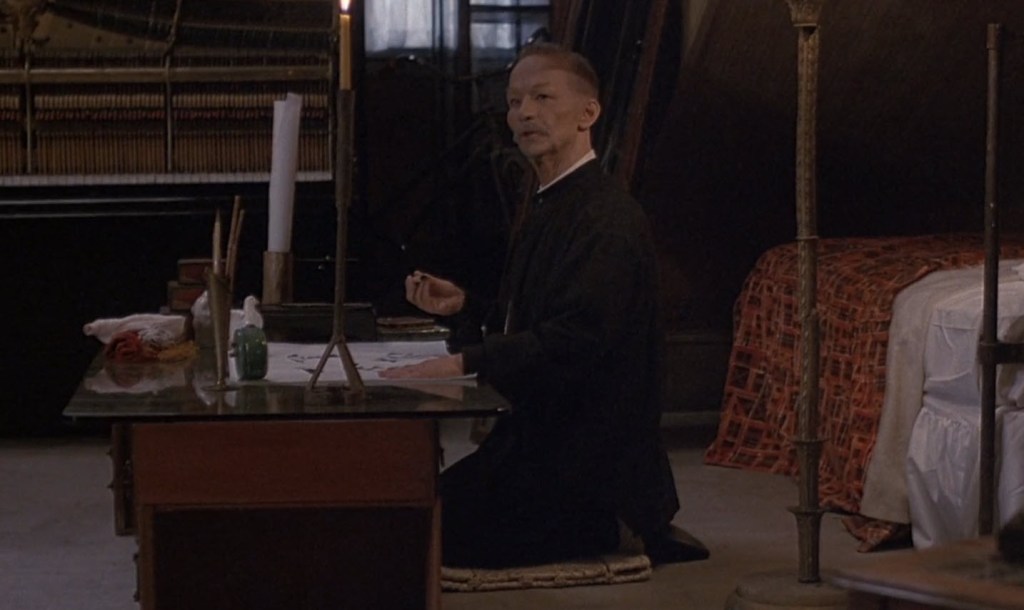
Yup! That’s some old-fashioned yellowface, my dear readers. That’s some yikesy shit, my dudes. Sure, it used to be common for white actors to play Asian characters (like Charlie Chan being played by Warner Oland). It wasn’t all that uncommon for white actors to play Hispanics and definitely Native Americans not all that long ago. By the 80s, though, it had been a long time since a white guy played an Asian character in any kind of serious way. I’m actually shocked that it was only more recently that the use of the made-up white man playing an almost mystical Korean martial arts sensei got any kind of attention for being pretty racist.
Anyway, this whole scene was a setup. While the use of Joel Grey as this character is pretty bad, the fight scene is kind of fun. There is good choreography in the scene and really does use Grey’s ability as a dancer well. He’s good at dodging punches, kicks, and bullets and smacks Remo around. MacCleary enters the room and asks Chiun’s opinion of Remo. Chiun thinks there is something here to work with even if the former cop’s reflexes are slow and his skills are lacking any real skill.

Back at CURE headquarters, Harold Smith is looking over information about George Grove. Grove is a contractor who is not a stranger to some questionable activities. He’s been investigated by multiple bureaus and no charges were ever filed. Witnesses to suspected crimes Grove has committed have either turned up dead or have gone missing.
MacCleary takes Remo to Chiun’s home where the two will begin Remo’s training. MacCleary says that they don’t do “bang-bang stuff”, their bodies and minds become their weapons. This first day of training goes about how you’d expect. Remo is a smart ass and Chiun kicks his ass. He teaches Remo how to breathe properly, how to run along the edge of a building’s roof, how to manage fear, and so on. One of his biggest pet peeves Chiun has is the average American diet – hamburgers and fast food junk.

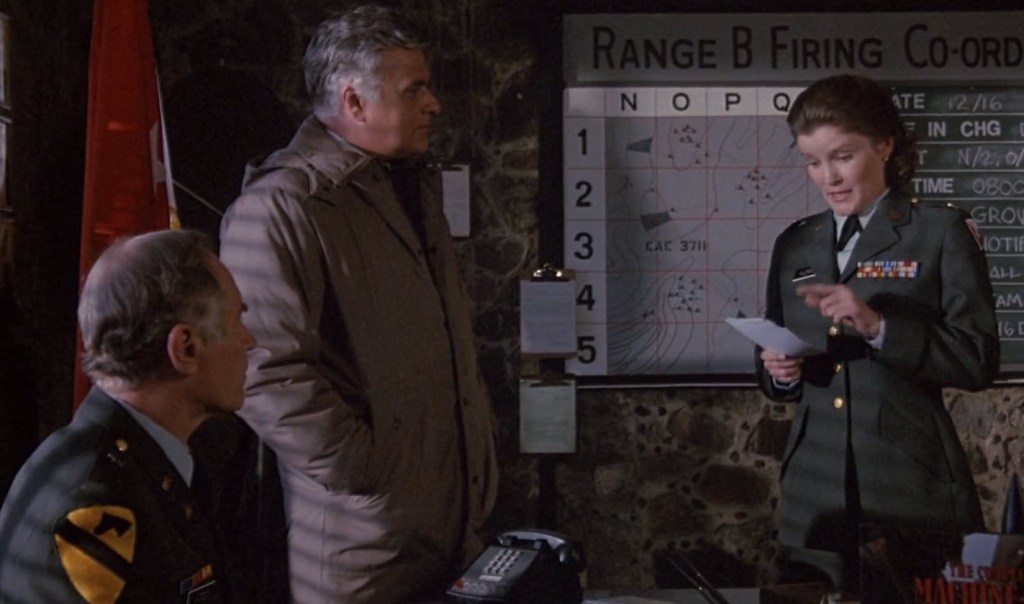
So something that this George Grove character is involved in is something called HARP. Basically, it’s either a part of or adjacent to the Star Wars weapons defense program that ol’ Ronnie Reagan started in the 80s. Harold Smith discovered that there’s something potentially fishy in the cost of the HARP program. The amount of money it was predicted to cost in 1983 vs. what the prototype one year later cost vs. what the full production cost jumped by quite a bit. What’s more, it seems someone has made the HARP files at the Pentagon inaccessible and it’s come to the attention of Major Kathryn Janeway… er, I mean Major Rayner Fleming.
Major Fleming is a go-getter. She reports the files being unavailable to her despite being a ranking officer who should be able to see them. She is also on the way to a demonstration of one of Grove’s new assault rifles. While Grove’s activities come under the scrutiny of Wilford Brimley, Major Fleming might be getting a tad too close to information Grove might not want her to have. The good news back at Chiun’s home, his training of Remo is starting to pay off with our hero now being able to master his balance much better. To impress Chiun, though, Remo needs to navigate all the various narrow walking paths he just traversed in the dark. He still has a little bit more to learn.
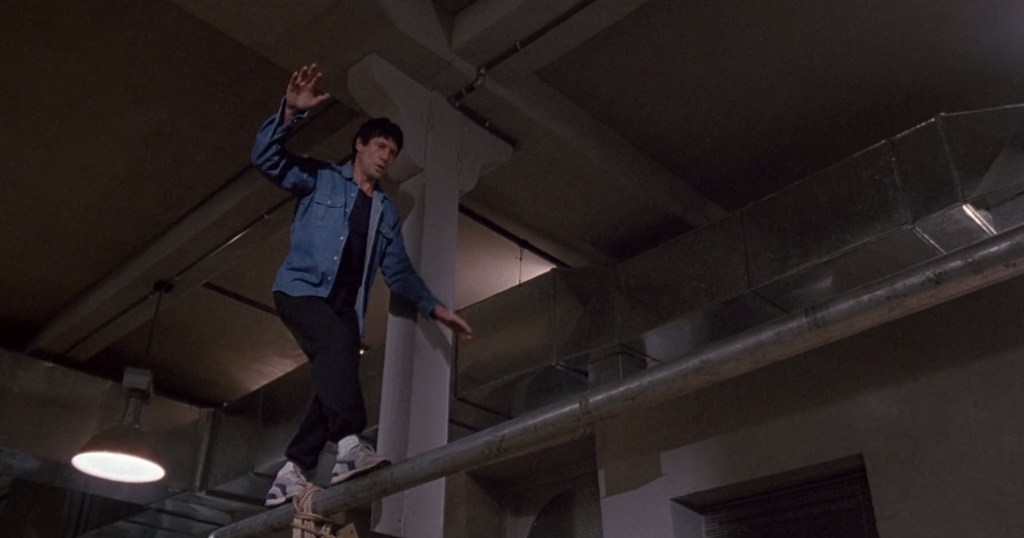
When that weapons demonstration goes awry and kills a soldier by blowing up in his hand after a jam, Major Fleming makes her report about the weapon’s unreliability. Her superior, General Watson, calls Grove to tell him he’s got a report of a dead soldier. Grove tells him to bury the report.
As we get ever closer to the halfway point of Remo Williams: The Adventure Begins, I do have to say this movie is not without some charm. I do not agree with Christopher Wood. Fred Ward is actually quite good as this gruff and sarcastic hero. I actually quite like Fred Ward. In fact, I can’t think of anything I’ve ever seen him in that I didn’t like him. He is actually perfectly fine as this less-than-perfect hero.
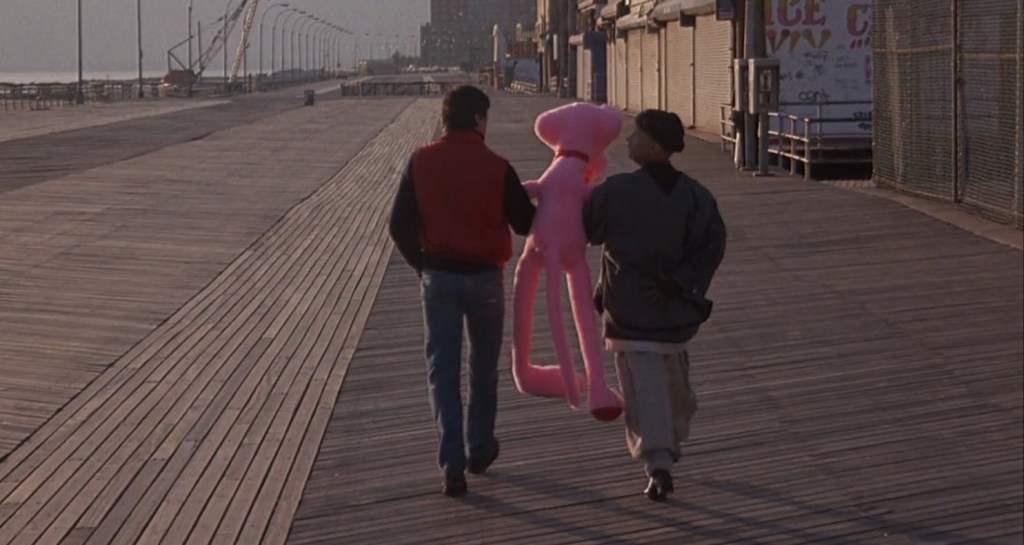
There are two glaring issues with this movie, but only one of them is found in the script. Generally speaking, I like the dialogue in this movie. In fact, as much of a glaring problem casting Joel Grey as Chiun is, he’s got some funny lines. Despite the mistake of his casting, he’s doing what he is supposed to be doing and I gotta give him some credit for disappearing into the role even if it’s really bad he is the guy performing the role. There’s a wonderful little scene at a fair where Chiun uses the Ferris wheel to continue training Remo. Before leaving, Chiun plays the ring toss game and wins a giant Pink Panther.
The two walk down the boardwalk with their arms hooked around Pink Panther’s arms and Chiun says, “Remember, this is mine.”
Generally speaking, I can almost enjoy this movie. The other glaring issue, though, drives this movie right into the ground from minute one. I mentioned above that the Destroyer, Remo Williams, is recruited into CURE after he is framed for murder, and gets a death sentence for the crime he didn’t commit. So, he faked his death, dropped his name, and became Remo Williams, right? The frame job and his pending execution are perfect reasons to become an agent of CURE. That’s cut and dry and you’d get very little complaint from me, even if Remo didn’t want to be in that situation.
That’s the backstory and you can build your story around that.
However, there is NO reason, other than the very obvious threat to his life, for Remo to work with CURE in this movie. In fact, CURE is, by all accounts, a villainous organization. They “kill” Sam Makin. When he wakes up in the hospital MacCleary just tells him he works for them now. There is no agency in our hero. He almost has to resign himself to being this trained assassin or be killed. That’s not heroic. At all. In fact, it makes him a fairly awful character. You know the saying “I’d rather die on my feet than live on my knees,” right? Remo Williams is living on his knees by just being a government assassin stooge. He should just say “Kill me” and refuse the job. If they call his bluff then so be it. It’s just a peculiar non-choice provided to the hero.
Frankly, that nagging fact that, right from the get-go, Remo Williams is an indentured servant to an organization he did not ask to join and named him after a bedpan makes me basically say the movie is flawed beyond repair or reasonable defense and, therefore, is a hulking turd of a movie.

Harold Smith sees that there is a growing concern both with Grove’s plans and Grove’s attention now being placed on Major Fleming. MacCleary checks in on Remo’s training. He asks Chiun when Remo will be ready. Chiun says he’ll likely be ready ahead of schedule – in 15 years, though, he does say if he cuts some corners, maybe 14 and a half years. MacCleary settles for being allowed to borrow him for a bit.
MacCleary arranges to meet with Major Fleming to give her some documents she’s requested, except that MacCleary is dressed as a Colonel. This also gives Remo a chance to shadow her by riding the elevator with her, and then trying to get her a taxi. Meanwhile, Grove has sent his top goon, Stone, to follow Fleming. Like any good goon in these types of stories, Stone has a peculiar trait – he has a diamond in one of his teeth.

To help get Major Fleming off their backs and stop asking so many questions, Grove says they need to have a body. Grove instructs his men to start with Remo Williams. Speaking of Remo, he’s gone to the top of the Statue of Liberty with Chiun. He’s here to overcome his fear of heights. So he’s just standing out on some of the scaffolding that was erected during the restoration project the statue was undergoing at the time.
On the ground, Stone paid off some guys who were working on the restoration project to make a little “accident” happen. The guys basically harass him by vibrating a catwalk he was standing on, then forcing him to hang onto pipes, or step on his fingers when he falls under one of the platforms. This is maybe the most memorable scene of the movie. So much so, that the image of Remo Williams hanging precariously from the Statue of Liberty was the poster for the movie. It’s a great scene. It’s full of tension and it is shot to make you feel the height and make you really think that Fred Ward is right there dangling from a couple hundred feet in the air. It’s well-shot and uses fantastic effects to make it all look like it’s really happening at dizzying heights.
See? There are elements of this movie that work exceptionally well. It was lost from the very beginning with the premise of how he became an agent, but the action scenes are actually fantastic.
Remo escapes the goons. He beats them up and gets back to the ground where Stone sends a couple of Grove’s other lackeys after him. He slips one by using a technique he learned from Chiun that allows him to lightly run over wet cement. When the lackey follows, the guy falls all the way into the cement and maybe dies. The second lackey is taken out by Chiun. Incensed by being the hunted instead of the hunter, Remo goes back to CURE headquarters and explains to Harold Smith and MacCleary what happened. Smith has been unable to get any dirt on what Grove is doing with this HARP project.
If I had to guess, it has something to do with mortgages.

When Remo says that one of the guys who was involved with trying to kill him today has a diamond in his tooth (in so many words), Mac thinks they may have what they need to move against Grove. Smith balks. He says that he can’t do anything about Grove because it could embarrass the president. Dude, Reagan is going to do that all by himself with memory loss and how he let gay people die from AIDS. I don’t think staging some sort of accidental death of Grove will be all that embarrassing in the grand scheme of things.
Smith says that Remo has gotten the attention of Grove. The problem is that if Remo Williams is now visible, CURE soon will be too. They must all disappear when that becomes the reality. For Smith, he’ll take a pill that will give him a massive heart attack. MacCleary will blow his own head off. Remo will be killed by Chiun.
Smith says it’s not that time yet. If they can get to whatever HARP is before they are all found out, they have a chance. Remo and MacCleary are going to visit one of Grove’s plants to see what they can find out. Remo returns home to get some stuff. Sensing his student has something weighing on him, Chiun does confirm that if Smith so ordered it, he would kill Remo. It’s part of the contract he has with CURE.

As much as I have quarrels about how this movie started with bringing Remo Williams into this organization, they do some good things with it. Remo’s disdain for his job is warranted and well-played. Brimley is good as the head of this organization. J.A. Preston, playing MacCleary, is good too as this kind of robotic type of character who has long accepted that he’s part of CURE. He’s hardened by it. Preston was later in A Few Good Men, but prior to this, he was known for Hill Street Blues. Really, where this movie shines is in any scene that Fred Ward and Joel Grey share together. They have great on-screen chemistry as student and master. Yes, I cannot say enough that the casting of Grey for an Asian character is unfortunate as hell, but the scene in which he has to confirm that he must kill Remo if it was ordered is so well acted in a nice, understated way.
Anyway, Remo and Mac go to the Grove plant in West Virginia. Remo has to dodge some killer Dobermans. It’s another good action scene. The dogs know of ways to get to him even when he thinks he’s bested them. He escapes them another time by tightrope walking across a cable, which one of the dogs does too. Mac gets files that might have what they need. Remo was in the same room where some sort of space-age contraption is and it suddenly gets zapped by lasers and starts a chain reaction of more explosions and fire at the plant. Just before they can get free, Mac is shot. He passes the information to Remo with instructions to get it to Smith. Mac is captured and kept alive with the hopes that Grove can get more information from him before he dies. Mac cuts wires that were providing life support for him.
Smith reviews the files from Remo. HARP was nothing more than extortion. Grove designed something he had no intention of officially building. What Remo saw was something he could show off to anyone asking about HARP’s progress, but it self-destructed before Remo could see that it was a fake. As Smith puts it, Grove will continue milking the government for funding for HARP 2 and HARP 3, and so on. Before long, no one will even remember to ask whatever happened to HARP 1. It’s all a plan to get all that sweet defense contract money. Remo asks if Mac paying with his life to get that information will ultimately mean nothing. Smith says that Remo can go after him, but in order to keep everyone’s noses clean, Remo’s kill must look like “one of Chiun’s perfect little accidents.”
Alright, so here we are, the final act of Remo Williams: The Adventure Begins. Remo is now allowed to act against Grove, and Grove is making his play to silence Janeway… er, Major Fleming. He shows her pictures of her and Remo Williams and says that she potentially is a national security. Grove asks her who she works for. She angrily says she does not like being spied on and she has no idea who the men in the pictures are or who they work for.
As she storms out, Remo happens to fall out of the back of an army truck. She figures out he’s from Intelligence. She assumes he’s looking in on the defective assault rifles. Grove’s #1 guy, Jim Wilson, played by Michael Pataki, picks her up to talk about those rifles. She invites Remo to come with them. Wilson leads them into a room where they are locked in and gas gets pumped into the room to kill them.
Going back to lesson #1 from Chiun, Remo controls his breathing. Fleming passes out while Remo tries busting a glass window. Before Remo passes out or succumbs to the gas, Stone puts on a gas mask and decides to beat up Remo for killing his friends at the Statue of Liberty the other day. Remo quickly gets the upper hand, rips off the dude’s gas mask, and uses the diamond in his tooth to weaken the window so he can smash through it.

Oh, I should mention that he also punched Stone so hard in the eye of the gas mask that I think he punched INTO his eye.
Remo and Fleming escape. Fleming keeps wanting to follow the typical rules and report this and file the bureaucratic procedures to file this report and that report and so on. Remo convinces her to do things his way instead of the usual military way. They find Chiun while on the run and the three of them steal a truck that has no breaks so they need to jump out before the truck tumbles down the side of a cliff. Chiun doesn’t get out before the truck falls down the cliff, but he (somehow) escapes without injury.
Chiun also slips up and refers to Remo as “my son” when he talks about how he managed to mostly escape broken bones and/or death.
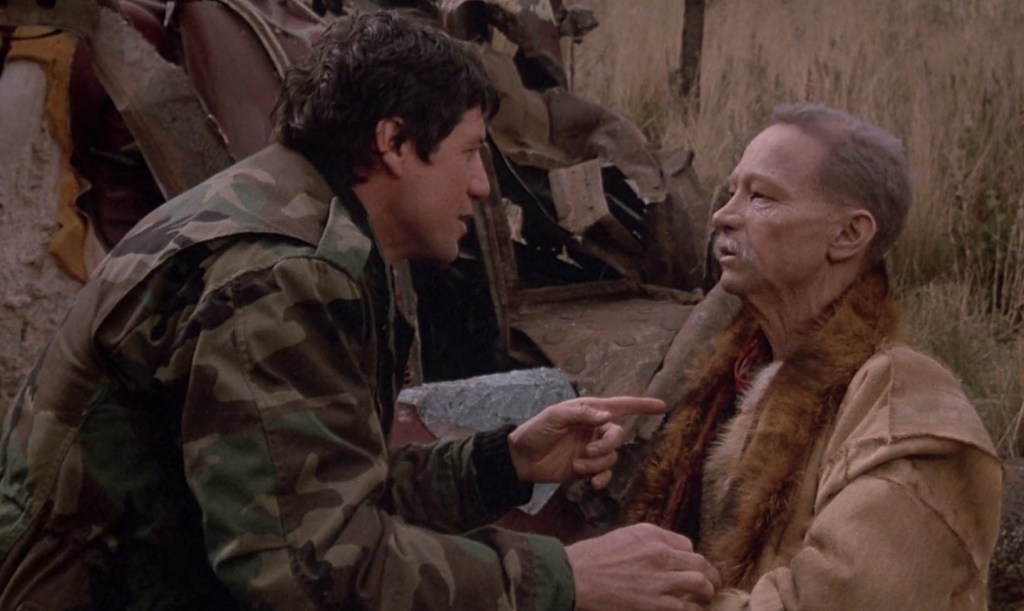
Remo leaves Fleming with Chiun while he goes to finish the job he was there to do. The base is looking for Remo and planning to basically hunt him. They try blowing up mines to get him, but he escapes that. He ends up holding onto a log that gets strung up and pulled along a wire. Aside from it being another stunt, I’m not exactly sure what this log on the wire is. When a soldier refuses to shoot Remo down because he really has no place to go because, again, he’s holding onto a log that is inexplicably being pulled along a wire, Grove grabs the gun and knocks the poor kid out with the butt of the gun and tries shooting Remo himself.
Remo disconnects the log and uses it to create a roadblock with other logs that knocks the jeep off the road. It is entirely possible that Remo didn’t just kill Grove and Wilson, but also the general who maybe wasn’t a bad guy? I mean, the only thing that the general did was think that Grove was a good guy but was duped like everyone else? Anyway, somehow Grove survived.

If there is anything else that Remo Williams learned from Chiun is how to dodge bullets. He does so and disarms Grove. He then tosses Grove over by the wrecked jeep. He tells him his name is Remo Williams and picks up a twig that he lights on fire by rubbing it with his thumb. He tosses it into a trail of gasoline that blows up the jeep. When the army comes to arrest Remo and Chiun, the soldiers are stunned by watching Chiun run on the water. Chiun and Remo escape on a speedboat.
Boy oh boy… Talk about having extremely complicated feelings about this one. Woo boy. At the start of this movie, and I mean, like, the first fifteen minutes, I thought this movie sucked. You had all the problems here right up front. The premise as to how or why Remo Williams is now working for a secret organization to be an assassin is right there in the first few minutes. Then, Joel Grey showed up in yellowface. Between these two things, the movie is nearly sunk with no hope for me to have a good time watching it.
But…
I did have a decent time watching it. Once I had to, basically, let go of the fact that Remo’s reasons for being an assassin are flimsy as fuck, I resigned myself to realizing that wasn’t going to change. The same goes for Grey’s casting as Chiun. It’s an unfortunate thing from the past, and I have to view this in as much of an even playing field as possible. Yes, his casting was not what could ever possibly happen today. Yes, he has to put on an almost cartoonish accent. These are things that are very unfortunate.
That said, Grey IS good in this movie. He gives Remo Williams a heart. Grey and Ward are fantastic together in this movie. They have wonderful scenes and moments together in this movie. I have to believe they were quite close while making this movie.
The action sequences in this movie are pretty top-notch. It’s clear this movie is made by Bond vets. They know how to construct an action scene and they know how to shoot stunts. That scene on the Statue of Liberty is as good as any action fight sequence filmed in the 80s. So, that kept me engaged. Each time I knew danger was coming, I perked up. The movie does not go long before getting back to an action scene.
Remo’s theme is fantastic. In fact, the entire score is phenomenal. The score is by Craig Safan. Early in his career, Safan did The Great Texas Dynamite Chase, which is a B-Movie Enema alum. He also did a single track for the Michael Mann classic Thief starring James Caan. For the most part, Tangerine Dream gets the credit for that score, but Safan was also involved. He also did the score for Angel. So he did scores for some recognizable movies. With this movie, though, he really does a great job making an upbeat, action score for a movie that really did try to be something more than just a one-off failure.
I recently came across a video on YouTube that I didn’t watch because I didn’t want it to color my opinion of this before I wrote this review. I don’t actually remember the title but it had something to do with how this movie was ALMOST a success. The movie lost money, but I think it’s possible if the critical reception was just a little higher it might have taken off and become a series. Gene Siskel was rather taken by the movie. Roger Ebert wasn’t as much into it, but did say it was a near miss for a positive thumbs up from him. So, today, the Rotten Tomatoes score is not great, and it likely reflects what the general consensus was back then, but how many of those were Ebert-style “near misses”?
There’s enough good here that I can say when the movie is good, it’s really pretty fun and good. You gotta get around some of that stuff I’ve really driven into the ground now, but if you can, you might really like this movie.
Next week, we’ve got a true classic on the docket. We go to the Caribbean for what’s often labeled one of the most influential Jamaican films ever made. Join me as I talk about 1972’s The Harder They Come by Perry Henzell!
 bmovieenema.com