

Welcome to a new B-Movie Enema review. This week, we’re going to do something a little different. We’re going to look at a movie that is an outright classic. This week, I’m going to look at 1972’s The Harder They Come by Perry Henzell starring reggae star Jimmy Cliff.
The Harder They Come is widely considered one of the most important films to ever come out of the Caribbean and very likely the most influential Jamaican film ever made. It was a massive hit in Jamaica. Henzell believed the success was mostly due to the naturalistic portrayal of black Jamaicans in recognizable locations and the local people portrayed in a way that allowed the black folks on the island to see themselves on the screen for the very first time. On top of that, when it was exported around the world in late 1972 and early 1973, the film is largely credited for bringing reggae to the world, especially the United States where it became a sensation. In the U.S., the film was distributed by Roger Corman’s New World Pictures where it eventually became a midnight movie hit.
The only issue is that the Creole dialect spoken by locals, known as Jamaican Patois, was so thick, that it struggled to be the same sensation outside Jamaica. It became the first English language movie that required subtitles in the United States. Still, the reviews were mostly good. It would go on to become a cult classic over the decades.
Director Perry Henzell was born in 1936 in Jamaica but was educated in the United Kingdom and Montreal. Once he returned to his native island, he began working in advertisements. That’s when he met Trevor Rhone who he’d go on to co-write The Harder They Come with. Rhone later became a playwright and wrote a handful of films. For Henzell, he only made two films. He made this one and then went to work on a drama called No Place Like Home.
However, No Place Like Home ran into budget issues. He filmed it in 1974, but couldn’t finish it when funds ran dry. He then thought he lost what he did shoot. He ended up settling on writing books. Thirty years later, he found the footage he shot for No Place Like Home and assembled a rough cut that got a great deal of positive feedback from those he showed it. It eventually played to a packed house at the Toronto Film Festival. Henzell died after a battle with cancer a couple months later.
Starring in this film was Jimmy Cliff. In the film, he plays Ivan Martin, which is named after a Jamaican criminal and folk hero Vincent “Ivanhoe” Martin (aka “Rhyging”). Cliff was already a reggae and pop star by the time he starred in this film. His first album was released in 1967. He was coming off a hot 1971 where he released three albums. By the time this film was released, he had already had six records out and was a bonafide star. Later, he did successful covers of Cat Stevens’ “Wild World” and Johnny Nash’s “I Can See Clearly Now”. The latter was from the 1993 movie Cool Runnings. In fact, I remember that cover getting radio play when I was a teenager. Later on, he did a cover of The Lion King song “Hakuna Matata”. Cliff was inducted into the Rock and Roll Hall of Fame in 2010 and is likely among the most important names in the history of reggae and ska music.
Fun fact about Cliff – in 1997, he appeared on Space Ghost Coast to Coast as a guest.
The movie opens with Jimmy Cliff’s “You Can Get It If You Really Want” as we watch a bus truck down the road. Right out of the gate, you get this raw feeling that presents this movie and life in a realistic way. The people on the bus and those on the street are authentic folks. they are not the typical American movie extras. These are real people doing their normal day-to-day stuff.

Cliff plays Ivan Martin. He arrives in town on the bus and meets a guy who has a cart to help him carry his belongings. The man with the cart tells him that someone “over there” owes him money. When Ivan goes over to help the guy helping him so he can get that money, the guy with the cart takes off and takes everything Ivan has. Ivan is a little naive. He’s a simple rural guy and this is the big city of Kingston.
Later, Ivan finds his mother who is living in poverty. He explains that his grandmother died. Most of the money the grandmother had was spent on her final wish to have a big funeral. What’s left is given to his impoverished mother. She asks how he’s going to get back to the country. Ivan says he’s planning to stay in the city. She can’t help him and basically says that the only way for him to make ends meet will be to become a criminal. Ivan is disappointed in his mother’s lack of confidence in his ability to succeed in the city. She just wants him to go back to the country.

Seeing Ivan is not going to leave the city, she gives him the name of a preacher who might just be able to help him get a job and get on his feet. Things are so bad for Ivan and his mother, when she asked if he brought her mango from the country, he says that mango season sucked this year. Damn, they can’t even get some fruit from the country they are so broke.
Ivan leaves and watches some guys outside playing dominos. He mentions to the one who directed him toward his mother’s place that he heard about the Rialto. The guy takes him there and we learn that the Rialto is a movie theater. They watch the spaghetti western Django. They then go to the arcade where locals play pinball and other boardwalk games. The man who took him to the Rialto is Jose. Jose is played by Carl Bradshaw.
Bradshaw is widely considered to be Jamaica’s premier actor. He later appeared in the 1989 American comedy-thriller The Mighty Quinn which starred Denzel Washington. He also appeared in Henzell’s second movie No Place Like Home. Interestingly, he also had a role in a movie called Goldeneye, but not the Bond film. Why I find that interesting is because Ian Fleming lived in Jamaica at a home he called Goldeneye. It’s why the 1995 Bond film is titled that. Being that it is a Jamaican home and that film was a Jamaican film starring Jamaica’s premier actor, I dunno, it’s interesting to me.

Ivan tries finding work in Kingston, but is turned away everywhere he goes. He’s willing to do work, but the work that is hiring requires experience or skill. He even wanders onto the property of a well-to-do woman. He asks if she has work for him. She has nothing. Her husband gets the car washed downtown. She has a gardening service. He says he can do anything she needs, but she, again, says she has no work. This leaves Ivan to basically live on the street and beg for dimes.
Finally, Ivan is desperate enough to finally go to the preacher’s church that was on that card his mother gave him. He gets work, but it’s mostly gopher and menial stuff. While working for the preacher, he takes a liking to the preacher’s ward, Elsa. He especially likes that the preacher is not her father, just a guardian. She likes the idea of going for a bicycle ride with Ivan… If he’s a true Christian.
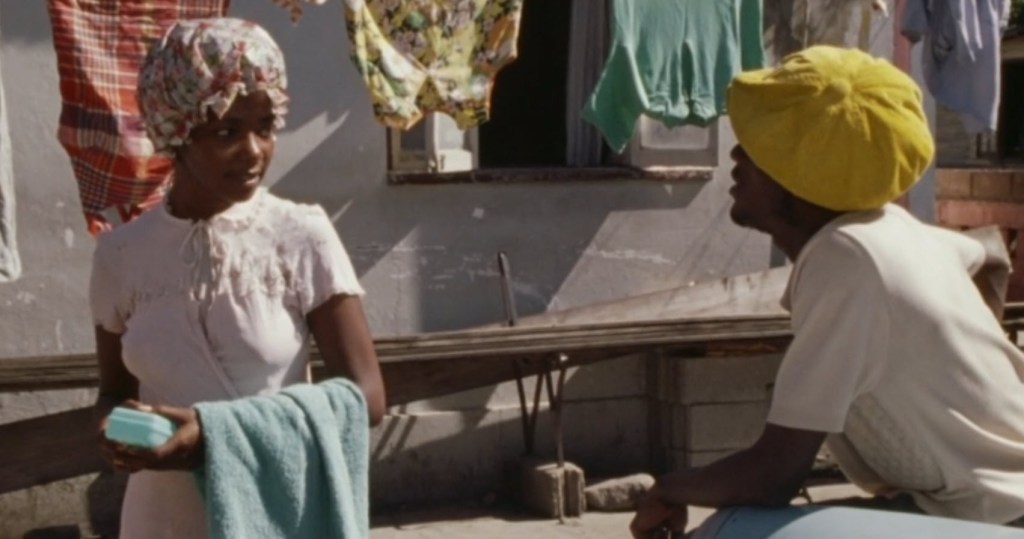
Ivan runs afoul of the preacher, though. He doesn’t like Ivan’s reggae music on the radio. That music is not something a good Christian would like. In addition, he doesn’t like Ivan hanging around late at night. Ivan says he’s fixing the bicycle. The preacher says he should be reading his bible.
Some of the other girls also wonder if maybe the preacher is so protective of her and not too hot on Ivan because the preacher himself would like to go forth and multiply with his young, virginal ward.
At church services, one of the deacons is giving a raucous sermon. While the congregation is celebrating with music and dancing while empowered by Jesus’ love, Elsa begins to imagine herself and Ivan naked in the ocean and giving in to their passion. He does get to have that ride on the bike with Ivan, but as they have fun, the preacher goes on the rampage. He goes through Ivan’s stuff and finds a Playboy and a bunch of 45s of reggae songs. He tears up the Playboy and yells at Ivan for not being there to run some stuff for an upcoming rally to a recording studio.

There, he asks the recording producer if he can record his song with them. As Ivan puts it, he has a boss track. This only gets Ivan further on the preacher’s bad side. Not only is the preacher aware of Ivan and Elsa’s attraction for each other but he convinces Elsa to help him get into the church to practice the secular music he wants to record in the church. Ivan says that if this hits big, he can marry her and take her away from the preacher.
When Ivan is caught by the preacher, Ivan and his friend are tossed out of the church. When the preacher finds out they got into the church with the key, he goes to Elsa and threatens to beat her thinking that she didn’t just give Ivan the key to the church, she gave him her virginity too. Ivan gets into a fight the next day with his coworker, Longo, at the church when Longo takes the bike that Ivan fixed up. Ivan cuts Longo up pretty good with a straight razor. He’s sentenced to eight strokes of the tamarin switch.

Not everything for Ivan is terrible. He does get his chance to record his song “Harder They Come” at the producer’s studio. He only gets twenty bucks for the song, but he thinks the song is worth $200. He does not get that. He does have a record, though. He goes to radio stations to get it played. However, the producer has a steel grip over the stations in a payola scheme. Ivan is forced to go back to the producer and accept the $20 contract. The producer teaches him the hard lesson about who makes a star around these parts, but he does give Ivan a few extra bucks.
However, the producer has no intention of making Ivan a star. He tells his guys to play the record a little bit, but don’t go crazy with it. The producer labels him a troublemaker even though his assistant does think the record is rather good (which it is, that song is awesome).

Ivan and Elsa are now living together, but there is no work. They are flat-busted. Ivan still dreams that his song will get played tonight and the other producers in Jamaica will hear and he will become an overnight success. Ivan wants to go out, but Elsa is too tired from walking all over Kingston looking for work. They argue over money and where they are headed in life.
Ivan does get the song played on the radio. People at the dancehall are dancing to it, so it might seem like Ivan is on his way. But his dreams come crashing down when Hilton, the producer who runs the payola scheme, has successfully relegated Ivan to obscurity. While at the dancehall, Ivan sees Jose. The two catch up, and Jose shoots Ivan straight. He’s not going to get any more money from Hilton. He knows how the business works in Kingston.
So, Jose convinces Ivan to run marijuana. He gets something of a salary. He’s offered a gun for protection. Ivan isn’t too bad at the job. Elsa is ignorant of what he actually does for work. She reads about how a plan loaded with $100k worth of ganja was raided in Florida. She mentions that she’s glad that the U.S. Army will assist the Jamaican military in bringing down the cartel.
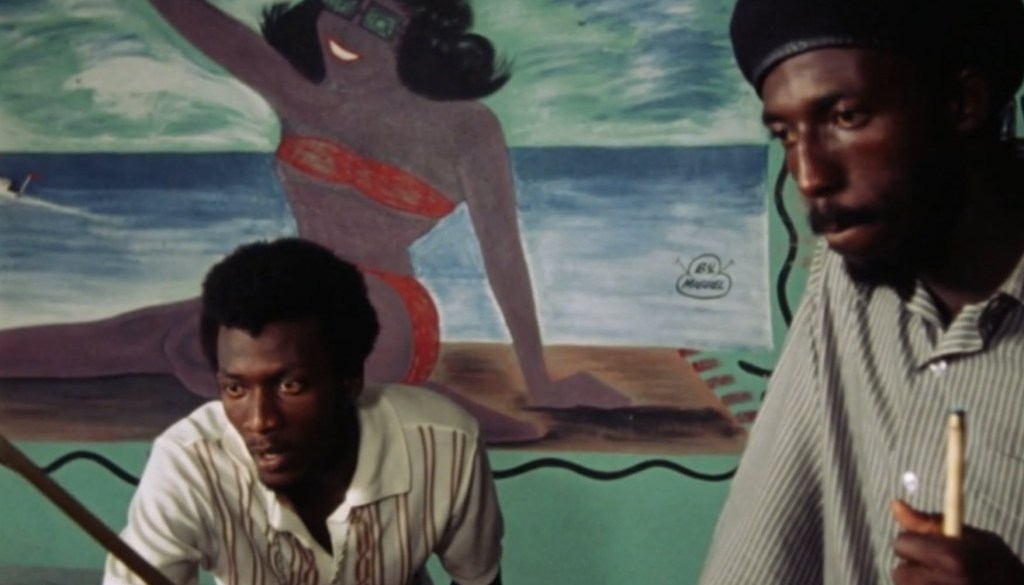
Ivan and Jose talk about the size of the bust. Ivan figures someone is making big money. Not Ivan or Jose, but someone is. Ivan and Jose are both the ones at risk by running the stuff. Shouldn’t they get a better deal than $15 a week? Ivan then talks to Pedro, someone Ivan works on the money-collecting side of things. Basically, he talks about how Jose shouldn’t get his full share for the week.
So, Jose calls someone to say the guy he brought in to help Pedro is causing him some problems.
Things start to go south quickly for Ivan. He doesn’t realize the cops are protecting this cartel. This entire thing is going to be quick to basically hang Ivan out to dry. When Jose called in the problem with Ivan, that sicced the cops on him. Scared of being caught on a run, Ivan guns down a motorcycle cop who chased after him. This makes Ivan Public Enema #1 for the cops. Then, when Ivan is fucking Jose’s girl, cops try to surround him and gun him down. He escaped after shooting three more cops. Ivan is now a multiple cop killer and a fugitive.

There is something else all this has made Ivan – famous. He takes some satisfaction in telling Elsa that he told her he’d become famous. Ivan knows Jose informed on him. He plans to get back at Jose by killing him. Instead, he finds the girlfriend who Ivan was just sleeping with when the police tried to ambush him. He shoots and wounds her. He then tries to attack Jose, but chases him off and it turns out the people in the shanty town help chase Jose off by throwing tin cans at him.
With the legend of Ivan Martin growing, the producer decides he needs to cash in on that record he recorded with him previously. The song becomes a huge hit and turns Ivan into something of a folk hero and rebel standing up to the man. When the police try to get Hilton to cooperate and help them capture Ivan, he says he’d like them to let him know when they catch him so Hilton can get another record from him before he’s strung up by the cops.
Ivan’s popularity grows and the police grow more and more frustrated when they can’t catch him. People around the island are helping him hide from the cops. He’s also growing more and more reckless as he wantonly steals a guy’s convertible and drives it around for shits and giggles. Maybe the worst thing that Ivan is really doing is falling in love with his own rebellious myth. He stages photos of him carrying two guns like he’s some Wild West outlaw character.

The cops’ frustration, personified by the lead detective, Jones, is starting to make regular life for regular folks pretty hard. Hilton stops Jones on the street to ask why he banned Ivan’s song from the radio. Hilton tells him that if he thinks that the song playing on the radio is making him a big deal, banning it will only make him a bigger one. On top of that, he’s not too pleased with Jones stopping the ganja trade on the streets. It was one of the few ways money flowed into the city. If there’s no ganja and no hit parade on the radio, Hilton tells Jones he better catch Ivan fast.
Ivan’s rampage, and the response by Jones to shut down the ganja racket, have Pedro and the other dealers starting to question what they should do. They can’t continue dealing because of the cops refusing to protect them. They are running out of food and they are broke. Pedro tells Ivan that several of the dealers are still backing the plan to be rid of Jose. Pedro suggests that Ivan hop a boat to Cuba.
Elsa goes to the preacher seeking help. A kid Pedro’s been looking after since his mother died running drugs is very sick. Still pissed at Ivan, the preacher calls Detective Jones to tell him what he learned about what’s going on with Ivan. In addition, other cops lean on Pedro who tells him that he’s going to get a boat to Cuba, but he doesn’t give any further details. When Ivan sees the boat he’s supposed to get on arriving, he tries to approach it, but an injured shoulder from an earlier attempt to capture him makes it impossible for him to catch the boat and climb up the ladder lowered for him. The police approach as Ivan washes ashore.
Ivan is ambushed by the police. Similar to what he saw at the Rialto when Jose took him to see Django, he’s standing alone against an entire force. However, this isn’t a movie. That means Ivan is gunned down and killed. Ivan lives on in his recording of “The Harder They Come” which ends the movie as a girl dances to the song.

This movie is phenomenal. As I said earlier, this movie has a raw attitude to it that makes it feel authentic while also so lovingly made. I like to think of it as a cross between Sweet Sweetback Baadasssss Song and Bonnie and Clyde. It possesses that rawness of Sweet Sweetback and shows real people from the poorest parts of Kingston. It doesn’t fix accents to make it more palatable to people in other countries. This is the real dialect of these people. Of course, the appeal of fame through an outlaw’s life is where that Bonnie and Clyde comparison comes from.
What’s great about a movie like this is that it is a great example of a charismatic, and likable, criminal lead character. Don’t confuse what that means. Ivan Martin is a bad guy. He’s selfish. He’s lost in some sort of delusion that his sheer willpower can make all his goals and dreams come true with little effort. He’s someone who is always reaching for the next rung on the ladder but doesn’t realize that the next step is too far from his grasp. At the very least, he expects that next run to lower itself to his reach instead of him working to pull himself up to that level.
Here’s the funny thing about Ivan’s character… He was ALWAYS this person. Some might look at where we see Ivan coming to Kingston from the country and see a totally different person than who he is at the end of the movie. I don’t. He’s naive, sure, but here’s a guy who comes to town instantly thinking he’s going to get a job and live the city life. He has no meaningful relationship with his own mother. He knows all this stuff about the city and the movie theater and the nightlife, but he only knows that by what he’s read about it. He has nothing more than a fool’s overly-idealized version of Kingston. That’s easy to sell to a country bumpkin who might want to see more of the world, but it was so much easier to sell to a dreamer like Ivan.
I have no doubt that his life prior to the start of this movie involved him always trying to figure out how to be the most notable and adored person in the country. That’s great and all, but he wanted more and more notoriety. The only place he was going to get that was in the city.
There’s another way to read this too. If you read this from the standpoint of class and power structures, this movie does take on a different identity. Nothing I wrote above is necessarily different. Ivan may still be selfish and always seeking more fame and fortune, but he’s also crushed by socio-economic situations. He doesn’t come to Kingston with money or standing. He’s broke in a town that has no jobs for him. Through desperation, the only thing you can do is dream of a way to work yourself out from under that dire situation. On top of being a dreamer, he’s an independent personality. He’s not interested in the preacher’s religion or rules, only his ward. His dreams tell him he’s better than whatever standard offer, no matter if it is exploitative or not, that Hilton will give him for his record. This only allows for these built-in structures to make him more desperate.
He finds a modicum of success as a ganja runner. Great! However, his overflowing desire to be more than just some lackey (and his knack for thinking pretty independently) makes him ask questions and want to start cutting people out of the equation, even the guy who got him the job. At first, it might have seemed like he was cooked when he killed a cop, but when it brought him the fame he was searching for, the only thing he wanted to do was to continue to be famous by way of becoming this Frankenstein monster that the structure around him built. It becomes this phenomenal character study.
Speaking of the character of Ivan, Jimmy Cliff is fantastic in this movie. Again, this movie presents a likable and charismatic lead. Cliff carries this movie almost effortlessly on his shoulders. He HAD to be liked and relatable or this whole thing falls flat on its face. The Harder They Come is the first of only three roles Cliff had in films. I know he’s best known as a musician, but he easily could have been a huge movie star.
I recommend this movie to anyone who has an interest in a crime character study. I’m guessing if you liked 1983’s Scarface, you’d really like this one too. Next week, though, has a movie that might not quite be on the same filmmaking or general overall level that The Harder They Come has, but it has a much larger devoted, rabid fan base. Join me next time as we jump right into the radioactive sludge barrel that is my Christmas gift to you, my dear Enemaniacs, and myself as your favorite blogger, as I take a long, and loving, look at Lloyd Kaufman’s The Toxic Avenger!
 bmovieenema.com