
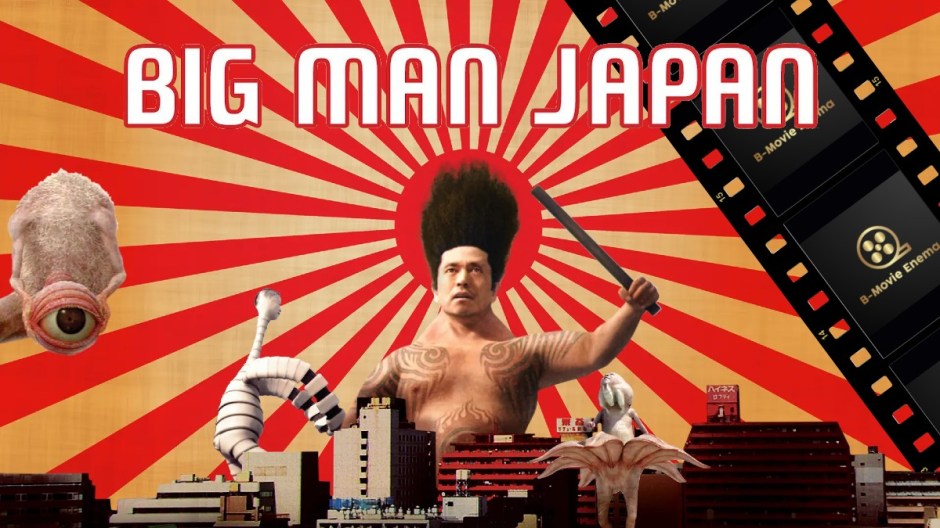
Welcome back, Enemaniacs!
Yup, it’s another Friday and another review here at B-Movie Enema. This week, allow me to take you to the magical islands of Japan. There, we’ll meet Masaru Daisatou. Daisatou-san is seemingly a normal guy, but he’s got a special superpower. That superpower allows him to grow about 30 meters in height when he receives a jolt of high voltage electricity. He uses this superpower to fight monsters just as his father and grandfather did before him in the identity of Big Man Japan.
Alright, so check it out… I learned about this movie thanks to Shudder’s series Horror’s Greatest. It got its own brief segment in the second episode called “Giant Monsters”. If you do not know what Big Man Japan is, we’ll get to the main reason why I had to get this movie reviewed on the blog in time.
Let’s start with something I can finally talk about in this blog. I love kaiju films. I’m a big fan of Godzilla and the other creatures from Toho, but I also love Gamera. How can you not? Are the Gamera films anywhere nearly as good as the Godzilla films of the same 60s era? Oh, hell no. But they are still a blast to watch. As I was looking ahead at what might be someday reviewed here, I landed on really needing to get a few Godzilla flicks here. And I’m not just talking about the bad and/or really odd ones, I’m talking about almost any of them up to 2004. So, I guess… look forward to those coming at some point down the pike?
Big Man Japan is the brainchild of director and co-writer Hitoshi Matsumoto. Matsumoto was born in 1961 and by the early 80s, he formed a comedy duo called Downtown. In 1989, Downtown began hosting a variety show called Downtown no Gaki no Tsukai ya Arahende!! That’s a show that’s so popular that it still airs to this day. Later, Matsumoto made some comedic shorts. Big Man Japan would be his first full-length film.
Now, I do feel like I need to at least bring this up before we get into this movie. In 2023, two women made anonymous allegations stating Matsumoto sexually assaulted them in 2015 at parties. Naturally, Matsumoto denied these allegations. He sued the celebrity magazine that published the women’s stories, but he later dropped the lawsuit. He still made a statement apologizing if any woman attending these parties felt offended or hurt by anything he said or did. All of this is still relatively new and kind of unresolved. The lawsuit began in March 2024 but was just dropped back in November. So if anything else comes to light about this, it might be after this review was written and/or published. It’s possible there are all sorts of updates on this that we don’t hear about at all because it’s a Japanese legal matter and may not get a lot of exposure here.
But, with that, let’s talk about this incredible oddball mockumentary. Oh, yeah. That’s another thing. This is the blog’s first true mockumentary. I mean I kind of consider Faces of Death a mockumentary because it is presenting real footage and concepts mixed in with fake footage of real things and concepts. It’s also starting from a pretty fraudulent basis of having a “doctor” wanting to explore more about his favorite topic, death, but the information is not exactly entirely fraudulent. But whatever! Let’s check out this Big Man Japan business.
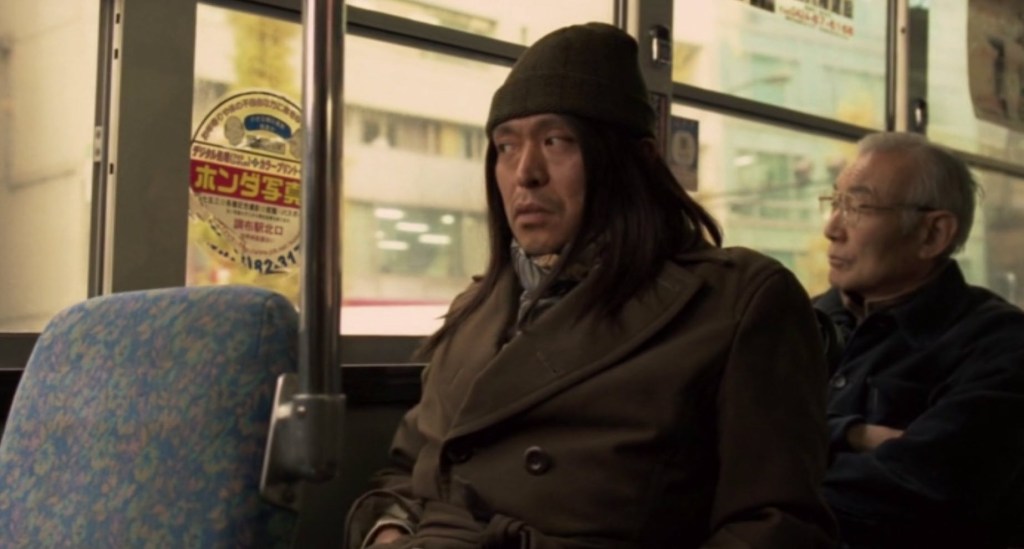
Big Man Japan follows ordinary Japanese citizen Masaru Daisatou. The filmmaker asks a relatively mundane question to start: Does Masaru prefer warm weather? Masaru agrees that with his work, he does prefer warmer weather. To continue on with the topic of weather, the filmmaker points out that it didn’t rain today and doesn’t seem to look like it will rain either. Masaru, realizing the filmmaker is commenting on the umbrella in his hand, says he just likes always having an umbrella with him. In fact, after taking the train home, he walks past a store advertising 20% off umbrellas and considers buying a new one. The umbrella thing isn’t much of a plot point. It’s more of a character quirk for Masaru.
So, yeah, this is just a normal guy. He likes warmer weather as most do. He takes the train to work like many do in Tokyo. He carries on with a relatively normal life. Oh, sure, maybe he seemingly likes umbrellas like some people like little trinkets, but he seems kind of normal.
When he does finally get home, his yard is overgrown with nasty weeds and tall dead grass. There is a rusted swingset in the yard as well. The stone wall at the edge of his property has graffiti covering it. It’s clear that as normal as this guy is, he does live in a pretty low-end part of the city. Inside, his house is small and cluttered. There’s a cat that makes itself at home in his house and gladly accepts food from him but it isn’t his cat. He doesn’t know who that cat belongs to, but, as he puts it, when you really think about it, all cats are strays, aren’t they?

Masaru does have one thing to be sad about. He is married, but he and his wife are separated. There appeared to be some disagreement over how to raise their daughter. As he talks about his separation and his daughter, someone throws a rock through the window. Later, after cleaning up his dinner plates, and covering the hole in his window, he’s asked about his line of work with the Ministry of Monster Prevention while another rock flies in through the same window he just patched with newspaper.
Later, he reveals he always wanted to have a son to carry on his family’s legacy, but he also doesn’t think there’s anything keeping his daughter from carrying that legacy on either it’s just he thought he’d have a son to pass this onto like it was passed to him.
You see… Masaru is what you can kind of call a hero for hire. He, like his father and grandfather before him, fights monsters. He makes roughly 2,000 a month salary with a bonus of up to 3,000 more depending on the circumstances. Of course, he’d like to make more but he doesn’t think his position allows for him to make demands for pay. The problem is, while Masaru is, effectively, a television star due to his battles being televised and the popularity of the broadcasts is what determines his pay. While he is good at what he does for the most part, he gets that graffiti on his gate and the rocks thrown through his window because he is constantly mocked by the public despite being a hero who fights monsters and on TV whenever there’s one to fight.
So, again, Masaru is kind of a normal guy, but he’s definitely also a sad sack.

Masaru gets a call saying it’s time to go to work. He says he has to go “bake” which means that he needs to go to a power station and get charged up for his family superpower to kick in and make him grow to 30 meters tall. For those of you dolts that live in the United States, 30 meters is just under 100 feet tall. I’m not saying that to make myself sound smart. I’m a dolt like you. The metric system is dumb.
Anyway, the first monster we see Big Man Japan fight is known as The Strangling Monster. This is a creature who looks like a guy with a really long neck and wearing a straight jacket, but here’s the thing… It’s not something tying up his arms. His arms are a hoop that it uses to… well… strangle people and rip buildings up and toss around. It then shits out a harpoon-like penis from its visible butthole and dumps eggs into the hole where the building was.

Oh, and the Strangling Monster also has a really massive comb-over.
At first, the Strangling Monster gets the better of Big Man Japan by using its arms to wrap around Big Man Japan and then slamming him into the street with a suplex move. However, as the creature tries to rip a larger building out of the ground, Big Man Japan returns and kills the creature with a hit from his batan. A glow from the sky beams down onto the Strangling Monster and seemingly beams its essence or soul away.
Big Man Japan, after each fight, retires to his official recovery building so he can return to normal size. Here, we meet his manager, Kobori. She mostly just checks how well he performed and gives him pointers on how to do better for the sponsors. However, she’s not super interested in being part of the interview for the documentary it seems. Speaking of not being interested, we see some street interviews while Masaru recovers. Most people either pay no attention to his broadcasts or think he does more harm than good. One lady makes fun of his big face. A younger couple in the punk rock scene complains that he’s not as edgy as he used to be and thinks he’s fat.
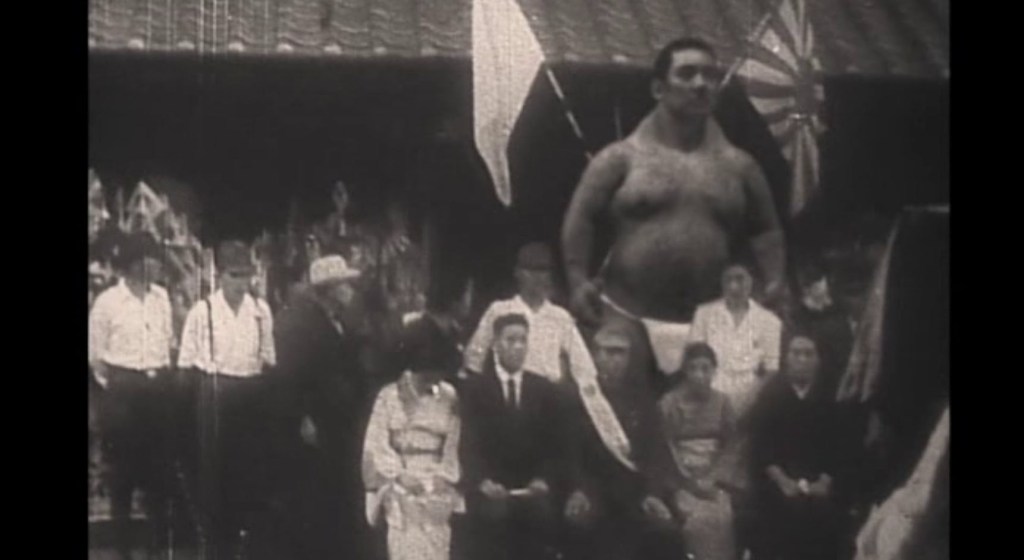
Contrasting with the street interviews, we learn about Big Man Japan IV, Masaru’s grandfather. He was the hero during the Imperial era of Japan. He was widely cheered and had a huge fanbase. Masaru said that he had up to 50 servants in his time. He said he never had to carry a wallet because his fans would follow him everywhere and pay for things for him. Masaru thinks he was so popular and beloved because there were more monsters running around and there were more like him. It was a whole thing. Now, though, Masaru is the only one and there are far fewer monsters.
In fact, the monster fighting thing is so obscure now, it used to be a prime-time television show but Masaru’s exploits are aired at 2:40 am.
On the way to another town where there is a concern of another monster showing up, we get a little understanding of how difficult it is for Masaru to do his job now. You see, in the golden days of monster fighting, the fighters who would get juiced up by high voltage electricity had up to 52 different power plants to choose from. However, nowadays, there are only two. The one we saw earlier in Tokyo, and another in another town near where Big Man Japan is being sent currently to fight a monster that may or may not appear. While on the train, we also get a little bit of a clue that maybe Masaru isn’t quite as sharp as the other former hunters when it was a more illustrious job. The interviewer asks why doesn’t he just get charged up in Tokyo and then travel to where he’s supposed to be. Wouldn’t that make more sense than taking a train that takes a long time to get to the destination where he would then charge up in a neighboring town to then take on the monster that may or may not already be rampaging through the city?
Masaru has no response to that very logical question.

Upon arriving at the Mikawa power station, the camera crew goes inside with Masaru. This time they may actually get to see him transform. Here, there is a whole ritual that is performed. When talking to a couple of the officers on site, they mention that this ritual has… degenerated a bit. It used to be a bit more fancy and solemnly observed. But not so much anymore. It’s just a thing that has always been done more than anything. In fact, the guy at the door who let them in says it isn’t even necessary. It has nothing to do with his transformation. In the ceremony, the “priest” even suggests to the filmmaker what is the right time to show him for dramatic effect.
As funny as this scene is where some of the guys are trying to be a little more coy about the degradation of the ceremony while others are just letting it spill that it isn’t even necessary and the priest even trying to look good while they film him, my favorite thing is the big dramatic slow-motion shot of them stringing his purple speedo up like a flag so he can grow into them.

What’s more, when he steps inside the speedo, his face is pressed right up to the part that his balls will be resting against.
The next monster Big Man Japan must fight is called The Leaping Monster. It’s basically a head on a giant pogo leg. The Leaping Monster is kind of a dullard, though. We’re told it basically has the intellect of an eight-year-old. However, to make it a little more difficult for Big Man Japan, this time he has a new sponsor that he has to wear into battle as a sticker on his chest. Manager Kobori has to remind him to always make sure the sponsor’s sticker is visible at all times for the broadcast.
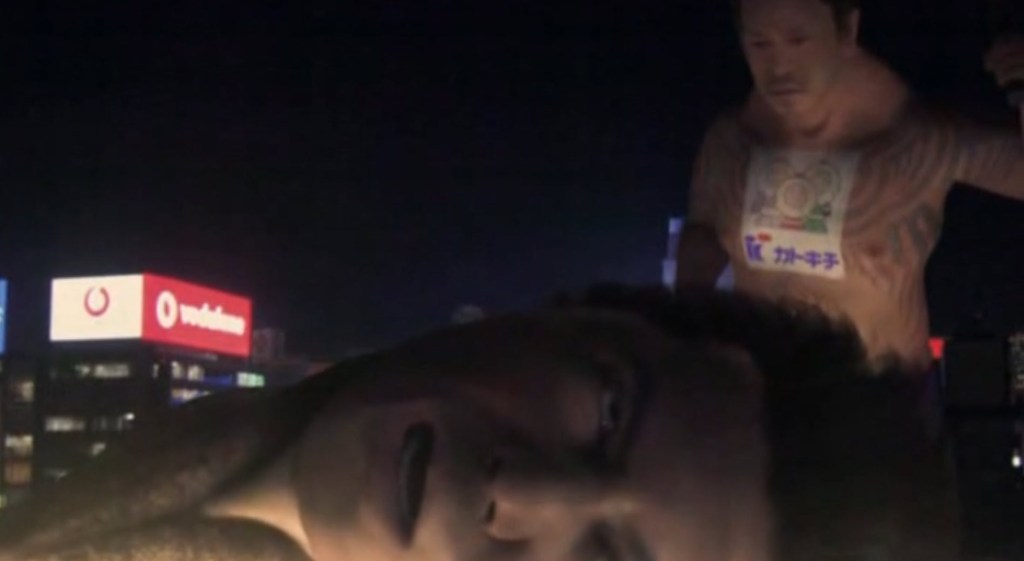
Defeating the Leaping Monster is pretty easy. Not only is it just a head on a leg, not only is it kind of a dummy, all Big Man Japan needed to do was get the creature’s head lodged between two similarly tall buildings where it can no longer jump. This literally kills the Leaping Monster and has its soul transported upward.

Some time passes and we pick back up with Masaru in Spring. He’s come to a retirement community. There, he visits his grandfather, the famed Big Man Japan IV. Sadly, his grandfather is suffering from dementia. His once strong body is now frail and he is mostly confined to a wheelchair. The cause of this was being given too much electricity when he was younger. Masaru reveals there is no government assistance for his grandfather. In addition, his father, trying to grow even larger, electrocuted himself. His grandfather stepped back into the role of monster fighter which only hastened his decline. The reason his father wanted to grow larger was because he was macho and constantly tried to prove himself as a real hero.
Later, Masaru is awoken by a phone call about his grandfather roaming free. We see various instances in which Big Man Japan IV, in his demented state, is creating giant-sized havoc. These include squaring off against Tokyo Tower for no reason. Blowing on smoke stacks like they are bottles of Coke or beer. Picking up airplanes and playing with them like toys. These shenanigans from the Fourth are creating backlash for Masaru and his sponsors. Manager Kobori has an ultimatum for Masaru. He needs to either fix this public image issue caused by his grandfather, or he needs to give up more prime real estate on his body for sponsorship stickers. He doesn’t care much for either option but opts for the ads on his body.

But the next battle he fights is the monster everyone who knows this movie knows and is the whole reason why I knew I needed to cover this one day. Yup, it’s The Evil Stare Monster, otherwise known as the Eyeball Dick Monster. The Evil Stare Monster uses its own eyeball as a weapon. It throws the eyeball from its crotch and is able to extend it as far as needed to strike an opponent. Luckily, it’s also known to fall asleep instantly when shrouded in darkness.

But yeah, it’s got an eyeball for a dick.

Look at that thing go…

Because the eyeball gets tossed around and scrapes across the ground when being reeled back in, of course, it gets a bunch of junk in it so the monster has to dip it into the water to wash out the eyeball.

He can also use it as a mace.

To defeat the monster, Big Man Japan just has to dodge the eye. Which he does causing the penicular part to get caught in a powerline pole. He then makes the Evil Stare Monster pull too hard to free itself and the eye goes rolling into a warehouse, a darkened warehouse, and it instantly falls asleep. He then jams his baton up the creature’s butt and it’s destroyed.
But it’s not the only monster that appeared that day. After defeating the Evil Stare Monster, a second monster sneak attacks Masaru and defeats him by stomping on his face while he was on the ground. When Masaru needs to run away, he’s labeled a loser. He doesn’t know what kind of monster defeated him. He doesn’t even know if it will return.
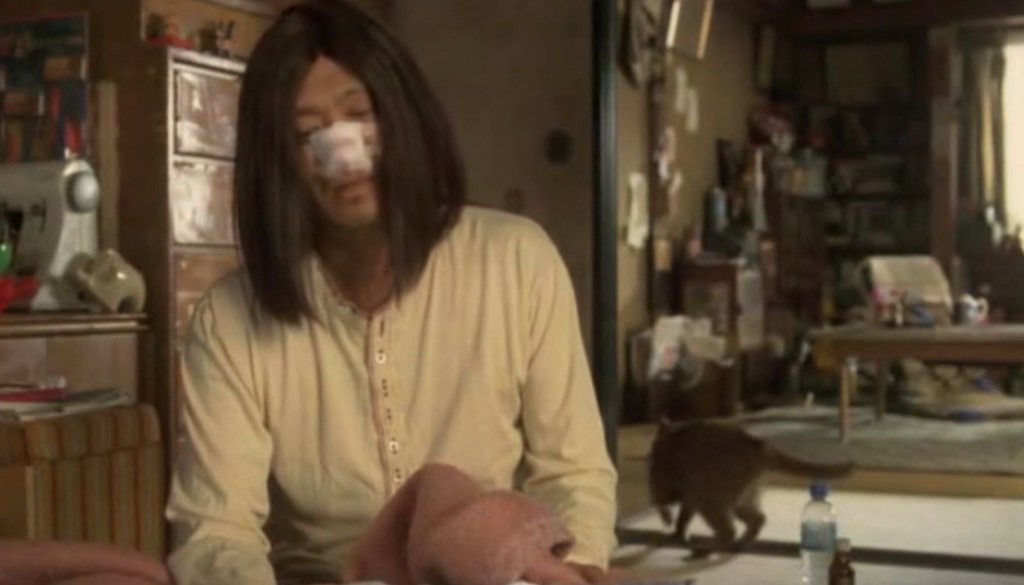
One ironic side effect is that the episode in which he was defeated got three times the audience than his usual viewership proving people would rather watch him lose than save the city. Another round of street interviews basically proves that. Everyone shown are people who don’t normally watch Big Man Japan. They call the performance pathetic. One guy says he would rather see a real fight, but, of course, most episodes are a real fight and he wins them. So… Masaru can’t even really win for losing.
Manager Kobori reveals to Big Man Japan that the creature that attacked him was not even Japanese. We later discover that it was a Korean monster. One that the Korean press says was sent to Japan by their Gods to punish Big Man Japan for angering their “General”.
Masaru arrives for his once-a-month meeting with his estranged wife and daughter, but his wife was not aware that the documentarian would be there with him filming. She doesn’t approve of Masaru’s profession as a monster fighter (she finds it “strange”). Plus, the age of their daughter makes her not want her face to be seen. This is because their daughter, Selina, gets teased at school for who her father is. Not only do they heavily pixelated her face, they also mask and deepen her voice to disguise her even further.
And there are A LOT of shots of Selina’s face that have to be blurred out of existence too.
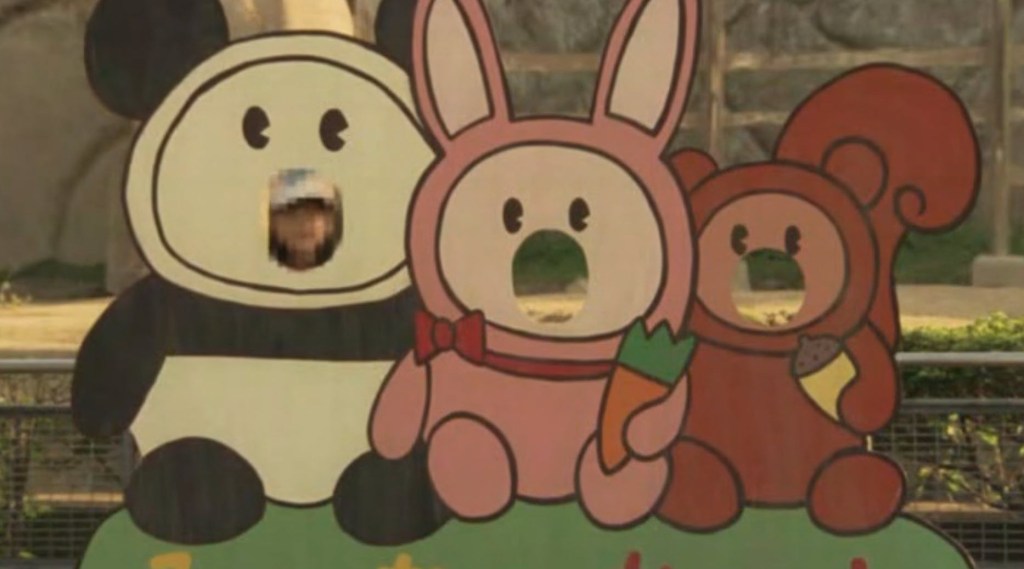
In an interview with Masaru’s wife, she explains she only sees him once every six months. The interviewer finds that odd. She says Masaru requests to see her twice a month but twice a year is more than enough for her. She also is very much opposed to the idea that her daughter would ever be a Big Woman Japan. Sadly, it’s discovered in the course of the interview that she has found a “regular” Japanese man and she’s very happy. When this information is taken back to Masaru, it makes him very sad.
The summer comes and it’s time for Masaru to get his summer cut so he doesn’t suffocate under his long locks. However, summertime also means it’s time for the Stink Monster. The Stink Monster mates every mid-summer. We’re told the foul odor it emits is equivalent to 10,000 human feces. It turns out to be a fart monster of sorts.
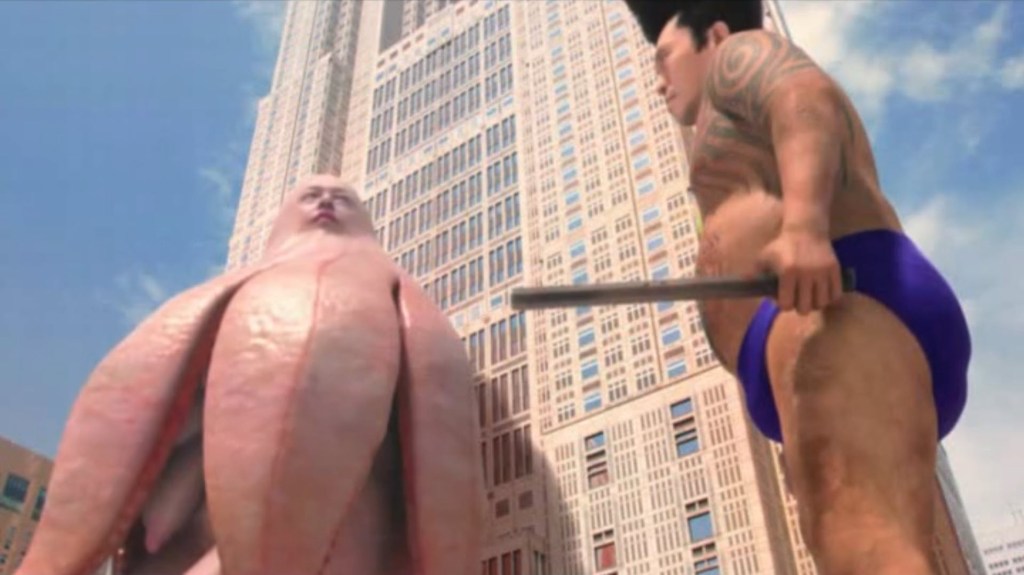
Big Man Japan approaches a Stink Monster to basically tell it to leave the city and go out to the suburbs to stop stinking up the city. The Stink Monster is not so compliant. It kicks some cars over from the traffic jam it created. It pokes windows out of the building it’s resting up against. Even shouting at it won’t get it to leave.
Worse, this Stink Monster is a female and it is mating season.

A young male Stink Monster arrives to perform a mating dance for the female. She says this one has been following her for miles and wants to do it with her. Big Man Japan does NOT want that happening in the city. Turns out the female Stink Monster doesn’t want that to happen either. She has higher standards than this young buck. Plus she’s not impressed with his dance.
She tells Big Man Japan to tell the male what’s what and get rid of him for her. However, as he tells him to get lost and that she’s not interested, she actually presents to the male and they mate. The next day, the press has a field day over how children watch TV too and it wasn’t appropriate for them (never mind this is on at 2:40 am). The newspaper calls Big Man Japan a “Monster Pimp” and it’s another mess that affects his image.
The next monster is The Child Monster. The Child Monster is weak and cannot harm humans whatsoever. However, it does have a very interesting drive built into its personality. All it wants to do and its entire purpose is to return to the suburbs.

The Child Monster is found on top of the Tokyo Dome. It seems… less weird? I mean that shit is nightmare fuel if you really think about it, but it seems sweet. Big Man Japan picks the child up as she explains a race or something she either ran or dreamt. It then tries to feed from Big Man Japan’s teet thinking he is her mother. He drops the child from the pain of her biting into his nipple and she dies.
That, of course, leads to Big Man Japan being derided as a child killer and the country holding a massive vigil for the baby with one woman saying that he should have shown up to improve his public image.
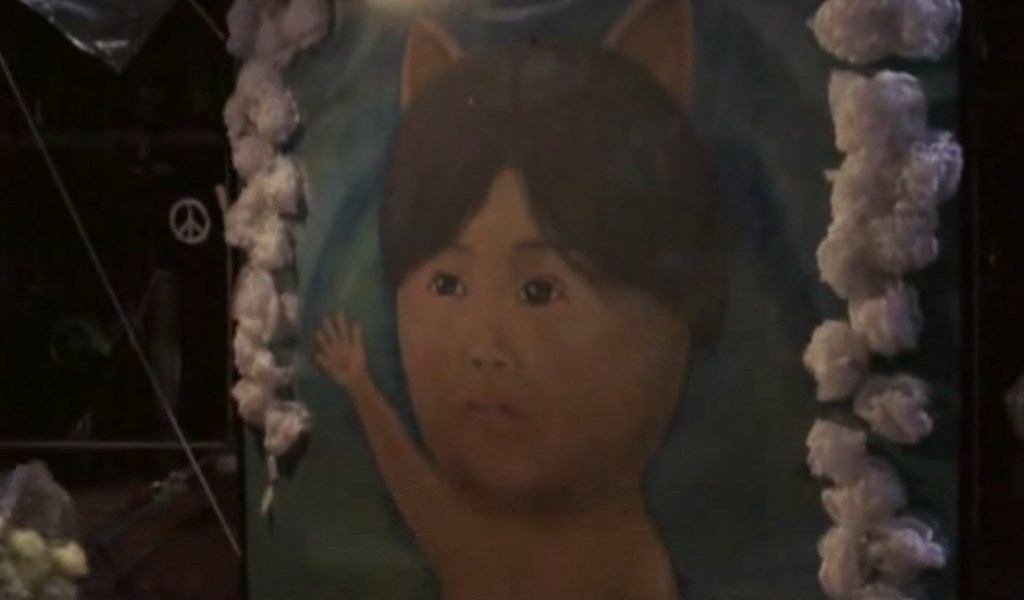
Masaru is adamant that he did nothing wrong with the Child Monster. In fact, he says that the child was already that way when he approached him. You know… He was already heading for death the moment it was born.
There is still the subject of the big red monster that attacked him after he got rid of the eyeball penis creature. The interviewer asks him if he’s chicken to face the monster now being referred to as the “Red One” and Masaru says he’s only worried about who would look after his grandfather if something happened to him.
We get a little bit of backstory on Masaru. He was a fat child. His father kept telling him to “eat up” and that caused him to be a pretty big load. We’re reminded that his father killed himself by zapping himself with too much power to try to be bigger and better as Big Man Japan V. Well, he also was the first person to try to zap Masaru. His grandfather stopped it but it was only after his father had zapped him. Unfortunately, the only things to get enlarged from the zapping were the nipples that his father hooked up to the electricity source.

After a night of hard drinking and feeling sorry for himself over the health of his grandfather and his failed marriage, members of the Ministry of Monster Prevention storm into his house while he’s passed out. Even that priest guy is there to do the whole ceremony thing before he’s zapped and enlarged. It just so happens that he was holding that cat that shows up at his house when he was zapped and the cat got super big too.
Big Man Japan is confused as to why he was zapped but as he looks around the city, it’s clear why Manager Kobori arranged this zapping for a TV broadcast – the Red One is here and looking for a fight.
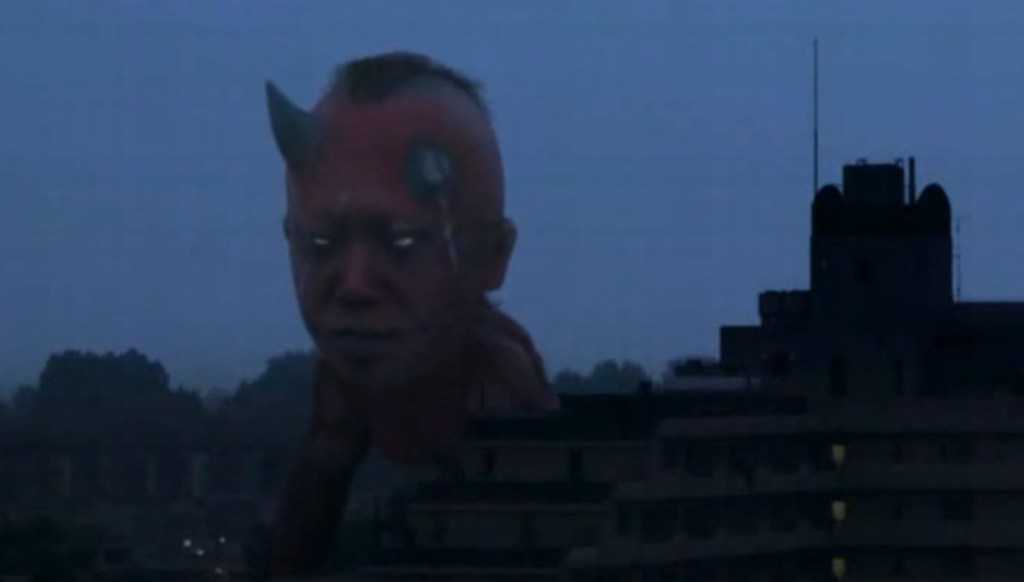
Now Mama Big Man Japan didn’t raise no dummies. Seeing how the Red One smashed his face in previously, Masaru decides to take off running again, but the Red One chases him. As morning breaks, the two fight in the city streets and, once again, the Red One knocks Big Man Japan down and begins stomping him. Just as the Red One plans to finish Big Man Japan off with his own baton, the Fourth arrives to join the battle.
The old man faces down the creepy devil-looking monster but immediately takes a knee to the face and is killed. Well… It looks like he’s about to die as his soul is about to make its way up into the sky but it keeps yo-yoing back and forth above his body. It’s not until Masaru decides to run away and sort of trips over his grandpa’s own face that it kills off the Fourth. As the Red One chases Big Man Japan and breathes fire at him, much younger and better backup arrives in the form of a family of Korean giant superheroes.

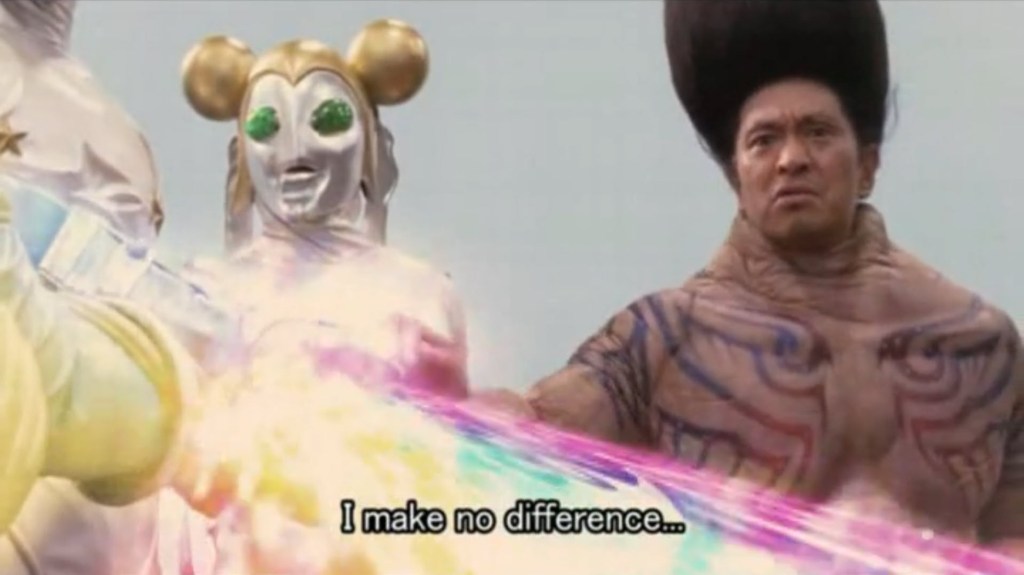
Our heroes are Super Justice! Super Justice’s Dad! Super Justice’s Mom! His Little Sister! The Baby!
They are here to kick the shit out of Red One. In fact, they are also joined by backup in the form of a bunch of 70s-style sci-fi guys in a cool car and a cool jet with cool laser guns. Back in Korea, a blind girl in a hospital prays for Super Justice to give them more strength. It’s all so perfectly styled after the late 60s and 70s Ultraman that even the Red One now looks like a giant foam costume that looks more like a baby devil than the demonic version that was chasing after Big Man Japan. Even Big Man himself looks less computer-generated than before and more like Matsumoto in a big fake suit.
This is absolutely brilliant stuff that I laughed all the way through. I mean, to start with, when Super Justice arrives, the look on Big Man Japan’s face is just perfect. It’s like he just can’t believe this is real life. Yet… It’s happening. It’s a look of complete disdain for his life, complete disbelief that these characters have suddenly shown up out of nowhere, and a complete feeling of utter uselessness as they clearly know how to do his job better than the one he was born to do.

Honestly, that’s how I look at most things in life anymore.
But, yes, Super Justice and fam just start picking stuff up from the street and start whaling on the Red One. It’s actually brutal. One of the moves is to place-kick the baby off the mother’s head and then jump-kick it into Red One. From there, they tear Red One’s clothes off and drag it through the street while kicking him in the head. It’s such a horrific beating they humiliate the monster until eventually, they bring Big Man Japan in to finger-laser the Red One to oblivion.

What’s so brilliant about this scene is that it’s what a real fight between these giant monsters would really be like if some of the combatants were actually human. It’s a slaughter. All the while, Super Justice’s family motto is “PEACE!” They all fly off together and the credits play over Big Man Japan celebrating at a feast with Super Justice and his family while he awkwardly sits around while the family criticize each other’s techniques… as well as criticize him for not being like them.
Big Man Japan is truly a brilliant comedy. What makes it so good is that it really tells you a well-rounded story for the first 100 minutes before really cranking up the insanity for that final scene of the movie. In those first 100 minutes, you fully get the idea of who Masaru is. He’s just a guy. Sure, he’s got this ability to grow large when massive amounts of electricity are run through him. However, he’s a schlub. He does this thing because he feels like it is his burden to carry as a member of this famous family of giant monster fighting heroes. But he’s doing this at a time in which fighting monsters is a bit passe.
In a lot of ways, you’d think that if this movie existed in the real world, you’d dislike Masaru for being a bit of a nepo-baby. But that’s not the case. He’s disliked more for pragmatic and social reasons. He causes as much or more damage than the monsters do. He dropped a monster that looked like a baby. He runs away from a fight after being nearly killed. These were all things his grandfather was heralded as a hero for in the old days. It’s become so passe to fight monsters that his own wife can’t understand his duty and she had to know who he was when he married her and they had a child. He’s so hated in society that you would think he would just give up and do a more normal job, but he does all this out of a special duty to his grandfather who he idolizes.
I would say that Masaru turns out to be such a normal person that he becomes a loser. After all, this is, ostensibly, a documentary being made about him as Big Man Japan, the last monster fighter in all of Japan. Yet, while he’s mostly competent at his job, he’s completely and totally uninteresting in the ways that you’d think would be what attracted the filmmaker to making this documentary. Anything and everything interesting about him is his very real issues with relationships, family history, and an underlying issue with self-confidence he harbors. We think we’re watching a “documentary” about a superhero, but we’re just watching a documentary about any other man with baggage.
Oh, and while he’s competent as a monster fighter, we actually see him get worse and worse at his one job as each scene of him fighting monsters passes. He quickly sorts out how to defeat the Strangling Monster and the Leaping Monster. However, each monster proves to be a bigger hurdle for him to defeat or at least not do something that will be scrutinized by an already contentious court of public opinion. By the time the Super Justice team arrives to battle the one monster that really took it to Big Man Japan on a physical level (as opposed to the social level), he’s cowering off in the distance and ultimately completely useless in the fight.
And, oh boy, that fight at the end. I believe, unironically, that the conclusion to Big Man Japan is one of the very best conclusions to a comedy, or, hell, ANY movie, ever. Not only does the style of the movie move away from the grittier, more realistic, look, but it also does an amazing job of lampooning the tokusatsu style shows that this is clearly inspired by. The look of the Super Justice family, the heroic music playing as they completely humiliate the supposedly evil Red One monster while shouting “PEACE!”, and the reaction to all of this that Big Man Japan has to everything happening is pitch perfect. It is as great as it is unexpected for what we saw previously. It almost purposely derails itself for the big joke at the end.
You can find this movie on certain gray market sites as well as the full movie split into two halves on DailyMotion. I recommend watching it if you enjoy dry comedies or Japanese tokusatsu stuff. It’s wonderful.
That does it for this week’s review. Next week, I think I need to try to finally answer the age-old question of whether or not there’s beer on the sun. Join me as I go north of the border for the Canadian thriller The Final Sacrifice. Oh yeah… It’s time for Troy and Rowsdower to save the day.
See ya next week everyone.
 bmovieenema.com