

Welcome to spooky month here at B-Movie Enema!
This year, I decided to do something a little bit different. Throughout the history of B-Movie Enema, and you should be aware of this if you’ve been around here for a bit, I hope I’ve been able to properly state that I love October and I love blaxploitation. For this year’s theme, I thought to myself, “Why not mix the two?” So, yeah… Welcome to Black Horror Halloween!
Now I might have used the term “blaxploitation” in the previous paragraph. I have five movies selected, and I would say that I think three of the movies selected can fall into that subgenre of blaxploitation. The other two can leave a lot of room for debate, that they should not be simply called (or for some, dismissed) as “blaxploitation.” I think director Bill Gunn would say our opener should simply be called a black film. Join me for the vampire horror of Ganja & Hess.
Bill Gunn was multi-talented. He was born in Philadelphia in 1934. By the time he was 15 or 16, he was studying acting in the East Village in New York. His teacher was Mira Rostova, who was a method acting teacher. Her students included Montgomery Clift, Alec Baldwin, Jessica Lange, and Madonna. By the mid-50s, he started hanging out with a lot of really famous people like Clift, James Dean, Eartha Kitt, and Marlon Brando. By the end of the decade, he started writing his own plays and would continue to do that through the 80s.
He transitioned to film and television in the late 60s and into the 70s. 1971 brought the big cultural moment for black cinema – Melvin Van Peebles’ Sweet Sweetback’s Baadasssss Song. While that generally does, along with the next big film for black cinema, Shaft, get called “blaxploitation,” the impression it left was nothing to sneeze at. It broke the door clean open for more stories of all kinds that centered directly on the black experience in the post-Summer of Love United States.
With any explosion of new voices and new types of stories to play to audiences, naturally, all genres would follow with that. I’ve already covered a number of blaxploitation horrors, but Bill Gunn’s 1973 film, Ganja & Hess, would be considered one of the most important black films after Sweet Sweetback. But getting there would be a bit of a hard row to hoe. Production company Kelly-Jordan Enterprises was unimpressed with the film’s box office receipts. This led to them, without the approval of Gunn, to re-edit the film from 113 minutes down to a paltry 78 minutes. Thankfully, Kino Lorber restored the film to its original length, but that was after years of that shorter version being the only official release of the story, under several aliases. The original cut was saved thanks to it being donated to the Museum of Modern Art in New York City. They would screen the film over the years, leading to it being considered one of the great cult classics that only a few could ever really see for themselves.
The film’s legacy was never in doubt. Not only did the film portray black characters in a light that was rare for decades, but it also used a lot of allusions to the concept of black assimilation through the metaphor of vampirism. For more references to that concept, go see this year’s brilliant film by Ryan Coogler, Sinners. This film is slightly experimental as it doesn’t really offer a normal plot, but centers on the title characters’ portrayals by actors Duane Jones (best known for his outstanding portrayal of Ben in Night of the Living Dead) as Dr. Hess Green and Marlene Clark (best known probably as Lamont’s girlfriend on Sanford and Son) as Ganja Meda.
The film does have a remake too. Spike Lee remade the film in 2014 under the title Da Sweet Blood of Jesus. It’s so close to the original that Lee shares screenwriting credit with Gunn, who had passed away 25 years before its release, and even recreates moments scene-for-scene and shot-for-shot. Unfortunately, Lee’s remake is not considered one of his greats. Critic Kelli Weston noted that Gunn was very adept at subtlety, nuance, complexity, and creating a fully independent woman. She stated that none of those are traits Lee shares with the former.
But let’s formally kick off this month of Black Horror and unwrap the secrets and mysteries of Ganja & Hess!
The movie opens with some title cards about Dr. Hess Green. Green is a doctor of both anthropology and geology. He was studying an ancient Black civilization called Myrthia when he was stabbed by a stranger three times. It wasn’t exactly a random number. He was stabbed once for the Father, once again for the Son, and finally for the Holy Ghost. The dagger was contaminated. The contamination made Dr. Green an immortal, but also an addict.
And away we go…

Along with the classic Christian iconography during the credits, there is also a sermon from a Black Baptist preacher, Reverend Luther Williams. This film is cut into various parts. As we enter the first part, titled “Victim,” we hear a voiceover from Williams. He works for Dr. Green part-time as his driver, stable boy, and performs other odd jobs for the very wealthy anthropologist. He explains that, yes, Green is an addict. But he’s no criminal. He’s the victim in this situation.
Because, you see, Dr. Hess Green is addicted to blood.
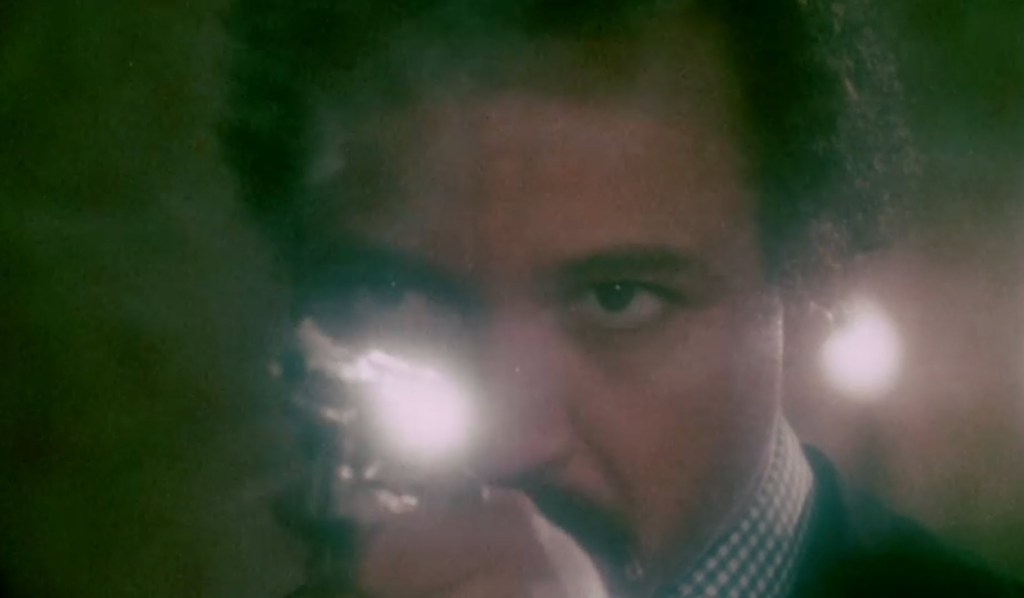
Reverend Williams drives Green to a meeting where Green is meeting at a museum, where he will meet his new assistant, George Meda, played by Bill Gunn himself (interestingly, seen for the first time with a gun). Green and Meda arrive at Green’s mansion. As Meda settles into getting to know him, he’s telling a story about a director friend of his who was making a movie and how he confused the word “Cut” with “Cunt” and pissed off a bunch of locals.
Now, the subject of the conversation is peculiar, but not exactly as peculiar as other things happening around the conversation. First, we saw that Meda has a gun. Right before we met him for the first time, we saw what I captured above: him checking his gun. But while he’s telling his story at Green’s mansion, he keeps getting sidetracked by one of Green’s servants, Archie, bringing desserts and drinks. Meda is blown away by the quality and quantity of the food that Green is offering him. It keeps bringing his story to a standstill, breaking any kind of possible comedy or impact his story might have. Still, this is somewhat similar to when Renfield is brought to Dracula’s castle at the beginning of that story. One guy is nervous, but being served an abundance of food, the host is not taking part in and so forth.
Oh, I should also mention Dr. Green looks totally unimpressed, and nearly displeased, with the story George is telling.
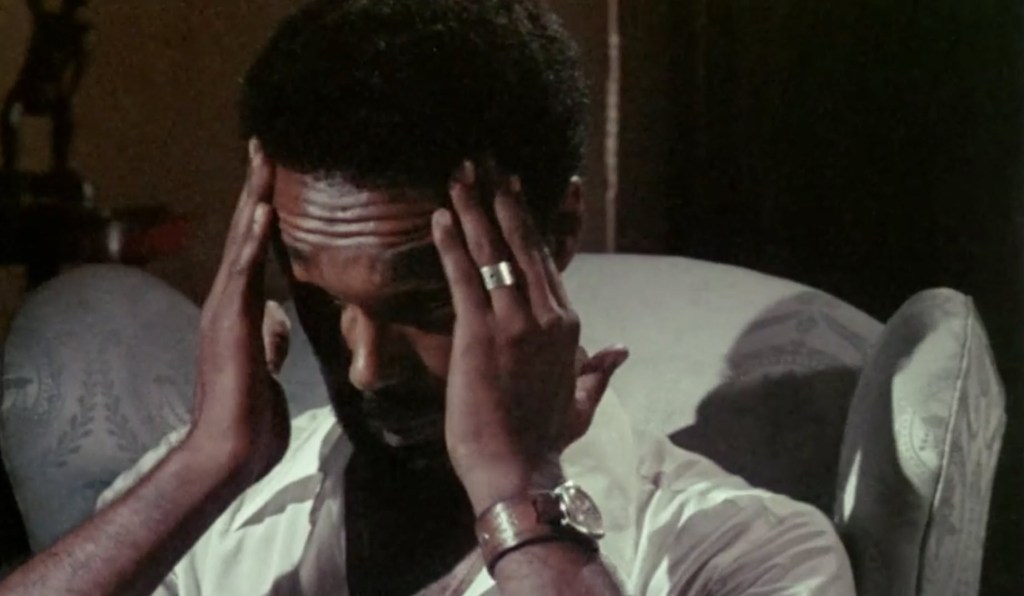
Later, Hess has strange visions and dreams mixing what he saw from the Myrthian culture and the man he met at the museum, Jack Sargent. These dreams make it difficult for him to get any real rest. When he gets up, he calls for Meda, who, himself, is acting quite strangely. Meda is sitting in a tree with a noose hanging from it. He tells Hess that he’s drunk. He also says he doesn’t want Hess to try to impress him. He then accuses Hess of putting something in his drink before saying he’s neurotic.
Hess is fine letting Meda be as neurotic and drunk as he wants, buuuut, he’s not so sure about Meda hanging himself from a tree on his property. You see, that sort of shit involves the police, who would instantly invade his cherished privacy. But that’s okay. Meda also considered throwing himself into the lake on the property. That’s not okay with Hess. He asks Meda if he realizes that there are no other black folk in this neighborhood. If a brother washes up from the lake, the police will immediately drag Hess in for questioning, and that’s not really something he digs too much on.
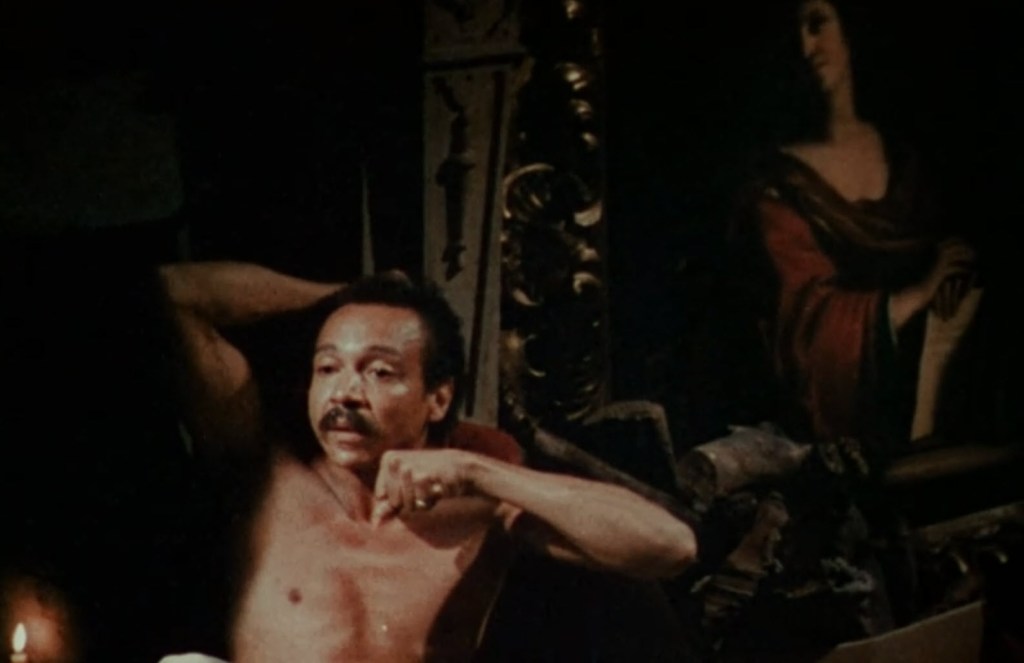
Meda eventually sobers up a little bit and comes inside. There, he tells Hess about his suicidal ideation and a past time he attempted to kill himself with a knife. He had the knife right there at his throat, but he just couldn’t bring himself to do it. He likens this to a murderer letting his victim go.
The two men return to their beds, but Meda sneaks into Green’s bedroom and attempts to clobber him to death. The two men wrestle. Eventually, Meda gets the upper hand and appears to stab Hess to death with a dagger carved from a bone. After calming down from seemingly murdering Dr. Green, Meda then types a letter to young black men about how life is endless, and they won’t be remembered for the individuals they are. He then takes a bath. In that bath, Meda also brushes his teeth.
Look, I don’t normally point out something as mundane as brushing one’s teeth, but I gotta bring this shit up, because this is easily the most horrific moment in this horror movie. People tend to brush their teeth in a limited number of ways, right? At the sink or in the shower. Okay, maybe sometimes the sink or shower in question is a public bathroom/shower room or a hotel room, but normally it still is something done at a sink or somewhere that CLEAN water is coming out of a faucet or showerhead, right? This motherfucker, Meda? He dips his toothbrush into his own bathwater, right next to his pubes and dick and taint. He brushes his teeth with that same toothbrush. THEN HE CROUCHES INTO HIS OWN DIRTY BATH WATER AND SUCKS UP WATER TO WASH HIS MOUTH OUT! That’s some gross shit, man! No wonder this guy considers killing himself on the reg. In fact, that’s his plan! He’s going to shoot himself with that gun we saw him with earlier, right in the chest.
THEN WHY DO THE GROSS BATH?!?
Oh, whatever, Meda goes through with killing himself this time. Turns out that, yeah, Dr. Hess Green is not only immortal by way of not being able to die naturally, but he also can’t be killed. He is also absolutely addicted to blood! However, this is the show part of the stuff we were told about in the title cards. Meda was the one who actually cursed/addicted Hess to blood and turned him into something of a vampire. Meda wasn’t necessarily acting on anything ceremonial or anything else; he was just… crazy. But it was that dagger made out of a bone that was the thing that carried the Myrthian ancient contamination of vampirism with it. Hess Green was dead until he awoke as a vampire.

The first 26 minutes or so, labeled “Victim,” were the evidence that he was what Reverend Williams said he was, and not a criminal. Clearly, Meda had some issues. He was a nervous kind of guy, claiming that it was due to some sort of neurosis he had. He told an inappropriate story that Hess was not amused by. He drank too much. He didn’t seem particularly gracious or courteous, nor did it seem like he had any manners at all in regard to being treated somewhat lavishly by Dr. Green.
I will have more to say about how this movie is structured later because that’s going to be the make-or-break thing about this movie for many. However, I do know and understand how important this movie is in terms of Black cinema. As a goofy white fuck in a Midwest fly-over state, I am absolutely not the person that is learned enough about the Black experience to be taken all that seriously here, but I can’t help but notice some things. First, Green’s wealth and opulence seem curiously couched in something that would generally be considered White. He lives in a White neighborhood. He has a house that probably still has the stench of old money that was surely possessed by some old crusty Caucasian. Hess himself carries himself as if he’s better than Meda. That could just be that he sees something off with Meda, but it could also be his upperclass attitude or assimilation into primarily White surroundings as a highly educated Black man. Then, of course, Meda’s problems ultimately corrupt Hess, dragging this opulent, well-educated Black man down to sucking blood from the floor of a bathroom and, as the second act begins, stealing from a medical center. Hell, even before that, he was warning Meda that the drunk’s actions would bring consequences upon him that he did not want any part of.
Again, I am definitely NOT an authority here, but I can’t help but wonder if I’m picking something up from how Dr. Green is portrayed and interacts with Meda.

We now begin Part II of the story – “Survival.” We see Hess going to a doctor appointment, but then setting off an explosion to distract the staff while he raids the refrigerator for blood. He also attends a high-class party at his house, where his son is also attending, showing that he is also being well-educated. Hess has to excuse himself at one point to pour himself a cool glass of Type O to satisfy his addiction.
Hess picks up a hooker at a bar, but it turns out to be a different kind of trick. She and her pimp want to rip a guy off and get as much money as they can for some other shenanigans they are trying to do. While Hess and the girl are together, the pimp comes in to try to knife him, but, yeah… He’s immortal. The pimp tries shooting him, and the hooker tries to shoot him, but no good. He, in turn, kills both of them and attempts to drink from them, but ultimately gets sick.
Part II ends and leads into Part III, “Letting Go.” As the third part starts, he gets a phone call looking for George Meda. It’s his wife, Ganja. She just arrived from Amsterdam and needs a place to stay. She called the museum, and they told her to call Hess because that’s where Meda’s been staying. She suffers NO bullshit. First, Hess tries to tell her that George isn’t there because he’s disappeared on him. She says that’s no big deal because he goes crazy sometimes, and he’ll be back in no time. But here’s the thing. She wants to stay at Hess’s mansion. George is living there, so why can’t she?

It does not take long for Hess to realize he is not going to be able to get rid of this woman, so he agrees to have his limo pick her up at the airport. It’s clear from the first time we hear her, she’s assertive. But unlike her husband, she’s well put together. She wears furs and pearls. She also initially believes Hess works for Dr. Green, but after he reveals he is her host, she eases up a bit and asks for a place where she can change to relax a little bit from her long flight.
Now, yes, Meda’s story earlier was about how his friend was filming a movie in Europe and he couldn’t yell “Cut!” when he was finishing a shot because that was the place’s word for “cunt,” right? That story went over like a wet fart with Hess. However, Ganja, again, well-traveled and seemingly also has friends who are up to some shenanigans, tells a different story. She talks about a friend of hers in Mexico who came up with an idea of how to bring some pretty killer shit over the border. He puts the weed in a condom, twists it up to be narrow and insertable, and shoves it up his butt. He then wears extra underwear to prevent the dogs at customs from sniffing out the smuggling. So… how did that story about smuggling killer pot up your butt go over with Hess?
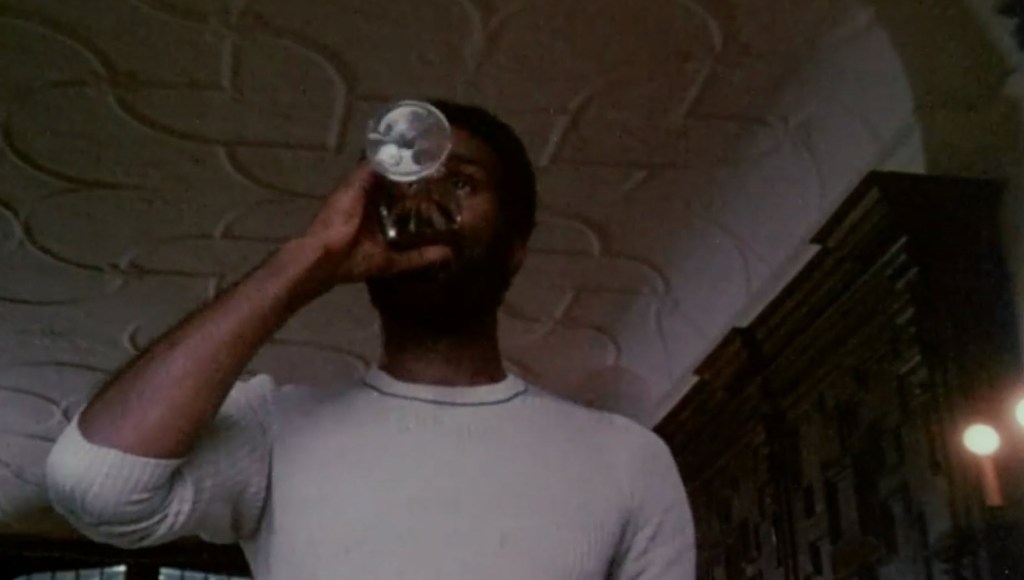
Like a dry fart in a hot tub.
Well, if your story about shoving pot up your crackhole doesn’t win over a guy, try, try again. Ganja goes over to the shirtless Hess, takes him by the hands, lays him down on the rug, and lays down her rug if you know what I mean. After falling asleep together, he has another dream about the Myrthian tribe and runs away. He hides himself in the attic and drinks blood. Ganja follows him to the attic, where she finds him asleep on a mattress, and they make love again.

The next morning, Ganja likes asking what Hess calls “impolite” questions. She wants to know why he lives in such a large house by himself. He doesn’t seem to want to reveal anything about himself. She teases Archie, his servant, because he always brings one thing at a time to the breakfast table. Her presence almost comes off like a disruption… but maybe not entirely in a bad way. She is challenging, but she’s not getting any info about Hess that is useful to her. More importantly, it’s maybe making her want to tease and flirt even more with him, even if it seems like he’s irritated by it.
Archie seems to be the most irritated and/or disrupted by Ganja’s existence. She makes him carry all the groceries as well as help her out of the car. She insists on getting wine from Hess’s cellar despite Archie saying no one is allowed there unless Dr. Green is with them. As she pokes around in there, she finds her husband’s body in the walk-in fridge.

Meanwhile, Hess, needing feeding, hooks up with a white woman and ultimately bleeds her. When we saw her for the first time, we saw that she had a baby. We hoped it wouldn’t be what it is because, frankly, up to this point, it isn’t like Hess has committed any terrible act for his thirst. Yeah, he stole some blood from the clinic that would be used for very important transfusions or what have you, but that’s far from the worst thing he could do. He killed a hooker and her pimp, but that could be seen as self-defense. Now, though, he’s done something pretty irredeemable. He killed a woman and left the baby crying and starving. Oh, yeah, and an orphan no less.
That’s juxtaposed with Ganja finding out that her husband has been dead all along. She doesn’t know that Hess really had nothing to do with that. In fact, if George Meda had his way, both he and Hess would have been dead. So she’s finding something that she can implicate him in that’s bad, but he’s innocent, and while she was discovering that and coming to her own conclusions (however false that is), he is doing something that he can be made guilty for.
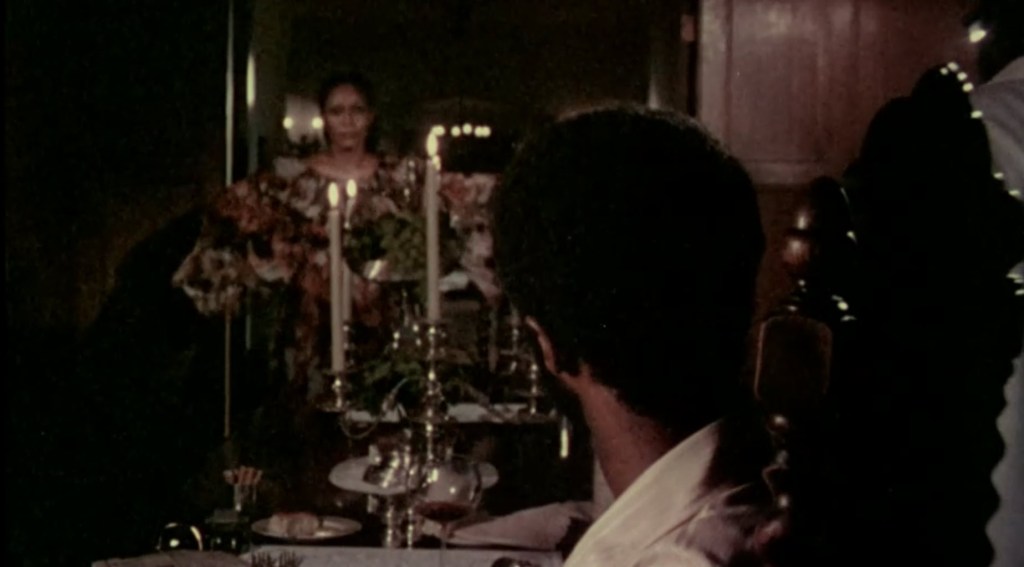
At dinner, later that night, Ganja confronts Hess about finding George’s body. Hess says nothing in response to her accusation that he killed him. She seems angry, but she relents. It’s like she is free from this guy, who is neurotic, crazy at times, and at other times, suicidal.
Later, she tells the story of a time when she was a kid, having a huge snowball fight. She said it was the most fun day she had ever had. However, her mother didn’t believe her that she was having a wholesome time with all these other kids in the neighborhood. Instead, her mother believed she was messing around with a boy. For the rest of her life, her mother thought she was a liar and a slut.
From that moment on, Ganja looked after herself first and foremost.

Shortly after, Ganja and Hess get married. They even dispose of George’s body. I guess he never told her that George killed himself because she still tells him that she thinks he’s psychotic. Well, at least to the point that anyone can be capable of doing something psychotic. However, yes, Hess is psychotic, but I think he’s blinded to that by his thirst. She just doesn’t know exactly how much of a freak her new husband actually is… yet.
It’s on their honeymoon night that he tells Ganja that he wants her to live forever… like for realsies. They make love. Afterwards, he is next to her lifeless body with bloodstains all over the sheets. He waits for her to reawaken as something like himself.

At some point later, she comes back to life. She says she had a strange dream of Hess murdering her. She struggles for a bit. That is, until Hess introduces her to a big ol’ glass of blood.
They have a dinner guest over that night. Ganja seduces the man. After the two have sex, she kills him, and the two vampires feed from him and dispose of that body as well. As they do that, Ganja tries to convince Hess that the guy is still alive, but when he drags her away from the body and goes back to the house, she tells him she hates him.
Ganja is always cold and uncomfortable. Hess realizes that they have become monsters. He reads up on how he can be destroyed. It comes down to basically returning to a deity. It seems as though any good deity will do. Basically, it would wash your tainted soul clean, but it will destroy you. He realizes it’s the shadow of the Christian Cross that will basically destroy them.
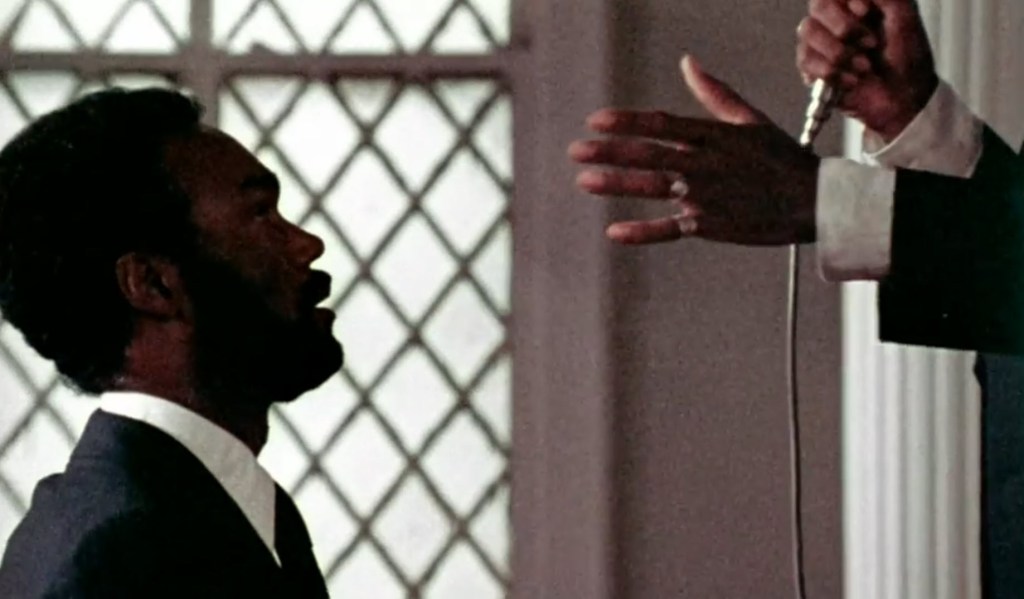
It’s a good thing he knows a guy for this. He decides to go to the church that his friend Reverend Williams presides over. In his sermon, Rev. Williams talks about getting a high from Jesus. He then asks the congregation if anyone would like to be prayed for. Hess steps forward to ask for salvation.
After the congregation sings praises and prays for him, Hess runs out into a field. Now full of the Christian gospel, Hess returns home. He sits in front of a cross and asks Ganja to come with him. But without a response from her, Hess approaches the cross, remembers when George killed himself, which coincided with his reawakening as a vampire, and collapses. He dies from having been freed from the vampiric curse.

True to her word, Ganja decides to look out for herself. Paramedics arrive at their mansion to find a dead Hess. They drive away with his body. Ganja continues living in Dr. Hess’s mansion. She watches as the man she seduced and killed earlier emerges from the pool and jumps over the dead corpse of Archie. Ganja simply smiles as she carries on, presumably as a vampire.
The movie’s end credits play over a choir of children singing a hymn.
Okay… So. Ganja & Hess is a very good movie that is made very well by director Bill Gunn. Let’s get that out of the way from the start. That said, it is not exactly an accessible movie to many. Is it horror? Not in the traditional sense at all. This is the kind of horror that is more about a crisis of the soul. Like the deep religious meaning of one’s soul and eternal salvation or damnation. It goes beyond the Count Dracula concept of: Guy is vampire. Vampire sucks blood and eats people. Those people may or may not become vampires too.
Layered within that, too, this is a movie that I believe, as I discussed earlier, to be a greater metaphor or commentary on the Black experience. Hess has a son that we only saw in a single scene. Beyond that, he’s an absent father. I’m sure there is something there that is all part of this chain of events that led to him becoming this cursed thing. I’m also positive that ties to the single mother that he killed and ignored the baby as it cried. So, yes, there is a heaven and hell element interwoven into sex and desire as well as other social commentary around what it is to be a Black man with as good or better education, intelligence, and success than most of the Whites living around him.
Speaking of sex and desire, this movie portrays lust in a very raw form. I mentioned that a scholarly look at this film stated that it was unusual up to that time to see an African American couple portrayed in this way, which felt real and raw. And, yeah… The entire relationship between Ganja and Hess is one of lust. It’s feeding an animal desire that ties to blood and the vampirism, just like any other vampire movie, but it’s most definitely coming through the lens of that Black experience.
This is a very difficult movie to recommend, despite how good it really is. It doesn’t portray horror in the typical fashion. It’s not the Count jumping out and ripping someone’s throat out. There are no jump scares. It’s mostly told in a fantasy way with the use of visions, dreams, and possibly not even portraying everything seen in the movie as being real to begin with. So it has this more stream-of-consciousness feel to it that even kind of affects the flow and structure of the movie. In the first half of the movie, you’re following Hess more, and, arguably, the focus shifts to Ganja for the second half. The only exception to that is the scene in which Hess seeks salvation.
Because of that focus, even getting a full grasp of how likable these characters are is difficult. Hess doesn’t feel fully human. He certainly doesn’t give you any indication in his scenes that he has sympathy for his manservant or commonality with his preacher friend. Ganja has a serious attitude in her first two scenes, but immediately melts and becomes this desirable woman through the eyes of Hess. When he’s gone, you seem to think she had already tired of him long before his salvation and wanted that other dude she seemingly resurrected as a vampire. She certainly told us who she was by saying she was always going to look out for herself, and that might have been the play from the beginning. She could have immortality, any man she wanted, and could have Dr. Green’s riches and mansion. All she had to do after Hess was gone was to get rid of Archie, and she was home free.
It’s more likely that Hess Green was kind of an asshole and rich prick, and Ganja Meda was always looking for her next meal ticket until she no longer needed someone else to get that. It’s far more likely these are bad people than they were truly sympathetic or fully likable people to begin with. What I’m getting at is this is a complicated movie that is more a fever dream than an easy plot. None of that, however, detracts from this being a very good movie.
So, there we have it. The first entry of Black Horror Halloween is in the books. While I do have one more that is less typical horror or monster type movie to come this month, next week, we are going to do something more in line with blaxploitation horror. Yup, it’s time for voodoo baby! Join me next time as I review 1974’s Sugar Hill!
Until then, if you are a vampire, at least eat the baby so it doesn’t grow up without its mother. Don’t be a dirtbag vampire.
 bmovieenema.com