
Welcome to October, Enemaniacs.
October is a big deal here at B-Movie Enema. Ten years ago on October 3, the blog was created with the release of an Exorcist ripoff with a Rocky Horror-esque title from Italy, The Eerie Midnight Horror Show. I wouldn’t necessarily go back and read too many of those old reviews. They aren’t particularly great as the tone and the vibe of this blog were ever-shifting and evolving. But, that doesn’t mean we can’t celebrate milestones and the history of this blog.
To do so, and considering the 450th review is also due next week with a movie I’ve long been planning for such an occasion, we’re going to be celebrating Halloween a little grimier this year. This month, we’re going to dig deep into four 70s movies that encapsulate the harder-edged attitude of horror in the decade. So, look forward to things getting pretty trigger-warningly real over the next four weeks. And we also get a bonus Halloween review as per the usual around here. It all starts right here with one of the most famous, and highly-regarded, exploitation horror films of all time, Wes Craven’s debut film, The Last House on the Left.
Now, I talked a little bit about Wes Craven waaaay back when I covered 1986’s Deadly Friend which was kind of a curious movie. It’s part teenage 80s drama with a hint of romance and part Frankenstein tale. It’s definitely 100% the movie that features Kristy Swanson throwing a basketball so hard at the head of Anne Ramsey, it explodes leaving her body to wander around like a chicken with its head cut off. It’s a movie that has such a different tone than his earlier successes like A Nightmare on Elm Street and The Hills Have Eyes which were both very serious films with sincere terror laced throughout them.
I am kind of known among my friends as being someone who is not a huge fan of Craven. Do I think he does good work? Yes. Do I think he’s very accomplished? Absolutely. But some of his most celebrated films are kind of hit-and-miss with me. I’m not a huge Freddy Krueger fan, though I will say the first three films of his franchise are legit interesting horror films for three very different reasons. The back half of the franchise irritates me to no end. I very much like Swamp Thing, but it also comes across as not sure if it wants to take itself seriously. That’s something THIS movie has in it too that I will definitely talk about. Scream was a massive success and introduced many people of my generation to the slasher genre, but thanks to my older brothers, I was already ahead of the curve and didn’t really find anything all that special about the movie. It’s a good movie. It’s fine to contextualize the “rules” of the genre (even if I think some of those rules are not as accurate as the film wants you to think they are). I just wasn’t blown away by it like so many other people my age and younger were.
Personally, if you ask me what I think Craven’s best film is, it’s The Hills Have Eyes. There are a lot of socio-economic things to talk about in the film. That is if you want to dig deeper into the ideas that Craven himself admitted to baking into the movie. I hear some people REALLY don’t like to admit or discuss some of those things that are the point of the movie and presented in an extremely uncomfortable way. If you just want to take it at face value, the movie is visceral and dirty and scary to think that a terrible thing can happen almost unexpectedly.
Personally, I think this movie, The Last House on the Left, has a couple of things to say that I will touch upon. I think the core concept of this movie matches The Hills Have Eyes. It just suffers badly from something else that is inexplicably interwoven into the film’s plot which sours a lot of the potential of the movie for me. We will most definitely be touching on that too. The thing that absolutely wins the movie for me, though, is David Hess as our primary villain Krug. First, you gotta love a bad guy’s name being “Krug”. It’s so obviously off-putting. The best that I can gather is that it’s not short for anything either. He came out of his mama’s womb with a scowling expression and she was like, “Yeah, he looks like a Krug to me.” Hess is never not imposing in films. For proof, see The House on the Edge of the Park which I covered here previously. He’s always proven to be a brilliant character actor and that’s definitely going to be on display in this movie.
The movie opens with a little bit of text about how this movie is based on real-life events but names have been changed to protect those who are still living. I don’t really believe that at all. In truth, the movie was based on the Ingmar Bergman film from about a dozen years earlier called The Virgin Spring. That film was based on a 13th-century ballad. Conceivably, that ballad was based on a 12th-century local legend in Sweden. Got it? Good.

What we learn right out of the gate is that Mari Collingwood has just turned 17 years old and seemingly has two things going for her – she’s incredibly intelligent, with a very bright future ahead of her, and she’s the girl every guy in town would like to date. The Collingwood family is very modern and liberal. There’s a lot of trust in Mari to go out with her friend, Phyllis Stone, to a rock concert in a not-so-great part of town. The band she’s going to see? Bloodlust. Bloodlust once sacrificed a chicken on stage. At least that’s a rumor we hear when Mari is talking to her parents about the band.
Something else that also gives some explanation around the family unit that is the Collingwood’s very progressive (for 1972) thinking is how they talk about Mari’s body. Mari is going to a concert with a friend, with no adult supervision, and Mari is not wearing a bra. On top of that, her father, John, comments on her shirt being fairly see-through. John doesn’t scold her for this. Estelle, her mother, gives a sort of condemnation of Mari’s choice of sexual expression but relents after Mari reminds her of her mother’s generation wearing torpedo-tit, and often stuffed, bras. Before leaving, John gives Mari her birthday gift, a necklace with a peace symbol on it that John says might bring her good luck.
Yeah, Mari is a hippie. Likely, she’s one of the more accurate portrayals of suburban or slightly rural hippies ever. It’s very clear the Collingwoods are fairly well off. They seem to have an almost overly all-American family vibe. Mari is beloved, she’s able to do whatever she wants, and is free to be an adult in the house with her parents. Estelle’s slightly more uppity attitude shows itself when Mari reveals she’s going to the Bloodlust concert with Phyllis, of whom Estelle is not a big fan. Part of this seems to be that Phyllis is from the “not-so-great” part of town and her father is so blue-collar that he works in both iron AND steel. For some reason, Estelle is somewhat surprised, or, more accurately, not exactly sure how to speak positively about what Mr. Stone does for a living.
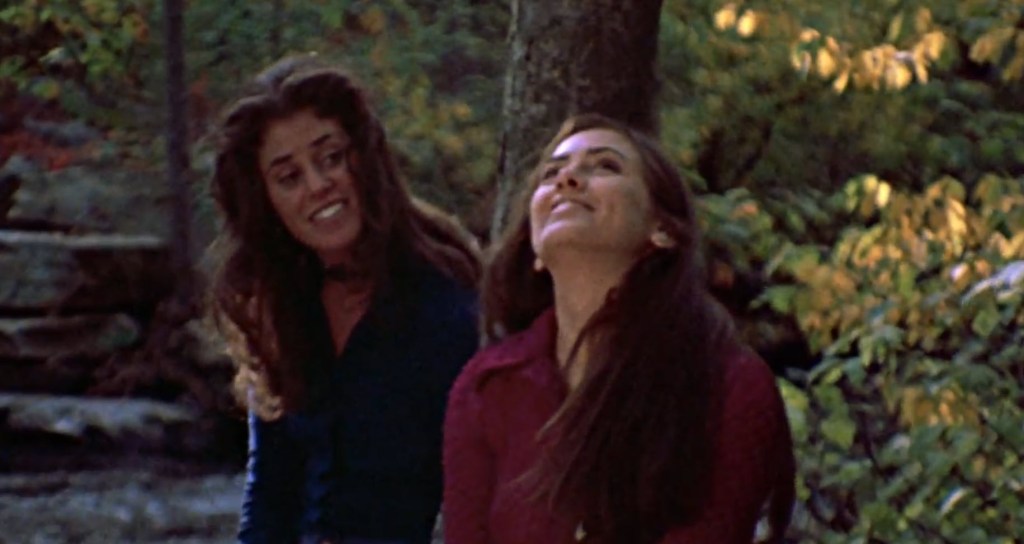
This movie does a lot of really interesting things in the early stages to help tell you that this is a movie about tone and about circumstances and about how the dream life can turn into a nightmare at the drop of a hat. This movie has a lot of soft rock songs that seem to almost celebrate the beauty of nature or lull the viewer into thinking that life is wonderful. Between that and Mari and Phyllis walking through the wilderness, we learn that Mari is on the precipice of liberation. She tells Phyllis that her breasts filled in over the recently passed summer. Even though the two girls didn’t know each other until just recently, Mari explains that before, she was flat-chested. Now, she feels like a woman for the first time in her life. It’s why the movie begins with the mailman saying that Mari is “just about the prettiest face” he ever saw and when we see Mari for the first time, she’s showering and fawning over her own body in the mirror. It’s why she wants to accentuate that by not wearing a bra under her shirt.
This is something that becomes repeated time and again in exploitation thrillers and horror films that follow this movie. The liberated woman enters the world without the protection of family or a man and she discovers the world itself is a mean and terrible place. In her desire to be grown up, she’s easy pickings for a bad guy. It’s her soon-to-be lost innocence that is the usual focus of these types of horror films in the feminism movement and post-Summer of Love. She’s wide-eyed and ready to conquer the world because her parents have lifted her up and supported her to be her own person who is kind of at fault for what happens to her. At least that’s one way to read things.
As for Phyllis? Well, she’s street-smart. She’s just as doomed, but she was kind of always going to be doomed due to the circumstances of being from “the not-so-good” part of town. This movie is already playing with some ideas that set the stage for liberated women being the main targets of psychopaths in the exploitation films of the 70s and the sexually liberated being the primary target of killers in the slashers of the 80s. In this movie, sexual liberation is played as Mari not wearing a bra, finally “feeling like a woman”, and wanting to live a little wilder through booze and scoring pot before the concert that will destroy her.
Oh, I should say also that these sweet songs about coming of age come from David Hess who was also a musician.

On the way to town to go to the concert, there is a radio report playing about convicted psychopaths who are fugitives and on the run. We have the ringleader and the one who has pretty much committed the worst of all the crimes the gang has committed, Krug. With him is his drug-addicted son, Junior, a peeping Tom and child molester, Weasel, and a violent sex addict named Sadie who tends to attack people like a rabid animal. These escaped convicts are hiding out in an apartment. Sadie is kind of there for the three guys’ pleasure if you catch my drift. Sadie says she’s not going to put out anymore for the other three until there are more chicks around.
Well, this creates the double whammy of unfortunate events that turns the movie on its head. Krug, irritated at Junior for messing around with Sadie when he wants to, kicks the kid out. He’s hanging out in front of the apartment building when Phyllis and Mari come along looking for someone who is likely dealing grass. They see Junior, Junior looking like Junior does, and their desire to score before the concert, causes the two paths to meet. Phyllis asks if Junior knows where she can get good weed. He first turns her down saying he doesn’t know anything about that, but remembers no one is getting laid until Sadie has more chicks around. So he calls them back to invite them up to the apartment our bad guys are squatting in.
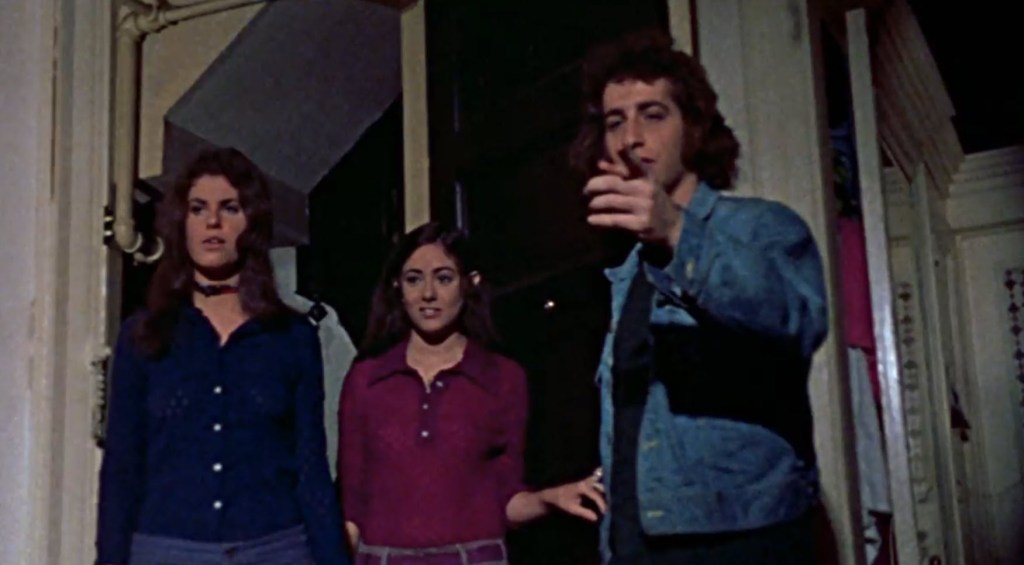
Sadly, the girls don’t quite pick up fast enough that something isn’t right. First off, when Junior says he’s got the good stuff, which he calls “Columbian”, the girls should know that’s not pot. Then, when they come up to the apartment, it’s utterly trashed. Sadie is sleeping on a dirty mattress. Weasel just looks like, well, a weasel. Before they can figure out it’s all gone south, Junior shuts the door and locks trapping them inside.
As the gang starts to tease and make things nice and uncomfortable for the girls, the movie juxtaposes shots of John and Estelle decorating the house for Mari’s birthday and baking a cake for her while happy, upbeat music plays. I’m sure there are entire theses written about these types of juxtapositions in this movie. This one I actually kind of like far more than the other that comes a little later. That’s because we’re getting that contrast between the world Mari comes from, the happy married parents who support their kid enough to trust her to go out into the city to see a concert and believe she’s smart enough to get home, and the world of the city kid, Phyllis, who likely is out without her blue-collar father knowing where she is, and is around the grime enough to know who would be the correct person to approach for grass on the street only to also know the moment Junior rushed behind her to shut the door that they were going to be in for a very rough night. Oh, and let’s not forget that Mari’s parents love her dearly whereas Krug and Junior have little to no real relationship whatsoever.
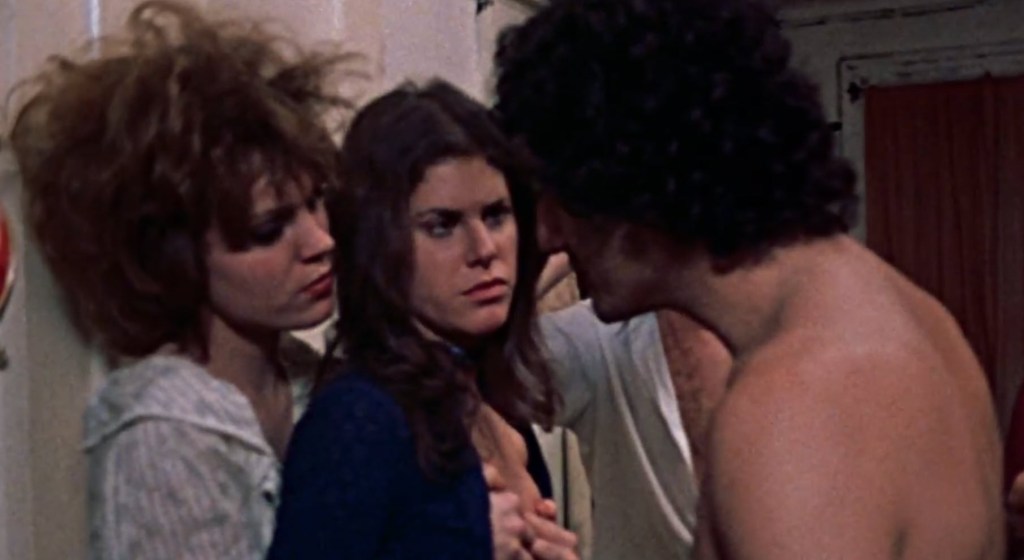
Phyllis is kind of tough. She doesn’t struggle while being held by Sadie and Krug is opening her shirt to see what they’re dealing with. When Weasel kisses one of her breasts, she spits at him. This gets her punched in the gut and thrown onto the floor to be raped by Krug and Weasel. Mari can’t really move. She’s not sure what she’s seeing. Remember, she’s a virgin who “just started to feel like a woman” for the first time in her life. This is her first in-person experience with sexual intercourse and it’s a brutal rape. You can see in her face that she’s not handling the sight well.
The next morning, the gang load up the car with the two girls still unconscious. At Mari’s house, Estelle is talking to the concert venue to get some idea why Mari hasn’t come home. John says their daughter will be fine. After all, she’s smart and they can trust her. Estelle is quick to blame Phyllis, but John shuts that down. Again, there’s derision from Estelle toward Phyllis who she considers an outside, negative influence. John believes in giving people the benefit of the doubt, another thing that shows how far he goes when things turn pretty bad later.
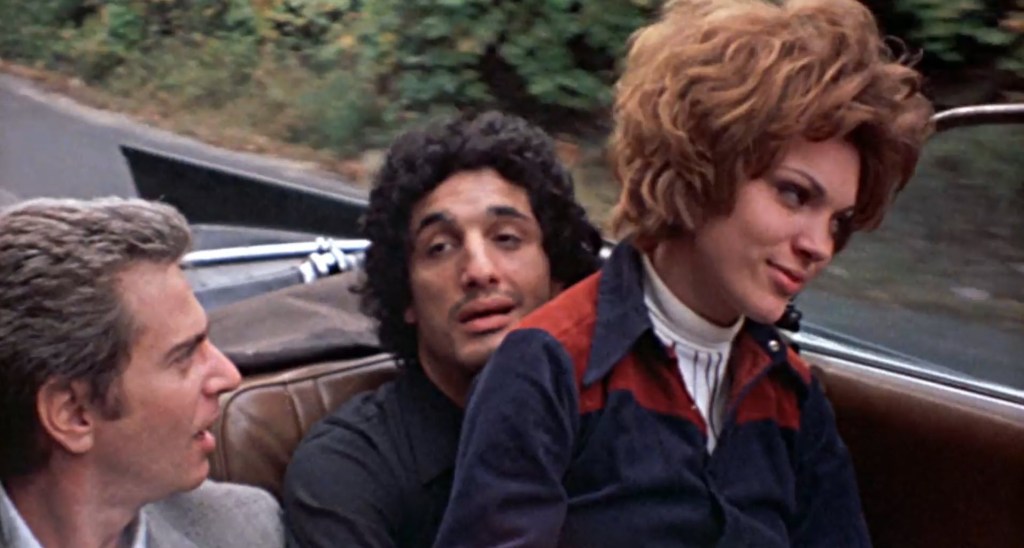
Another point of juxtaposition is in the scene with Junior driving the car down the road. In the backseat, Sadie is riding Krug while Weasel goes on and on about something or another. This bugs Krug because he’s losing his concentration on the fuck sesh. All the while, there’s an upbeat song about how much fun these four are having with the two girls. It might seem jarring how comedic this scene turns out to be and how upbeat the music is, but to these four psychos, it is accurate to their point of view.
This movie does an excellent job, in very subtle ways, of showing how little Krug and his crew care about much of anything. They are this group that only lives for immediate outcomes and doesn’t really care about each other or anyone else. They are almost like pure, animalistic instincts. The only way these four can actually work together is because they are kind of like a pack of wolves. They will go for what they want but they realize also that there’s enough of something for each of them and they can, more or less, avoid stepping on each other’s toes just enough to co-exist in some fucked up way.
So while on the joyride to wherever they plan to go next, the car breaks down. When Krug opens the trunk, Phylis tries biting his hand but it doesn’t really do much. He pulls the girls out of the trunk and tells Junior to get the car fixed so they can leave. That’s when Mari realizes where they’ve stopped… right outside her family’s property. What’s more… The cops are at the Collingwood residence to take a statement from Mari’s parents, but they never see the criminals or the girls.
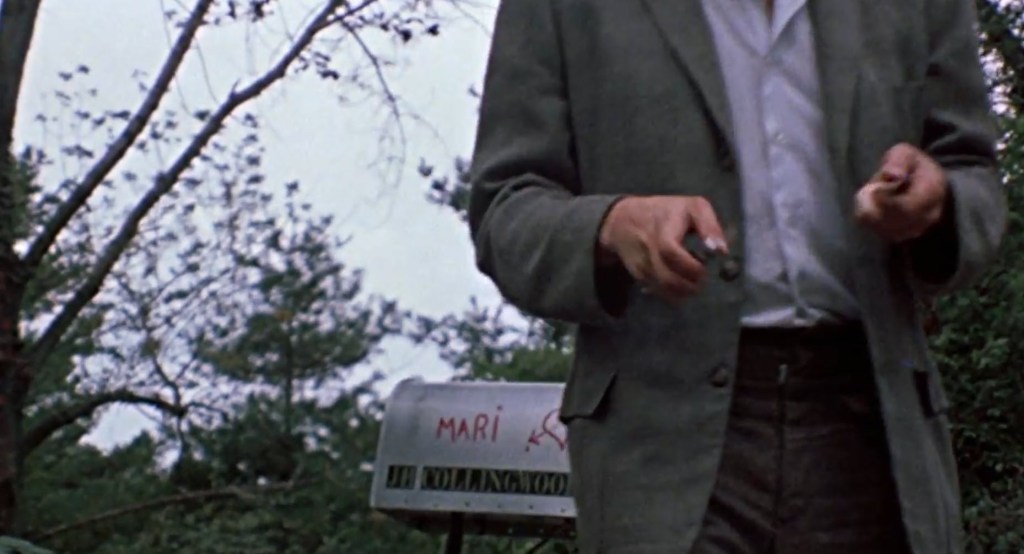
This is not the moment the movie is best known for. That’s coming up very shortly. Instead, this is the element that really makes this movie a heartbreaker. Krug and company take the girls out into the woods that, just one day prior, Mari and Phylis were screwing around in before they took off for New York City. This is where the girls’ torture really begins. Krug orders Phylis to piss her pants or they’ll cut up Mari. She complies and is then told to remove her pants. He then tells Phyilis to punch Mari in the gut.
All this unsettles Junior. He says that Krug will get someone killed if they keep this up. This only makes Sadie and Krug want to mess with the girls even more. Weasel was already willing to go pretty far to mess with these girls, but now Krug and Sadie are downright sadistic. They make the girls strip each other and then perform sex acts on each other. As bad as it has been so far, this is only really the beginning.
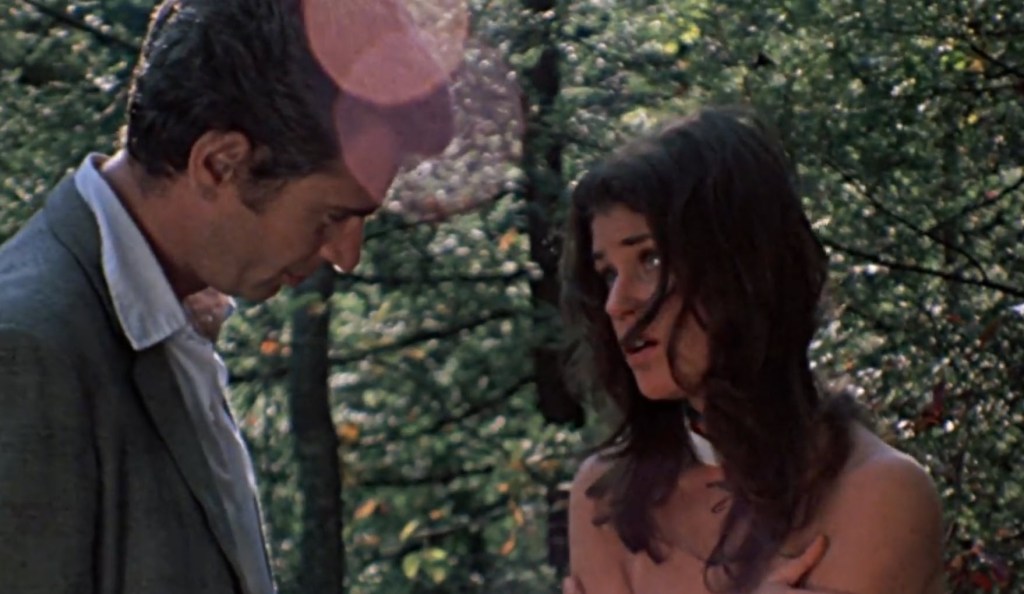
Mari is inconsolable for a while. Phylis is able to convince Weasel to let her put her clothes back on while Krug goes to the car to look for something to help build a fire. Phylis tells Mari she’s going to make a run for it to give her a chance to take off too. While Phylis is on the run, Mari tries to convince Junior to let her go. She tells him she’s going to give him a better name than Junior and settles on “Willow” because he’s kind of beautiful and shakes in the wind. She calls Krug the “Wind”. She says she wants to be his friend. She gives him her new necklace as a sign of their friendship. She says her father is a doctor and works with addicts so she can get a fix if he helps her.
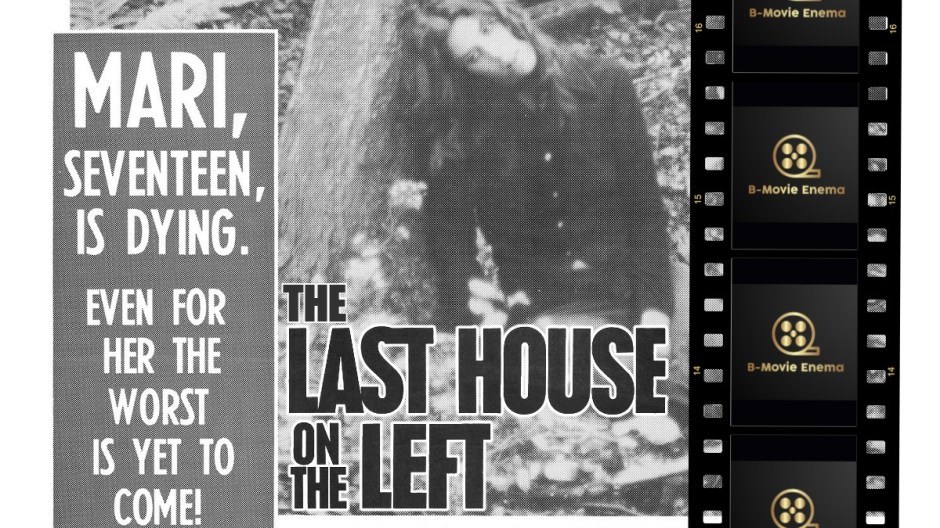
For the most part, Phylis is able to stay ahead of Weasel and Sadie, but just before she gets to the road, she’s stopped by Krug with Sadie and Weasel soon to catch up to her. Weasel stabs her in the back and she crawls away, eventually resting against a tree where Weseal and Sadie descend on her to stab her to death. It should be pointed out that the poster depicts this scene of Phylis dying against the tree, but calls her Mari. It’s the more striking, and more obvious scene of what’s going on. Plus, it’s talking about someone in the act of dying which is more striking for Phylis than what happens to Mari moments later.
Mari is just about to escape with Junior when Krug, Sadie, and Weasel return. She asks Krug if Phylis got away. Krug slowly shakes his head no, and that’s when she sees the blood covering Sadie and Weasel… Oh, and they also have her dismembered arm with them. Krug then carves his name into Mari’s chest and rapes her. There’s an interesting moment of quiet that follows. Krug almost seems disgusted with his own actions as Sadie and Weasel even seem to realize they’ve gone too far. Meanwhile, Mari is puking her guts out over what’s taken place over the last 24 hours. She wanders away slowly with the trio of psychos following. Mari walks into the pond while Krug asks for Weasel’s gun. Krug shoots Mari in the back while she stands in the pond in shock.
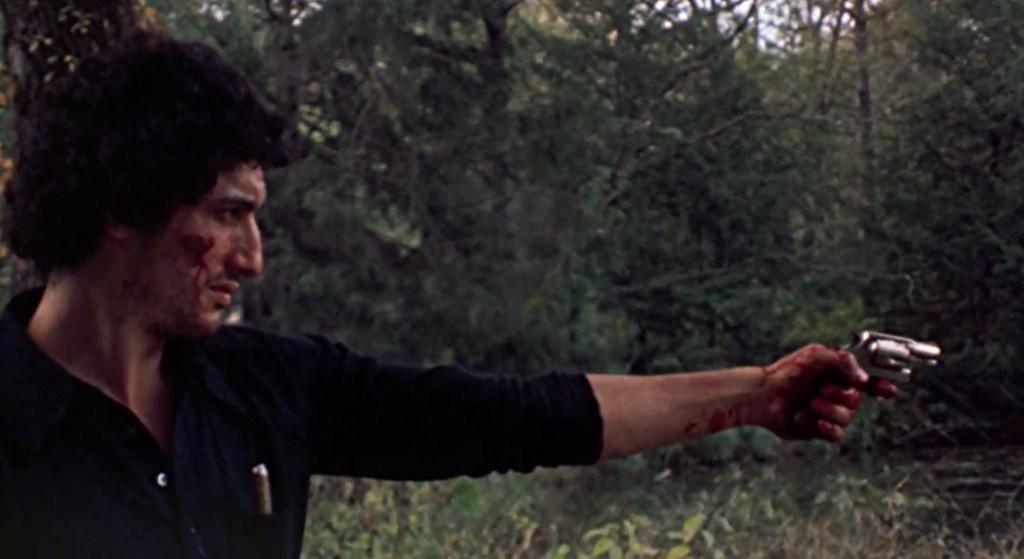
People who have seen this movie know this part well. This is what I was referring to earlier when I said that Mari being killed in the woods right in front of her own house is not the memorable thing, it’s the heartbreaking thing. Krug’s execution of Mari is the memorable thing for a couple reasons. One, it comes after the worst thing that Mari had to endure. Two, it almost comes across in the quiet moments and the subtle facial expressions on David Hess, Fred Lincoln, and Jeramie Rain’s faces as they try to get the blood off their hands after brutally killing and dismembering one girl and the mutilation and rape of the second girl. Like I said, it almost seems like they aren’t exactly taking pride in what they’ve done to these girls but it’s also the come down from the worst they did to these girls. If the girls never came to them, they likely wouldn’t have gone out of their way to kidnap, rape, torture, and kill anyone. But now they have and it’s time to end it. Mari’s final moments in the pond almost seem to come off as a release from the horror she went through in her final hours.
It’s a hard scene. It’s cold. It’s brutal. It’s also probably fairly realistic when it comes to the most brutal of murders committed.

Alright, before we get into the final act and the big climax that should give something to at least hold onto after all we had to see over the last 30 minutes or so, we gotta talk about the most inexplicable and downright worst part of this movie… the fucking sheriff and his deputy. Good god these two sour the entire vibe of the movie whenever they show up. Ostensibly, this movie takes place not too far away from New York City. These two guys talk like they are they should be chasing after them Duke boys and not trying to find killer fugitives.
The “lighthearted” scene with Krug and Sadie banging while Junior drives and Weasel drives Krug nuts with bullshit while an almost out-of-place upbeat song plays about them makes sense. These people are out having their version of fun. That makes sense to me. We’re seeing this story for that moment from their own points of view. The cops are downright idiotic. Most anytime you hear anyone say something negative about the movie, it’s for the two cop characters. The older sheriff talks like he’s from the bayou. The younger deputy talks like he’s from Tennessee. They bicker at each other. The younger deputy forgot to fill up the patrol car so they are stuck walking. They flag down a truck driven by an old black lady who is transporting crates of chickens. She only allows them to sit on the roof of the truck and they fall off with the truck lurches… it’s all terrible. It makes me want to die every time I see this movie. It makes me wish I was getting shot by Krug in the pond instead of Mari. It’s terrible.
I think the reason these scenes play like they do comes down to maybe a couple concepts. The first is to give us much more satisfaction out of how the finale plays out. Second, I think it might be a comment on the fact that the cops are basically no more effective against the evils of society like Krug and his gang than anyone else. They have the law and the car with the sirens and the guns and the badges, but they aren’t able to prevent terrible people from existing and they can’t do anything to save Mari. The rot is already in society and you’re better off to avoid the rot than expect someone to be able to officially cut it out of society through the use of the law. That’s only exacerbated by this being a rural town so the police are that much more ineffective and downright ill-prepared to handle such a problem.
Alright, I said all I was going to say about the police characters, so let’s move on.

Much to the surprise of the audience, we return to the Collingwood residence where Estelle tells John they have guests… Krug, Sadie, Weasel, and Junior. They are simply posing as well-adjusted people who were passing through when their car broke down. They can’t take the four of them to a hotel because Mari took the car the night before. So now, they have to let these guys stay with them for now.
Estelle shows them to a room where they can rest and Weasel notices the pictures on the mirror are of Mari. So now, we get to the big climax. We already knew Mari and Phylis were killed right next to Mari’s house. We knew their car broke down right at the end of the Collingwood driveway. But now the killers are inside the house with Mari’s parents who we should expect to be in major danger. Well… The parents are a little smarter than we might expect. They realize these “insurance salesmen” are kind of odd. One of them (Junior) is not in good shape. Plus there was a slip-up with one of them saying they were insurance salesmen while another said they were plumbers.
It all comes across as peculiar.
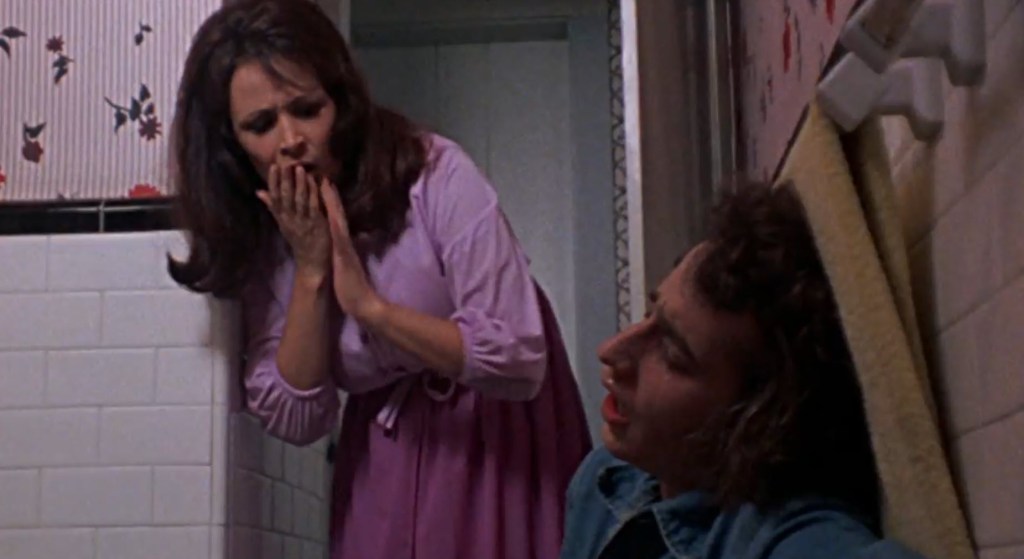
What comes back to haunt this movie is the tell-tale peace sign. That was Mari’s birthday present that she gave to Junior in hopes that he would help her escape, and now Estelle sees it around Junior’s neck. While anyone could have a necklace like that, this feels a little too convenient for her to shake off as a coincidence. After taking a very sick Junior back to bed, she takes a peek at their visitors’ luggage. She finds their blood-soaked clothes while she hears Junior and the others argue about needing to leave immediately because of what they did.
On a hunch, John and Estelle run out into the woods and to the pond where they find Mari’s body. They decide to take revenge on their daughter’s killers. Noticing Weasel giving her the eyes earlier, Estelle makes herself available to him. Meanwhile, in the basement, John tries to figure out what will be his instrument of revenge. He first picks up a heavy wrench but that probably won’t really work. He then picks up his rifle. That won’t be what he ultimately uses… we’ll come back around to him in just a moment. First, we gotta set up a boobytrap that will shock whoever trips it and have John put a layer of shaving cream outside their room to make them slip and fall as they run out into the hallway. Again… Hold that thought, because we’ve got some outside business to deal with.

Outside, Estelle and Weasel go for a walk in the wooded area around the Collingwood house where she is laying it on thick to seduce Weasel. She convinces him that she has this fantasy of pleasuring a man while his hands are tied behind his back. There is a wonderful line in this movie during this scene. Her hands are cold which causes his dick to shrivel and she says, “Oh that poor little thing!” which makes Weasel respond, “It’s not little!” That’s followed by her going down on him and bringing him to the edge of orgasm almost immediately. Damn, Estelle has some serious dick-sucking chops on her. Maybe I should say she’s got dick-sucking chomps because just before he cums, she bites his dick off… ALL THE WAY off.
His screaming causes Sadie and Krug to wake up to find John waiting for them with the shotgun. However, Krug unplugs the light in the room making John miss his shot and escape the room. Krug begins beating up John in the living room while he taunts him about how much longer Mari lasted than he will. He’s about to be strangled to death when Junior comes in with Krug’s gun and fires it at him, but misses. Krug belittles his son for failing to kill him and convinces Junior to turn the gun on himself and blow his own brains out.
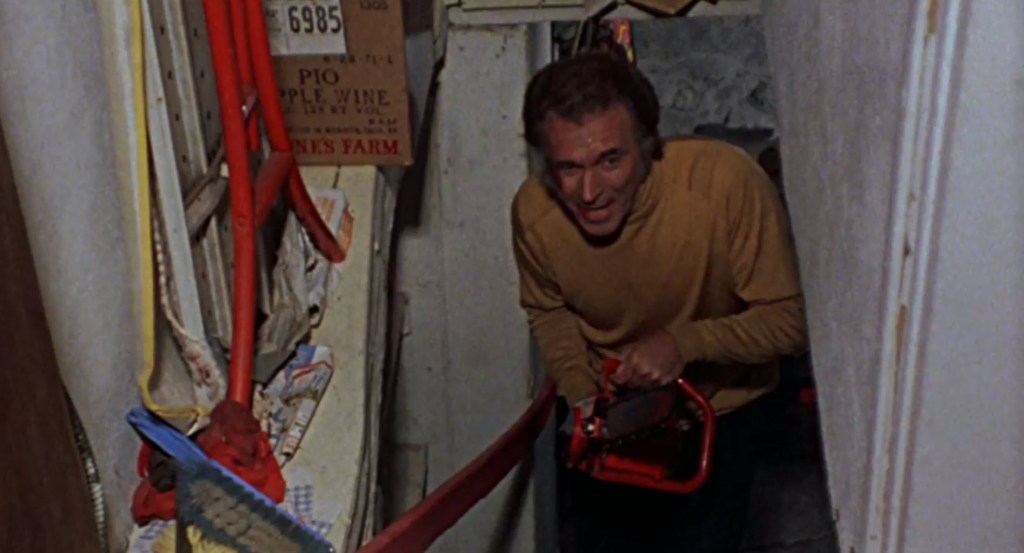
While Krug was dealing with that, John gets a goddamn chainsaw and comes after him. Remember I said John needed to find what his instrument of revenge will be? Well, he found it. He goes after Krug with that while Sadie escapes the house only to run into Estelle. Sadie fights her way free of Estelle but ultimately falls into the pool. As the sheriff arrives, John kills Krug with the chainsaw while Estelle uses Sadie’s own switchblade to slash her throat.
While the police check out the scene, John and Estelle hold each other and grieve Mari’s death.
The Last House on the Left is a curious beast. On one hand, it’s a brilliant piece of hard-hitting exploitation horror focusing on the horrific final 24 hours of two girls’ lives while also giving the audience something to cheer for in the form of the parents getting their revenge on the psychos responsible for their deaths. That’s a concept Craven would return to for Freddy Krueger’s origin. The police scenes, to the exception of the first and last times we saw them, are completely awful. I hate those scenes so hard. I almost wonder if their bits are only there to help fill out this movie to 85 minutes. Either way, the stuff dealing with Mari, Phylis, Krug and his gang, and Mari’s parents are great. The movie doesn’t put its finger on the scale to force you to feel bad about what’s happening. It isn’t trying to tell you that you must feel a certain way for Mari and Phylis when they are tortured and killed. You just do. It’s realistic in that way. I think that’s why people gravitate toward this movie for about 50 years after its release.
Speaking of gravitating toward what this movie was, The Last House on the Left serves as the origin point of TWO decades’ worth of exploitation horror. The first thing this movie immediately inspired was a whole slew of 70s horror films that this movie should get a lot of credit for inspiring. I would say that The Texas Chainsaw Massacre and Halloween should both pay this movie some credit for their existence. That’s not even mentioning the tons of lower-end gritty horror films that would run at grindhouse theaters and drive-ins across the country. This was the first real step away from the gothic horror of Hammer Films’ monster movies. Between this and The Exorcist a year later, the 70s were set for what it was going to do.
The other origin point was the 80s slasher films. On its face, this movie doesn’t quite fit the bill as a slasher. However, you have a movie written and directed by Wes Craven who would create two franchises of slashers that would be immensely popular – A Nightmare on Elm Street and Scream. But The Last House on the Left was also produced by Sean Cunningham who produced, created, and is the source for much of the rights quagmire preventing a new film of Friday the 13th. I mean the guy who first conjured up the idea of Freddy and the guy who first created the concept of Jason are working on this film together. That’s kind of amazing.
Well, all I can say to wrap this up is if you have not seen this movie and you are either a) not all that familiar with 70s exploitation horror or b) under the age of, say, 35 and therefore expect much more tangible jump scares, your mileage may absolutely vary on The Last House on the Left. I don’t know anything about the remake from the 2000s. Maybe one day I will get around to that. I have to imagine it really doesn’t have the realistic bite this film does, but I’ll have to find out to be sure.
What I know for sure, though, is two big things coming up. First, there’s a new episode of B-Movie Enema: The Series tomorrow night for Devils of Darkness. Be sure to check out all that devilish vampiric business on YouTube, Vimeo, or on Roku. All the relevant links are on the right side of the page in the links section. But, if yesterday was the 10th anniversary of the very first B-Movie Enema review, I think next week takes the cake in terms of being a big deal. Next week marks the 450th review at B-Movie Enema! If we’re going to look at 70s exploitation classics this month, then the 450th review needs to be a special one. And, indeed it is… Join me next week for the all-time infamous exploitation classic I Spit on Your Grave.
Until then, I leave you with David Hess performing “Sadie and Krug (Baddies Theme)”.


Happy tenth anniversary, Geoffrey!
LikeLiked by 1 person
Thank you, Johnfrey!
LikeLike
also, sorry about calling you Geoffrey. Barely awake yet and autocorrect went there for me.
LikeLiked by 1 person
It’s quite alright. I was born with it and I am not at all against being recognized by more formal means. ☺️
LikeLike
one final note: did you know that in his 1981 book Danse Macabre Stephen King urged a boycott of all Wes Craven films on the strength of this movie?
“the genre labors under enough disapproval without this type of Porno-Violence.”
Little did he know what was coming.
LikeLiked by 1 person
Considering King’s taste in some movies that he lends a pull quite for… I’m not surprised he’s off base here. I have assume next week’s movie I’m reviewing was also blasted by him.
LikeLike
Also, I think Tarantino copped the scene in Pulp Fiction where Butch chooses his weapon to rescue Marcellus from this film.
LikeLiked by 1 person
You know what, I was thinking it had to have been influential to something and I couldn’t put my finger on it. I think this has to be right!
LikeLike