

Welcome to another B-Movie Enema review!
Over the last few months or so, it feels like I’ve waxed poetic over going to the video store or a sleepover with your dumb friends and being enticed by a particular movie. Maybe it was a movie that had box art that stood out. Hell, I talked about that just a couple of weeks ago about how enticing and striking the poster for My Bloody Valentine was to me as a kid. But I’m not even really talking about just horror either. Sometimes there was a sexy cover… but when you’re in, like, the fifth or sixth grade, maybe you don’t want to admit you really want to rent that Shannon Tweed thriller just because you felt tickles in your underpants from Ms. Tweed… BUT YOU HAVE TO WATCH THAT MOVIE!
But maybe the most enticing movies that would get you to watch them with your friends at a sleepover were what I called the “dare” movies. These are movies that had a certain reputation about them that made them near taboo in terms of legendary. These were movies like I Spit on Your Grave or Cannibal Holocaust. They didn’t necessarily have to advertise their own legendary status. Another was so proud of being both legendary and taboo that not only did every kid know of this movie and its sequels, but it wanted to make sure you knew it was proud of being kind of hated. It had it splashed across the corner of the VHS box: “BANNED! In 46 Countries!”
Yeah, let’s talk Faces of Death.

Man… it’s right there in bold font. BANNED! 46! Faces of Death wanted you to know it was something new. However, if we’re being honest, it really kind of wasn’t. The origin of a film that explored more of the macabre side of things really goes back to a 1962 Italian film called Mondo Cane. In that film, we see sexualized nudity as well as breastfeeding that is more connected to tribal purposes in New Guinea, geese force-fed for foie gras, snakes butchered and sold at a market in Singapore, and lots of other stuff that are either about death or sex. That movie was so well-known to a certain group of people that I heard my dad talk about that movie and then also even seek it out in the 90s or early 2000s to watch again. There were other films that followed Mondo Cane’s lead throughout the remainder of the 60s, including 1966’s Africa: Blood and Guts which featured a lot of animal cruelty, poaching, and executions.
So to say that there weren’t folks out there interested in some of the more off-beat stuff from other cultures that could challenge our perception of “decency” would be incorrect. The thing is, though, while Mondo Cane would show some animals being slaughtered for food, Faces of Death specifically wanted to show the last moments of a person’s life for shock value. Death was always a part of drama or horror or documentaries, but this felt almost underhanded and seedier in terms of why it existed. The perception and reputation of this film always centered around the idea of some producers sitting around willing to feed the sickest desires of people who took maybe a little too much interest in violent death.
Immediately upon release, the movie was instantly met with bans and slammed by critics. Because the movie did have a lot of real footage from accidents and other content purchased from real news stories, and seemingly packaged it as a documentary but also didn’t feel honest due to lots of recreations to fill things out the runtime, there were a lot of decency concerns. But here’s the thing… Faces of Death is relatively tame. It doesn’t show a lot of close-up real death. Yes, there is some grizzly imagery, but a lot of it is in the distance. No one is actually filmed literally dying.
But… the makers of this film, producers John Burrud, William B. James, Berbie Lee, Rosilyn T. Scott, and writer/director John Alan Schwartz got what they needed – the reputation of featuring actual, morbid, real death. Nothing gets you noticed and builds an underground cult following than saying you were banned for what you showed in the movie. It doesn’t matter if it’s nudity or death, if there’s something far enough kooky that gets it banned, people will want to see it at any cost.
Imagine you are a horror fan in the 80s. On top of that, you’re curious about things. Maybe you’re curious about sexuality. Maybe those horror movies you grew up with get you curious about real life death. Okay, maybe not so curious that you yourself are out there like a fuckin’ psycho torturing animals or willing to kill someone, gimme a break. What I mean is you have never been close to death or seen a dead anything… Faces of Death would have been incredibly appealing. Plus, that advertisement of being banned only entices you more. You now need to see this movie. After all, it’s, ooooooh, forbidden! So that’s why this is maybe one of the all-time kings of “I dare you to watch this tonight” cinema for sleepovers and hangouts with your buddies.
So, let’s get into it. Understand that, like I said, no actual footage of a real death is captured in real time, there are instances of disembodied limbs and what have you shown in the movie. While I typically will censor flat out nudity on this site, I’m not going to censor any images. [Read the next sentence like a real snobby movie fuck.] After all, this is a documentary and I must uphold the artistic integrity of the filmmakers.
The movie begins with open heart surgery. We have doctors working within the cavity and poking and prodding around, doing stitches, monitoring the heart rate, and so forth. The heart monitor starts freaking out, and we go into slow motion before a freeze frame leads us to believe the man has died. After the title card, we’re taken to a morgue where we see multiple dead bodies. Specifically, we see a lot of old dead bodies. We follow that with footage of an autopsy. For people who may not have ever seen a horror movie or didn’t go to medical school or something, this would be kind of unsettling to see in 1978, but if you had seen horror films, I’m not sure this stuff is all that much more terrible than some of the stuff faked in, say, The Wizard of Gore.
Sure, there’s plenty to be unnerved about. The score sounds scary. Our own mortality and what will become of our “souls” or our legacies will always be a concern for most people. I mean, not me because I already know that B-Movie Enema has afforded me, the great Dr. Geoffrey Robert Arbuckle, Esquire, a great deal of immortality, but I understand some of you plebes might be concerned with such things. But yeah… I guess if you don’t like looking at the stuff that should be on our insides being on the outsides, then I guess this sort of opening would at least have an immediate gross-out effect.
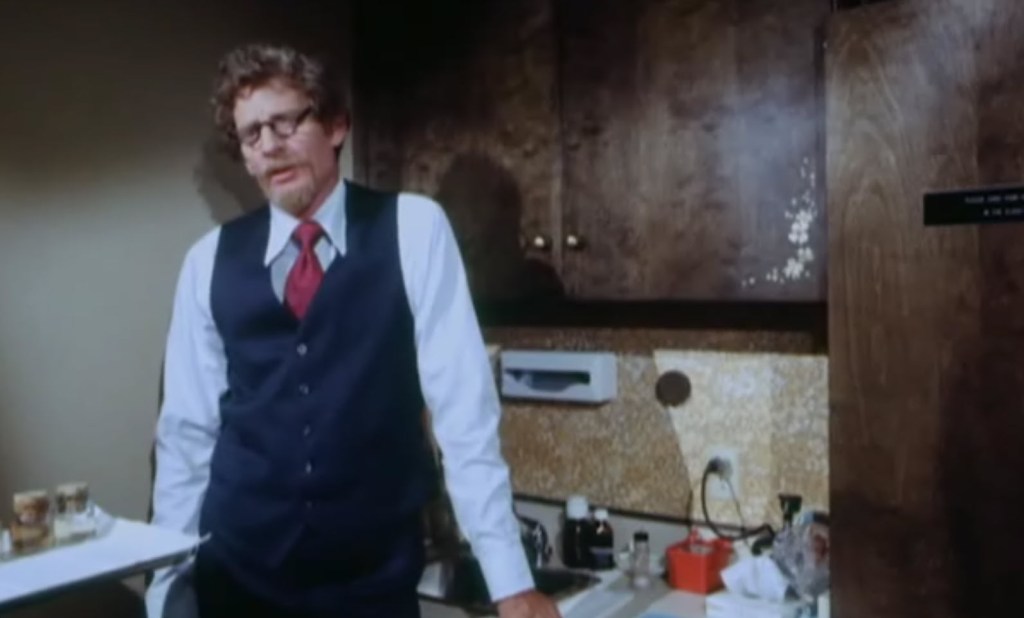
Oh… speaking of “gross”, let’s meet our “lead” of the picture, pathologist Francis B. Gross. This is not a real doctor. Instead, he’s played by character actor Michael Carr. Carr had a whole ass career leading up to his work in the first three Faces of Death films. His filmography features over 50 credits from 1947 to 1985. “Dr. Gross” is likely the only name that can really be attached to this series. The content within this and the sequels speak for themselves, but it’s Carr’s hosting duties and narration that serve as maybe the truly most memorable thing about the movie (if there is such a thing as a memorable element of Faces of Death as a franchise beyond its reputation).
For the most part, Dr. Gross is here to opine on death, situations that lead to death, and how it affects us. He tells us that he’s got a recurring dream that has plagued him for years. A priest and a woman in a coffin are the only things he can make out at a funeral. He became a pathologist and traveled the world over seeking death and the various causes of, well… death. So he’s made this movie to share the experiences of his journey.
Now, if I’m going to be “that guy”, I can tell you this should already be your first indication that this movie is kind of full of shit. It’s using an actor with a pretty good, deep voice talking with something of a hesitant conviction about his fascination with death and his studies of the many “faces of death” he encountered in his life. It uses this dream sequence to give us haunting imagery of a funeral for a young woman with a priest double-exposed into a shot of the sky as he makes his final blessings after her coffin is lowered into its final resting place. Of course, there is creepy organ music. Can you understand what I’m getting at? It’s manipulating you to be fearful. It’s trying to set a horror tone to make your skin crawl as you see some of the real footage they have and make you jump at some of the staged material that will play out over the next 90 minutes of film (yes, this film is inexplicably 105 minutes long).
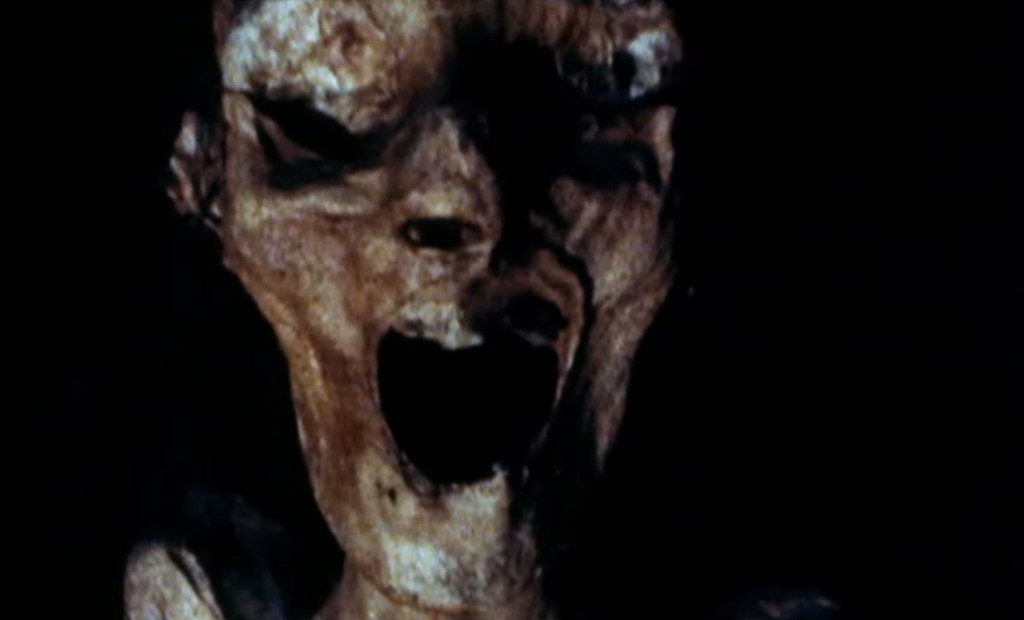
Dr. Gross talks about a town in Mexico that had to exhume bodies from graves due to their family not being able to afford the rental cost of their burial place. They discovered the bodies were mummified thanks to some rich minerals in the soil they were buried in. That’s it… Just some looks at mummies that look spooky.
After that, Gross speaks of bullfighting and dogfights. The bullfight used footage from a real fight in Spain but we don’t see much more than a matador preparing for a fight. The two Pitbull dogs fighting is the first instance of deceptive filmmaking. This was faked. The dogs were trained to play fight and costume blood and makeup was applied to the dogs to make it look like they had bleeding wounds and what have you. Move to the jungle where a large bird-eating tarantula is feeding on a bird in the Amazonian jungle. Anacondas, praying mantises, piranhas, and more are used for Dr. Gross to speak about death in nature. Connected to that are the jungle “savages” who spurn the modern world and exist in harmony with nature around them, even if they kill small monkeys with poisoned darts for food.
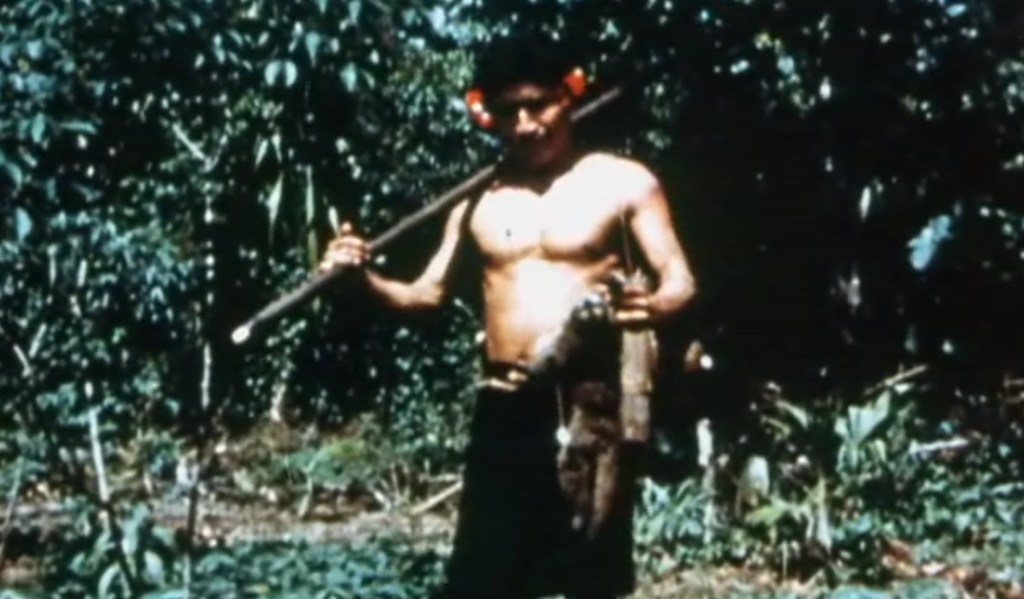
This is real, purchased footage from documentaries about the people in this jungle. He speaks about how they kill and eat everything they kill. They also have various ceremonies which, naturally, leads to how they seek revenge against other tribes. This is doctored footage as well with nothing more than the filming of one of these ceremonies with tribespeople dancing in a circle with their spears and then there is a severed, shrunken head on a pike that they appear to be dancing around or pointing their spears at. It’s very obviously edited to look that way. The footage of the tribe looks different than the footage of the shrunken head.
More “savages” follow as Gross visits a tribe in Africa. We see them kill a cow and use its blood in some sort of ceremony. It carries on with footage of the slaughter and butchering of cattle which compares to the western idea of farming chickens or pigs. So, yes, let’s watch a chicken get its head cut off and wobble around headless for a bit. These early moments of the movie, while somewhat interesting in a documentary sort of way, would not be well appreciated by vegetarians, vegans, or animal rights activists. Gross even states that if he had to provide for himself like these groups did, he would opt for vegetarianism. There is a certain amount of reverence paid to the tribes with how they eat all they kill and how the African tribe views meat as a delicacy due to it being somewhat more difficult to farm livestock in the plains where lions and other predators can get their stuff fairly easily.
A kind of fascinating dichotomy is then brought to the screen. We move from the collective hunt/killing/butchering of animals for food in tribes to an individual farmer simply providing for themselves to a slaughterhouse for the masses in the Western world. The slaughterhouse footage does not hold back in showing cows and lambs bled to death slowly and gruesomely. Then we see the workers all doing their own specified jobs with butchering, gutting, shaving, etc. of the animals. Again, nothing is held back in the footage. All the while, Gross is talking about the inhumane practices of the slaughterhouse. He opines about whether or not the animals know they are going to die. The workers say they don’t, but he thinks when the machinery comes to life, the sounds of the animals heading to their doom sure seem to indicate otherwise. He leaves the slaughterhouse saying that at least we, as consumers, are spared the entirety of the process and only see the end result of that juicy cut of beef that ends up on our plate for dinner.

That’s when we get to one of the more famous scenes of the movie. We see patrons in a “Middle Eastern” restaurant where they are treated like royalty with music and belly dancers and a very special item on the menu. Yes, this is the scene in which four people are going to dine on monkey brains. The monkey is brought in and placed in a portion of the table that has a hole in it that will secure it with only the head sticking out. The men are given mallets that are used to beat the monkey to death. Once dead, the monkey’s skull is carved open and there they will get their brain meal.
This is not real either. Sure, I suppose people eat monkey brains somewhere in the world, or at least did eat them somewhere. However, this was a total fabrication for the movie. No one here is in the Middle East. They are on a set in California. There was a monkey, but what was placed into the table is deceptively shot. Under the table, we see the body of a real monkey in restraints. Above the table, it’s either that monkey moving around with no harm coming to it or a puppet. We never see the impact of the mallets on the head of the monkey. We see the before and the after when the “monkey” is dead and his “brains” being cut out of its head. What was in his head was theater blood and cauliflower.
Admittedly, I have a bit of the Mandela Effect here. I thought, for however long the memory of seeing this movie has been in my brain, that we actually saw them clubbing the monkey to death, but no… We see the men kind of aghast at their own actions but we don’t see any shot of the hammers coming down onto the monkey only the men striking the mallets against something. I’m sure there will be people to this day who swear this is 1) real and 2) that you actually see the monkey get killed on screen. I’m not sure there is a more famous scene in this movie (or any of its sequels) than this.

Another famous scene most people of a certain age probably don’t realize they first saw in Faces of Death is the “seal clubbing” scene. Yeah, we all remember seeing images of seals pulling out glow sticks and really getting down to some seal techno music in a thumping club, but it was all fake. No, really. It looks like seals are indeed being clubbed to death by these men but it is staged to look real but the seals were not harmed. Clubbing seals have always been something my generation grew up hearing about (along with whaling) that were among some of the most deadly and terrible things that humans were doing to other life forms on the planet. It’s sort of alluded to that professional fishermen would kill, say, sharks, for food and many other products that would use the stuff from the creatures, but those who kill the seals are really only taking their pelts for expensive clothing and leaving the rest of the carcasses behind.
Let’s go to Florida where people and alligators are struggling to live together nicely. There’s a nice, super obviously faked news report being conducted between a “reporter” and locals who have called animal control to capture a gator. But, hilariously, he tries to wrangle the gator that is menacing a local pond only to be pulled into the water and killed by the creature. Again, more faked stuff. It’s obvious this time due to the editing of the footage. If the cameraman for the news report was good at his job, he wouldn’t be mostly looking at the crowd. This time, the staging is kind of funny, and very obviously faked.
So the first thirty or so minutes of the movie really goes hard on death for food or death dealing with animals for some sort of status. Killing a monkey to eat its brains is not something normal ol’ movie blog guy can do on his salary. Neither would buying a seal fur coat. But it dealt mostly with the death of animals. As we transition into the next segment, we get into humans killing humans. This section starts by listing the names of famous assassins in American history. Let’s not forget, this is only a decade and a half removed from JFK’s assassination which was caught on film. This section would have been titillating to some viewers who had a bit of a history interest.

We then see some footage from “France” where an “assassination” was captured on film. The man responsible for this assassination is named François Jordan. Mr. Jordan is an avid skiier and rifle collector. He also has a strange disease that makes his voice sound like it is being mechanized. He also is afflicted with the condition “There ain’t no fuckin’ way this is real” syndrome. I feel he’s a pretty good approximation of what a real assassin would be like in terms of how he talks about his profession. He states he kills solely for business and not for political or social causes. That seems about right. Some men just want that paycheck. However, I cannot imagine a low-budget pseudo-documentary about death would be able to pull off a real interview with an assassin and not use more than about 90 seconds of footage of him.
That leads us to the killer who kills for no reason. Gross tells the story of a 1973 case where a man snapped and killed his family before engaging in a shootout with police. After gassing the inside of the house he was sheltered in, the murderer ran outside and was killed in a hail of gunfire. Inside the house were the murdered remains of the guy’s family each of their throats slit.
While that footage of the shootout and what was found inside the home was not real (the story may have been), the footage from inside the Los Angeles County Coroner’s Office is real. So, as is the case with most of the movie, we get a little fakeness and a little bit of realness with footage of real dead husks of people.
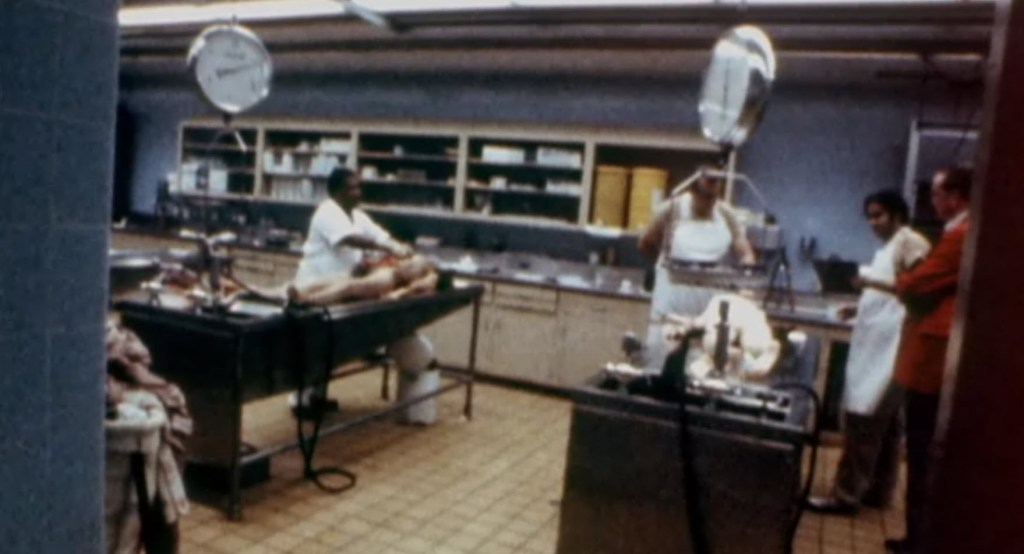
This section is vaguely interesting. Inside the coroner’s office, Gross explains how the law works and when they must be brought in for an autopsy. Sometimes, a typical autopsy can determine the cause of death for an individual. However, what happens when cutting open a body is not so easily determined? Well, they take tissue samples and use microscopes and more technology to find what the human eye cannot see.
There is some value to this exploration, however short it is. I often wonder why someone who is very obviously killed by gunshot or electrocution or car crash would really need an autopsy. If witnesses identified that someone raised a gun and shot some dude in the head, it seems pretty cut and dry. Find a guy in a bathtub with his toaster plugged in and floating with him, eh, it seems he decided to call for the check and cash out. Can you see the trail of tire tracks from one part of an icy road all the way off the road and to where the car is resting crumpled into the tree? Yeah, the guy died from car accident. But sometimes some of those things may not entirely add up. It’s possible other causes of death occurred that muddies the original assumption of what led to that moment of death. So there are laws and rules as to why the coroner needs to do the autopsy even if it seems obvious just the same as if the cause of death is completely unknown. That makes sense and could honestly be its own documentary. It reminds me of the old HBO docuseries called Autopsy. Death isn’t always exactly what it seems.
But enough about that, let’s get to the second most famous moment of this movie!
We meet rapist and murderer Larry DiSilva on death row. He is going to die by electric chair. So, when his time comes, he’s collected and he takes the long walk to the chair where he looks scared and worried about dying. He’s put into the chair while goofy music is played and he’s strapped down. As he’s prepared for execution, Gross ponders if two wrongs make a right. Electrocution is not an exact science. It might take several goes to kill a man by electrocution. Conceivably, the prisoner could be cooked to death before the voltage can kill him.

This part is not real either. Basically, it’s all special effects and good ol’ movie-makin’ hokum. The foam that comes out of the guy’s mouth is just toothpaste. I’m sure there was something that would eventually pump some thick red theater blood out of the helmet and down his face indicating his eyes have bled out. In addition, Gross claims he obtained footage from the Middle East from a Canadian who filmed an execution by beheading. That’s about as classic a horror makeup job as you can get.
We then move to some more fake shit. We learn about cults. One in particular we get to witness is from San Francisco. They think the key to eternal life is found in the internal organs of the dead. The guy who leads the cult suspiciously looks like the guy from Manos: The Hands of Fate. Dr. Gross claims that he met this leader and quickly discovered he’s a madman, but eventually got his permission to film a ceremony that included the cutting open of a person’s body and playing around with its guts and stuff. Again, it’s very obviously fake because if they were doing anything that led to them stealing a body, obtaining it some other illegal way, or sacrificing someone to perform this ritual, this footage would have been turned over to the authorities.

We don’t go too long with the fake crap before getting into some real crap. Let’s bring out the hillbilly snake cult! These cultists speak in tongues, carry snakes around, and dance around in jerky and convulsing movements. Of course, if one of these snakes bites a member of the cult, they don’t seem to be too shaken about their faith in God. It’s said that from this footage one of the members did indeed die of a snake bite and there is one good bit of editing as it freeze frames on one of the cult members wearing a snake almost like a necklace and the snake’s head pointed right at the man’s face as if it’s about to strike. Good stuff.
This is immediately followed by maybe the one bit of footage that is truly disturbing. We’re told the story of the 1977 suicide jump of Mary Ellen Brighton in San Francisco. There is ground footage from that night and I’m going to assume real footage of the firemen rushing up the stairwell of the building to get to her. But, regardless, while we don’t really see any graphic footage of her jump, we can see her standing on the ledge outside a window and we can see her fall to where she does land with a terrifying smack on the pavement. We’re given some mildly gruesome footage of Mary Ellen lying dead on the pavement with some blood around her but we don’t see any significant damage to her body. It’s… it’s still bad. I’ll have more to say about the film’s use of all this footage later, but this was certainly icky.
There is a brief exploration of cryogenic freezing. Specifically, Dr. Gross discusses the freezing of Samuel Berkowitz who was frozen at the moment of his death of cancer in 1978. He’s to be unfrozen when his illness can be cured more appropriately. It’s said that his family no longer really wanted to keep him frozen (likely due to the cost) and ultimately had Mr. Berkowitz unfrozen and appropriately buried five years later. I hope Sammy wasn’t counting on remaining frozen and waking up in about 300 years after the cure for cancer was found.
Immediately following this, the only unscripted and accidental footage of death was captured. Originally the movie was going to film some beach shots concerning pollution, but a man washed ashore dead after partying a little too hard and going into the sea only to drown. The filmmakers just so happened to be pretty much right where he washed up so they were there to get that footage. The stuff with the pollution and whatnot comes up later in the movie which also includes fake footage of self-immolation during a protest at the Three-Mile Island nuclear plant.
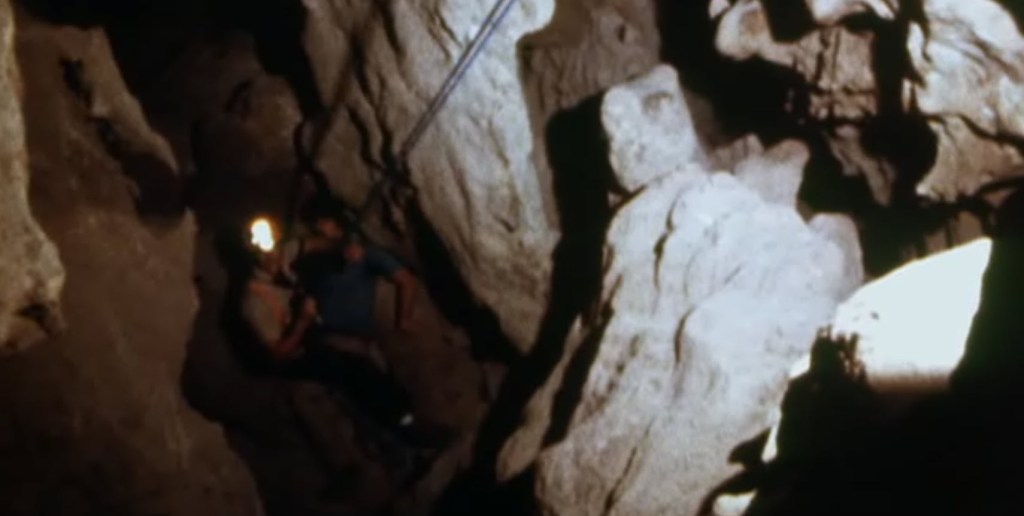
After spending some time with real footage, it was back to some staged stuff with the rescue of a young man who fell while exploring a cave. Considering he fell about 90 feet in a pretty rocky place, that guy is 100% dead. Gross says he included this story for a couple of reasons. One, the ill-prepared will not do so well in nature. Two, some seek danger and thrills and Dr. Gross wonders if it’s a latent death wish in people. Speaking of more nature and more fake stuff, we see someone trying to feed a bear. Because people don’t think of bears as what they really are, cold-blooded, cocaine-addicted murderers, it attacks because people are stupid.
Now it’s time to turn our attention to how the Earth is also trying to kill us! Volcanoes, flooding, tornadoes, and more are trying to shake humanity off the face of the planet like a dog shakes fleas from its coat. The most frightening of the footage was from a tornado that ripped through a Mississippi town and then caused a massive fire that wiped out more of the town. Nearly 600 people died. That’s followed by a high-rise fire that shows the desperate people taking their only way out of the burning building – by jumping out of the windows to their deaths. That footage of the people leaping from their apartments definitely felt more real.
We next take a stop at World War II when, on one side of the world, you have Hitler and the Nazis out there killing everything and everyone, and, on the other, you have the Americans eventually creating the most destructive weapon in the history of the world. This takes the time to talk about Hitler’s march through Europe. This is where real footage of the liberation of concentration camps and what was found there in terms of the slaughter of the Jews and others who were found in mass graves. It should also be stated that some of the first people outside those who liberated the camps to see the footage of what was found inside those camps were the people making the film Judgment at Nuremberg. That was about 1960 or 1961. So, yeah, that’s how gruesome that footage was that it was mostly kept out of the public eye for a couple of decades.
The next “face” of death is disease, famine, and poverty. Rats caused the plague. Bats spread rabies. I’m surprised mosquitos are not brought up as carriers of malaria which kills more people than any other disease. A lot of footage of the hungry in Africa that is really tough to see. Next, we learn a bit about how cancer is the modern-day plague that requires a great deal of further study and slow progress toward a cure, but the concern is that our own technological advances are what is causing cancer to begin with.

The penultimate section of Faces of Death contains some of the most controversial stuff. These are accidents caused by modes of transportation. It starts with real footage of a skydiver falling to his death after his parachute malfunctioned. Dr. Gross says the medical team attending to the man on the ground said he died painlessly as he entered cardiac arrest before hitting the ground. This just serves to replay the footage of this poor son of a bitch flailing through the air and for Dr. Gross to say, “I disagree. Look at his flailing in slow motion!”
There is some faked stunt footage of what was supposed to be a controlled car crash that led to the driver being killed. There is footage of drailed trains with some seemingly grizzly stuff shown of people trapped in the rubble. Some of this is real bodies being dug out of the wreckage.
But that’s not the footage that is most reviled in the movie. While this is almost singularly pointed out as the worst bit of footage, I actually didn’t remember it. After all, I have been used to seeing some pretty gnarly traffic videos thanks to driver’s ed classes making sure we see how nasty it is to suck at driving. But this was decried as the low point of the movie. It features the actual newsreel footage of the cleanup of a woman who was riding a bike, struck by a semitruck, and then dragged under the wheels making her unidentifiable.
The camera pans over this and lingers on the body under the trailer. It stays relatively stationary as it watches a woman with a camera taking close up pictures of the body so we still see the mangled corpse. We then watch two first responders lift the body that seems to be just a bag of blood and broken bones and liquified organs so she can be placed onto a stretcher to be loaded up into the coroner’s vehicle. But the thing that punctuates this scene is one of the people cleaning up the scene scooping bits of skull and brain into a bag. The camera zooms in to make sure we get a really good look at that grossness. It’s quite disgusting.
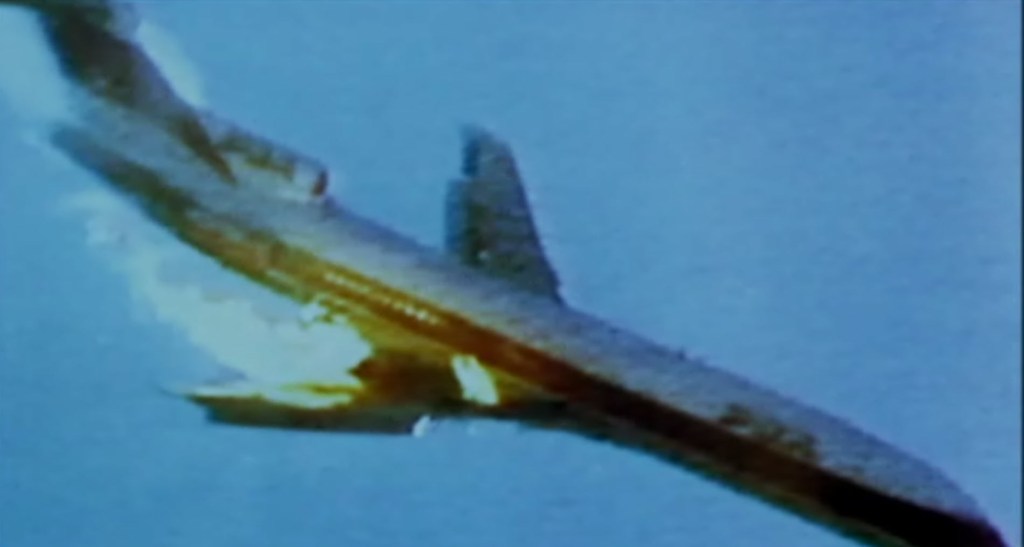
Some footage of a small plane crash with the dead bodies of the novice pilot and his friends pulled from the wreckage is shown before we get to an incident that took place about six weeks before the release of Faces of Death. Pacific Southwest Airlines Flight 182 crashed on September 25, 1978, after a mid-air collision with a private Cessna plane over San Diego, California. All 144 people from both planes died. It’s still one of the worst commercial airplane accidents in history.
Obviously, little footage can really be taken from the accident itself. A picture of Flight 182 on fire and heading for the ground was captured, but what is mostly used in the movie are still images and the radio transmissions from the plane to the control tower. Film footage was then obtained after the accident to show the damage to the residential area of San Diego and the bodies strewn across the ground. The wreck was so bad that it took a long time to find all the bodies of the passengers from being thrown all over the neighborhood where the planes came down. There are quite a few unrecognizable hunks of bloody something or another on the sidewalk or in the streets.

The final minutes of Faces of Death cover the concept of life after death. We’re introduced to “Joseph Binder”, an architect. He tells the story of the death of his young son by way of being hit by a car eight months previously. Three weeks after the loss of their son, Joseph’s wife committed suicide. As he healed, he says his house turned into a living nightmare. He claimed he saw ghosts and heard chilling sounds in an otherwise empty house. So, bring in the ghost hunters!
After two weeks of investigation, evidence of Joseph’s lost family was recorded. Cameras caught two ghosts, recordings caught audio of Joseph’s wife and son, and some flour spread across the floor captured footprints of ghosts. So they called in a psychic medium who gyrates around, makes funny faces, and becomes possessed by Diane, Joseph’s wife, and then his son. This is all very real footage. The weird way in which the voices of the dead reverberate and the blue and green lines that outline the medium when she gets possessed? Totally real.

Dr. Gross says after seeing the photos of the ghosts, he reevaluated his concepts of an afterlife. He began seeing life as a forever cycle of birth, death, and rebirth. And the movie ends with some pleasant music about life going on while we look at stuff from nature and babies and mothers and stuff.
So… Yeah. Faces of Death, huh? Yeah, this “documentary” doesn’t really hold up, nor does it really work at all. It’s undeniably one of the more important cult classics of the 70s era of horror and exploitation. The problem, though, is that there should be no living (or dead) soul on this planet who believes that everything packaged here is real. The stuff that isn’t real VERY much stands out as not being real. Those segments are poorly acted or just over the top. Only those who are still impressionable children would view absolutely everything in this as real.
And maybe that’s who this documentary works best for? I guess? I saw it when I was a kid. I don’t know if I believed it all back then either, but there is this kind of morbid curiosity kids get with death and seeing dead bodies. Maybe it’s due to the horror movies you see or maybe it’s something of a passage in life you need to take. Maybe it’s part of your innocence that kind of needs to die so you can really begin maturing and growing up. I dunno, but I do know a kid killed another after luring him into a wooded area and then blamed seeing this movie as his inspiration. However, the kid also had a lot of other problems. He got locked away and denied parole many times over due to those problems. No, I really do think a lot of young people, maybe it’s mostly boys of certain generations, get really curious about what death really looks like.
But as an adult, the real footage is, at best, kind of interesting, and at worst, really tasteless. The suicide footage of Mary Ellen Brighton, the slow-motion replay of the doomed parachuter, and the poor girl ground up in the wheels of a semi are definitely tasteless. It’s there to entice people to get through the fake stuff so you can get to the really good stuff with patience. It’s not really serving any purpose except to shock the audience.
The worst sin Faces of Death commits, though, is being boring. It’s got a whole lot of stuff in it and maybe too much. We cover just about every category of death from nature to war to disease to getting into an ill-fated airplane flight. Because there are so many categories and then the filmmakers wanted to tell stories to elaborate on the categories, it can’t stay on any one topic long enough. Instead, there are times in which it’s just looking at footage. There could be many more layers you can delve into but the movie either can’t due to time or just isn’t interested in doing so.
Maybe there is still some morbid curiosity surrounding it, but the movie is just not good. I am trying to think back about 35 years or so to try to find out what that version of me thought about this movie. How did I react to this movie? Did I think the cult that ate people to gain immortality was real? Surely not, right? I wasn’t that stupid, was I? I definitely know I thought the monkey brains was real. I also probably thought the guy who got gunned down by the cops after killing his family was real. It looked real. But, surely, I didn’t think all the most obvious fake shit was real.
Speaking of that guy getting gunned down by the cops after killing his family, that was very well done as a segment. It wasn’t real but I can only confidently have said that without looking it up because of how the scene continued on to discover the family dead on the floor. That said, the outside standoff and shoutout were very well shot and acted. I will give that fake scene its proper due.
I dunno… I don’t think I will ever watch this again and I doubt I will recommend it to anyone other than for passing curiosity and to see one of the most famous cult classics ever made despite that quality. So I think I’m done here. Maybe we will someday dive into Faces of Death II, but I’m not interested in that any time soon. Next week, we delve into some Troma beeswax as I exclaim that Surf Nazis Must Die!
Until then, remember the immortal words of Dr. Francis Gross: “Faces of Death be scary, yo.”
 bmovieenema.com
Ah yes, I remember it well. Bunch of teenage edgelords, stoned and looking for something cool in between watching The Wizard of Gore and I Spit on your Grave. Good times.
Surf Nazis next week? Can’t wait.
LikeLiked by 1 person