Remo Williams: The Adventure Begins (1985)

Welcome to yet another B-Movie Enema, my dear Enemaniacs! This week, we’ve got ourselves a real adventure. In fact, the title says it begins here. What it doesn’t say is that it also ended here. That’s right, I’m going to be writing many, many words about 1985’s Remo Williams: The Adventure Begins!

Where to start? Well, let’s start with our titular hero. Remo Williams is the lead character in a series of pulp adventure novels that go back to 1971’s Created, The Destroyer. He was created by authors Warren Murphy and Richard Sapir. Sapir wrote a handful of other books, but none were as popular as his Remo Williams co-creation. Murphy, on the other hand, is a little more interesting.

Murphy wrote the screenplay for 1975’s The Eiger Sanction starring Clint Eastwood. In 1989, he worked on the story for Lethal Weapon 2 with Shane Black. The TV Series Murphy’s Law was also based on the Trace series of books that he also wrote. Most interestingly, Murphy would be married to Nancy Cartwright from 1988 to 2002, the pair having two children. Who is Nancy Cartwright, and why does that name sound so familiar?

Continue reading “Remo Williams: The Adventure Begins (1985)”

Krull (1983)

Happy Thanksgiving weekend, Enemaniacs! I’ve got a bit of a feast for you for this week’s B-Movie Enema review.

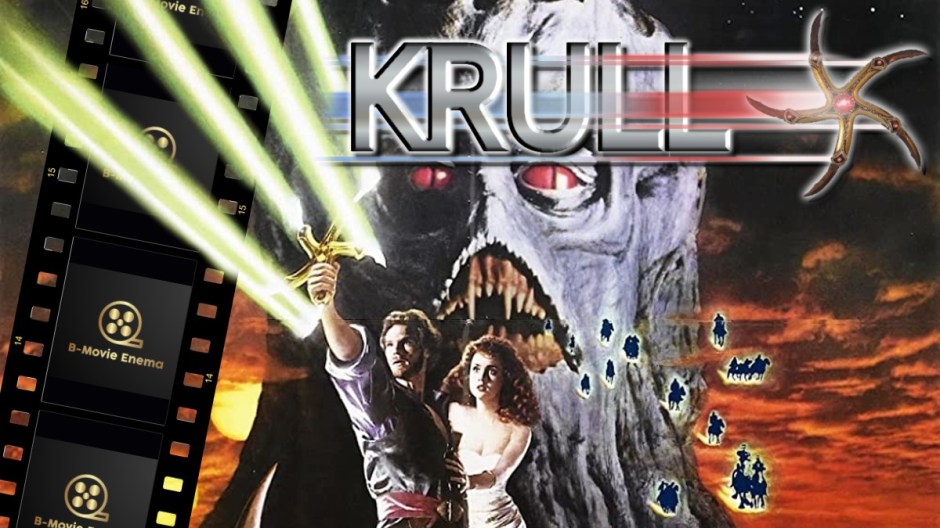
In the early 80s, there were a couple of phenomena going on. The first was the re-emergence of the sword and sorcery or sword and sandal movies. That was mostly due to the popularity of 1982’s Conan the Barbarian but I would also count 1981’s Clash of the Titans as also being an inspiration for the genre of fantasy action films. The other big phenomenon was the adventure sci-fi genre thanks to the huge success of 1977’s Star Wars and 1980’s The Empire Strikes Back.

If you really think about it, Star Wars isn’t really science fiction. More accurately, it would be called space opera. That means it’s a little more fantasy than true science fiction. Star Trek is the more true action science fiction type of movie where it both features some action and adventure but also tackles other concepts that are more sci-fi in nature. The advancements made in special effects also made for movies that could feature more lasers and spaceships and different types of creatures, though maybe the last one would be more due to advancements in makeup effects and artistry. That brings us to this week’s topic, 1983’s Krull.

Continue reading “Krull (1983)”

Black Snake (1973)

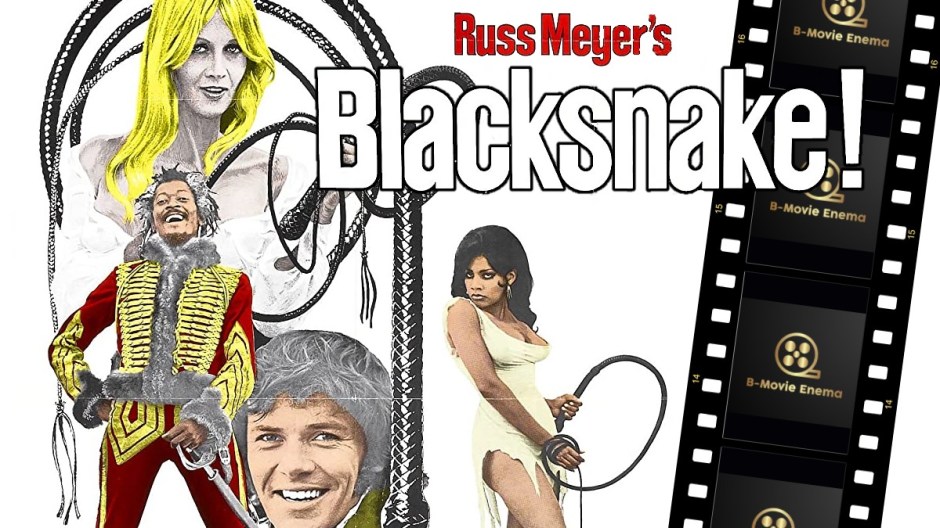
Welcome to the penultimate week of Russ Meyer Month II here at B-Movie Enema! We move from the 60s Russ Meyer sex comedies and romps to his 70s bigger budgeted and slightly more interesting films. This week, I’m reviewing 1973’s flop Black Snake.

This one is an interesting entry in Meyer’s filmography. I labeled it a flop. It was. Meyer was not unaccustomed to making a movie that wouldn’t perform well. Sure, maybe not all of his 60s films scored well with critics, but almost none of them were outright flops. As the 70s dawned, though, Meyer’s films would change. This would mostly be due to 20th Century Fox calling on Meyer to make actual studio-backed films. Beyond the Valley of the Dolls was the first and it was a hit – despite critics not really appreciating it. The next film for Fox was assigned to him after the original director had to back out. That film would be an adaptation of the book The Seven Minutes. Meyer’s friend, Roger Ebert, would write that the latter was not well-suited to Meyer’s affection toward eroticism. After all, it was a drama about law and freedom of speech. While the central thing in the movie did evolve around an erotic novel a teenager bought, it’s not really Meyer’s realm, even if the studio felt it was right for him based on the movies he made in the past and how he championed the abolishment of censorship.

The Seven Minutes was, by far, Meyer’s most expensive movie and it didn’t do well. In the end, it just didn’t work out. He would only complete one of the three films he was contracted to make for Fox after Beyond the Valley of the Dolls. The end was maybe on the horizon anyway. Black Snake would be his next movie and the first of the final five films he would ever make. While his next three would recoup some of his past magic, this film would prove to be a massive disappointment and bomb.

Continue reading “Black Snake (1973)”

Motorpsycho (1965)

Welcome to B-Movie Enema. This week, we enter week #2 of Russ Meyer Month II. Admittedly, last week was a rough one, and not a very good way to get things started. It wasn’t very good. It was hardly sexy. It was 70 minutes of exceptionally loose structure and too much plot for what we need from Meyer.

I have a great deal more faith in this week’s selection. The year is 1965. I would argue this was maybe the most important year in Meyer’s career. In the first half of the year, his 1964 German co-production Fanny Hill made its way stateside. The movie’s success was likely boosted by 1964’s Lorna which proved to be so controversial that it grossed roughly a million bucks on a $37,000 budget. Shortly after Fanny Hill was released, Mudhoney made it to theaters. That is a great little flick.

Later, in the late summer of 1965, Meyer’s most influential film, Faster, Pussycat! Kill! Kill! was unleashed to the world. It would inspire movies featuring bad ass women. It would act as a muse to the music industry for decades. Released one week later, but just before making Faster, Pussycat!, Meyer made another movie that would feature a roving gang of nogoodniks. That’s what we’re focusing on this week. This week’s movie, and the best title of all the films getting the review treatment this month by a wide margin, is Motorpsycho!

Continue reading “Motorpsycho (1965)”

Unmasking the Idol (1986)

Enema… B-Movie Enema.

That sounded a lot better in my head than it looked on the page. Hmm. Anyway, I’m a huge James Bond fan. When I was little, I remember getting my first looks at the Bond films on TV. At that time, I seem to remember more of the Roger Moore-era movies playing regularly than the Connery films, but I caught up with those older entries by the end of the 80s. It was then that I definitely remember ABC playing the movies on Sunday or Monday nights during the summer. What I didn’t see on TV, I’d rent from the video store.

This was around the same time as Licence to Kill hitting theaters and the first time I saw one of the movies in a theater. It was that summer that I became a huge Bond fan. I never looked back. Starting with GoldenEye in 1995, I started going to see each new Bond film in the theater with my father. I have a single tattoo on my body. It’s of a silhouetted James Bond in the famous gun barrel with his 007 logo under it.

So, when there is a movie like the one I’ll be reviewing this week, Unmasking the Idol, I’m immediately curious about it.

Continue reading “Unmasking the Idol (1986)”

Deathstalker II (1987)

Welcome to the final B-Movie Enema article for June!

So we spent a lot of time this month catching up with sequels to movies I’ve covered before. We started June with introducing ourselves to a series I’ve wanted to dive into for a while – Deathstalker. In the interest of keeping up with the whole point of this month, we’re going to round things out with Deathstalker II. If you think this is going to just be more of the same from the first film, well, you’ll be surprised to hear it isn’t. This is actually more of a comedy.

There could be multiple reasons why this sequel, that came four years after the original that was a success, decided to go this route. First of all, this was the final sword and sorcery film made in the Roger Corman-Argentinian deal. (To find out more about that, hit that link the paragraph above to read the review of that first film.) Honestly, the window had closed on these types of fantasy films by 1987. So why not try doing something a little different? Maybe wink and nod at the audience that these movies are kind of silly. Bringing Jim Wynorski in as director of this sequel certainly changes the mood. Wynorski’s pretty good at infusing a little bit of cheeky self-deprecation into his films. But then also the film was fairly low budget.

Continue reading “Deathstalker II (1987)”

Deathstalker (1983)

Welcome to B-Movie Enema, my friends! This month, we’re kind of setting aside time to cover two things. The first will be sequels to other movies we’ve covered in the past. The second is to cover the first movie and subsequent sequel in a series that I’ve been looking forward to dealing with for some time. It’s the latter that we are dealing with this week and the final week of June.

Hot off the heels of two quite successful sword and sorcery films in 1982, Conan the Barbarian (grossing somewhere near $80 million on a $20 million budget) and The Sword and Sorcerer (grossing around $40 million on a much more economic $4 million budget), audiences were hot for these types of movies. It’s kind of funny that the early 80s saw the rise in three distinct genres: fantasy, which sword and sorcery falls right smack-dab in the middle of, science fiction, thanks to Star Wars, and ninja action films. I think it’s safe to say that the fantasy genre lost the battle relatively quickly. More on that in just a moment.

It was thanks to Conan the Barbarian and The Sword and the Sorcerer that this week’s movie, Deathstalker, was made and was a modest hit, bringing in nearly $12 million against a $457,000 budget. This was brought to screens by Roger Corman’s New World Pictures. This was the first of ten international co-productions with Argentina. I’m not being facetious here, but I can’t name any other U.S.-Argentina co-productions. But this was definitely Roger Corman doing Roger Corman things. He quickly jumped on the fantasy trend and loaded this full of tits.

God, I love Roger Corman.

Continue reading “Deathstalker (1983)”