
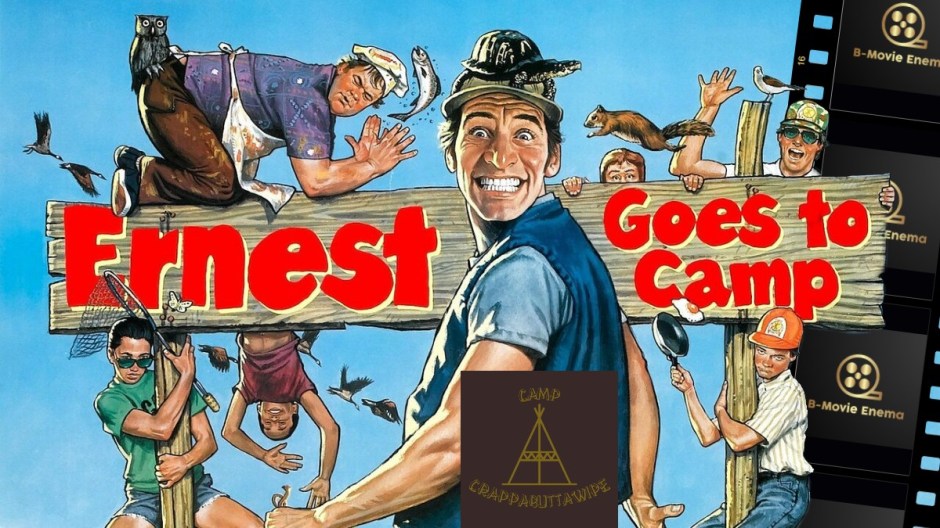
We close out the first month of Camp Crappabuttawipe at B-Movie Enema with one that falls into the column of “just for me.”
Despite the overly clever name of this theme summer, not all the movies that are getting covered here are truly crappy or butt-wipe material. No, I think we’ve already seen a couple diamonds in the rough already this month. However, sprinkled in amongst the slate for our summer camp shenanigans are a couple of movies that mean quite a bit to me on a more personal level. 1987’s Ernest Goes to Camp most certainly falls into that, um… camp.
The character of Ernest P. Worrell, played by American actor Jim Varney, was one of those creations that we see crop up from time to time. These are the characters specifically created by an advertising agency (Ernest’s creators being Carden & Cherry from Nashville, Tennessee) that are so popular or catch enough attention beyond the character’s original intention to promote various local businesses, that he becomes a national figure, used to promote global brands, and then launch that into a further pop culture footprint to appear in his own movies and TV shows. Most recently, I think GEICO’s Caveman characters were the last to attempt this, but think if Lily from AT&T or Flo from Progressive Insurance suddenly got to star in their own movies. That’s what Ernest was in the 80s.
Jim Varney, an actor from Lexington, Kentucky, was the guy chosen to be the rubber-faced local yokel Ernest P. Worrell. His schtick was that he was kind of a bumpkin who was always engaged in a conversation with the unseen character of “Vern.” During the course of these conversations with the mysterious Vern usually would include his catchphrases, “Hey, Vern!” and “Knowhutimean, Vern?” He was kind of that “aw, shucks” type of southern-accented character that was pretty easy to like. Varney had an easy way about him, and his way of speaking and the various ways he could contort his face could really get some genuine laughs from people.
While Varney largely worked various bit parts on various television shows before taking the role of Ernest, he ultimately ended up having a halfway decent career because of Ernest. At least, it was enough for him to score the role of Jed Clampett in the big-screen adaptation of The Beverly Hillbillies in 1993, the voice of the Slinky Dog in the first two Toy Story movies, and a beloved and quite memorable guest spot on an episode of The Simpsons in 1998. He was loved and appreciated by enough people that when his sudden death in 2000 from lung cancer was announced, it was quite sad.
But when it came to bringing Ernest P. Worrell to the big screen, the story is kind of amazing. In fact, the origin of Ernest Goes to Camp begins right here in my hometown of Indianapolis. You see, we have this thing here called the Indianapolis 500. Ever heard of it, Vern? It’s a big freakin’ deal… Knowhutimean? It was especially a big deal in the mid 80s and often attracted celebrities for the festivities. Well, one of these situations saw both Mickey Mouse and Jim Varney in attendance for the 500 Festival Parade that goes through the downtown streets of Indianapolis (the 500, you see, is run in a small berg inside the Indy city limits called, appropriately, Speedway on the west side of town). Varney was in his Ernest guise. When compared to Mickey Mouse, Ernest’s reception from people at the parade gave Disney CEO Michael Eisner and executive Jeffrey Katzenberg (the two men who brought Disney out of a decades-long slump to make it the juggernaut we know it as today) something to think about. In fact, they were quite impressed by how this yokel character seemed to be as recognizable and liked as Mickey freakin’ Mouse.
So, they came up with the idea. They met with John R. Cherry III, one of the creators of the character. Cherry and another guy by the name of Coke Sams had already made a movie called Dr. Otto and the Riddle of the Gloom Beam, which featured Ernest in a cameo. But with an actual studio wanting to back a larger film featuring directly on Ernest, Cherry and Sams were more than happy to negotiate. They landed on the idea of having Ernest play this kind of dope of a handyman at a camp because that would definitely assist in keeping the budget more affordable (you know, because fewer sets, more open spaces to film, etc).
Everything was coming up Ernest, buuuut… Varney wasn’t so sure. He was concerned about taking this character to this big of heights. He was afraid he would ultimately get typecast. To be fair… he kind of was right in what would happen after this movie’s success. Ultimately, he’d go on to make several Ernest movies, but, as I mentioned earlier, he did get a lot of extra opportunities from the success of the first few movies. I’m not sure if this was something that Varney often did or if it was over the nerves of making this film and what it might mean for his career, but Varney was known to go on drinking benders leading up to Ernest Goes to Camp going into production. However, all accounts said that he was actually quite good to work with on set and was quite professional during the film’s three-week production schedule.
Mostly, I would say Disney, by way of the film being produced by Touchstone Pictures, would be pleased with the outcome. They were frustrated with how much of Ernest’s dialogue was improvised, but the movie ultimately made a small bag of cash for the studio and would go on to become quite popular on home video. That’s where I would come into this story, and why this movie is included in Camp Crappabuttawipe’s slate of camp movies.
I didn’t see this movie in the theater when it was released in May of 1987. I went to movies a lot that summer and the whole year as a whole, but I didn’t see it until it hit video cassette rental stores. However, between rentals and cable, it became one of the all-time go-to movies for sleepovers with friends. It had lots of dumb kid humor, and Varney’s performance as Ernest is quotable as hell. So, yeah, after not having seen this movie in, probably, 35 years, how does it hold up? Let’s find out right now.
The movie begins “many lifetimes ago” with a Native American ceremony where a young man is tied to a wooden asterisk. A member of the ceremony throws a machete, then a hatchet, then fires an arrow at the young man. Because he showed no fear, he is now a man. The image of the asterisk-like symbol is now the symbol for Kamp Kikakee. Admittedly, I’m a little concerned about how many Ks are in that camp’s name, but whatever.
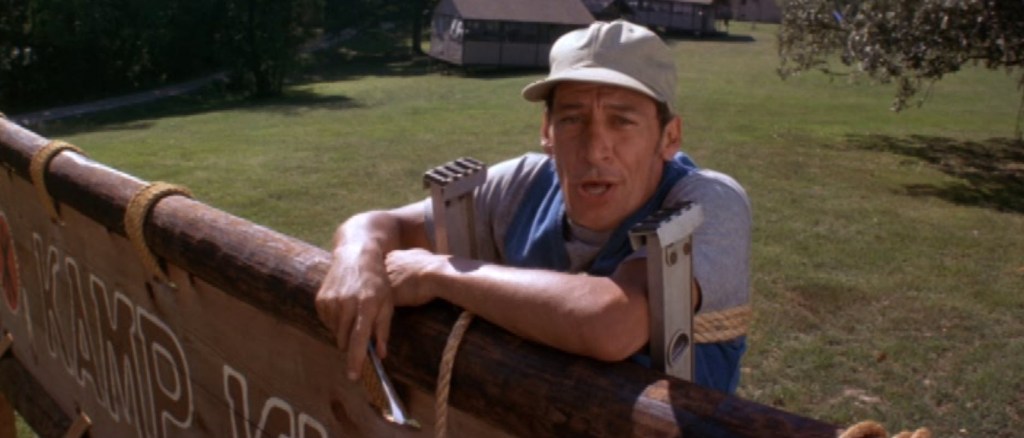
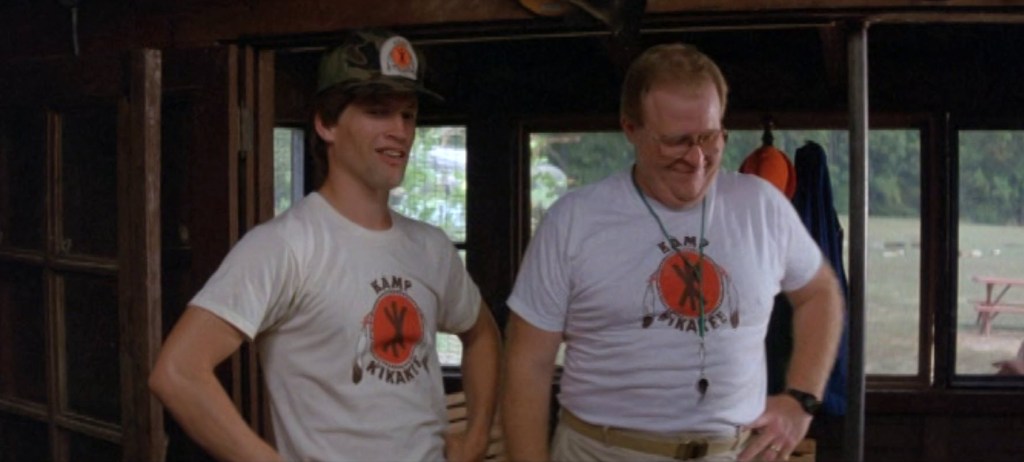
Ernest P. Worrell works at Kamp Kikakee as a maintenance man. He dreams of being a camp counselor. He takes a lot of pride in his work because he honestly cares about the camp itself and the Native elders who have owned the grounds for centuries. Now, as he works on the camp’s sign, he talks about how much he values safety. However, it’s really important while watching anything Ernest-related to realize that you cannot underestimate his… let’s call it… silliness.
For one, he’s working on the ladder on a tall slide alone. To move from one group of ropes he’s checking to the next, he is literally hopping the ladder, with him on it, to the left. Naturally, he fucks it up, and the ladder, along with him, goes tumbling backwards to the ground. Then, we next see him driving through the campgrounds on a cart… that he’s driving with his feet, causing him to knock over tents and trash cans all over the place. He pulls up to a bathroom to plunge a toilet. The cart was not fully stopped when he got out, so it drove off on its own. That’s important because the cart driving itself will become a running gag throughout the movie.
Whatever is in the toilet is one of the many facial expressions Varney makes in this movie that became the old school version of memes back when I was a kid. And by that, I mean we just all did an impression of him doing the “Ewwwwww” face. Impressions… also known as “analog memes.”
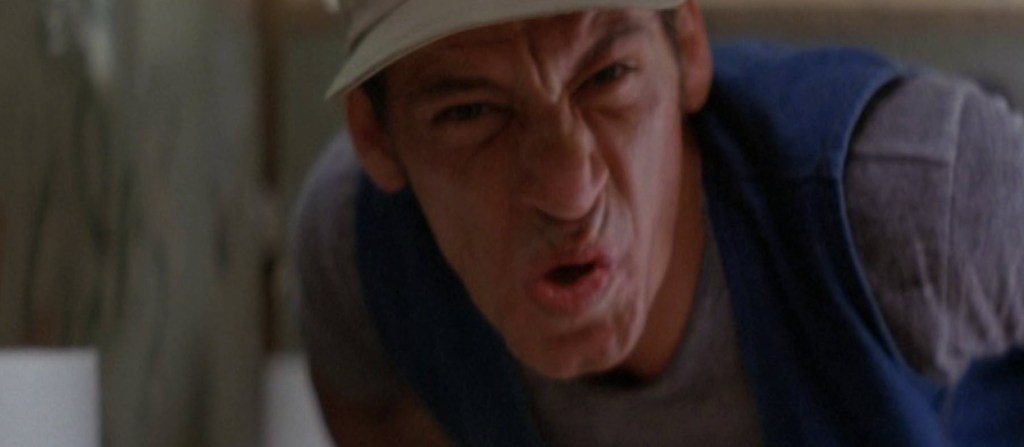
Naturally, Ernest struggles a bit with the plunging because the plunger gets stuck in the toilet. He’s crammed that sumbitch so far down the toilet, I’m not sure if he has it stuck in the pipes or if it’s stuck on the biggest of turds in human history. Anyway, he gets on top of the toilet to give himself leverage and then flushes the toilet to help him pull the plunger out(?), only for it to blow him off the toilet like a geyser.
So we got a little taste of what Ernest is and how he is kind of a moron. But we need to get the actual camp shenanigans. The kids arrive. It turns out that some of the older kids kind of mercilessly pick on Ernest, but he’s either so naive or painfully good-spirited to a fault that he thinks the older kids are something akin to friends. They shut his fingers in the bus windows, causing him to be stuck to the side of the bus for several minutes.
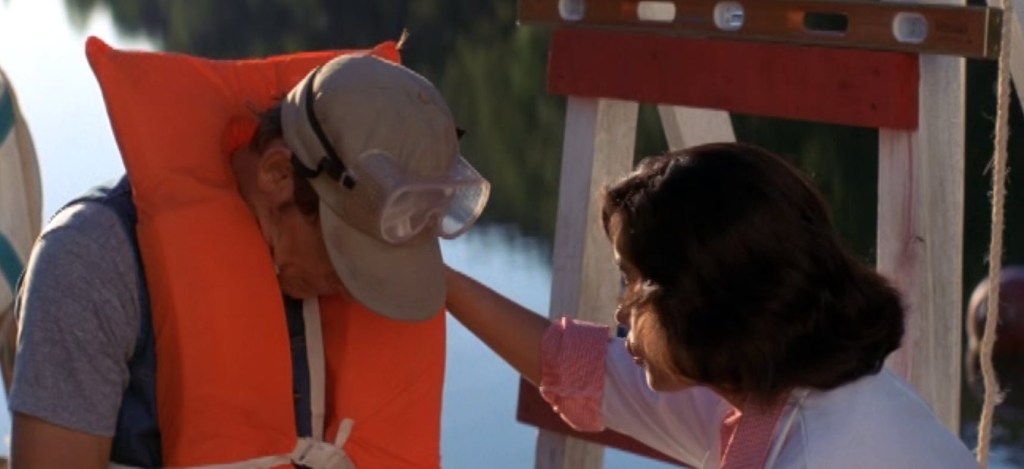
As I said, Ernest is very serious about his job because he really wants to be a counselor. He laments to his friend Nurse St. Cloud, a Native woman, who the script originally had a romantic subplot (and I really don’t think I want to see a character like Ernest be in a romantic situation), about knowing everything he would need to know to become a counselor, but no one will give a guy a chance. Nurse St. Cloud’s grandfather is the rightful owner of the grounds the camp is on. It’s why the camp honors the traditions at the end of each season that we saw at the beginning of the movie, which specifically uses a “blade, stone, and arrow.”
This year, Kamp Kikakee is participating in a Governor’s program called “Project Second Chance.” They are to take in a group of kids who are basically in juvenile detention. Head Counselor Tipton is more than happy to bring these kids in, even if the other counselors and campers think the kids are no good criminals. Tipton is one of these types who believes the right series of activities will build character and that every kid is, deep down, good. So he assigns Kamp Kikakee’s resident Andy Samberg, Ross Stennis, to watch after the Second Chancers.
Tipton sends Ernest over to pick up the Second Chancers. The “delinquents” are largely just outsiders by the looks of them. They are dressed like members of the Brat Pack. But anyway, there is the ringleader who has been in and out of just about every institution in the state, Bobby Wayne. Next, we have Crutchfield, a pickpocket. Then Danny, a member of a family full of criminals and lowlifes. Next is Chip Osgood, labeled the “Albert Einstein” of the group. Bubba “Too Cool” Vargas is… well he’s the Hispanic one? I’m not sure what the story is with Bubba. Lastly, we have Moose Jones. He’s a little tiny kid whom the others made carry their bags. The warden only says he’s the runt of the litter, but he seems to talk to the warden with respect.
While driving back to Kamp Kikakee, the Second Chancers, completely and totally unsupervised by the State, I might add, decide to pull a prank on Ernest by covering his eyes while he is driving.
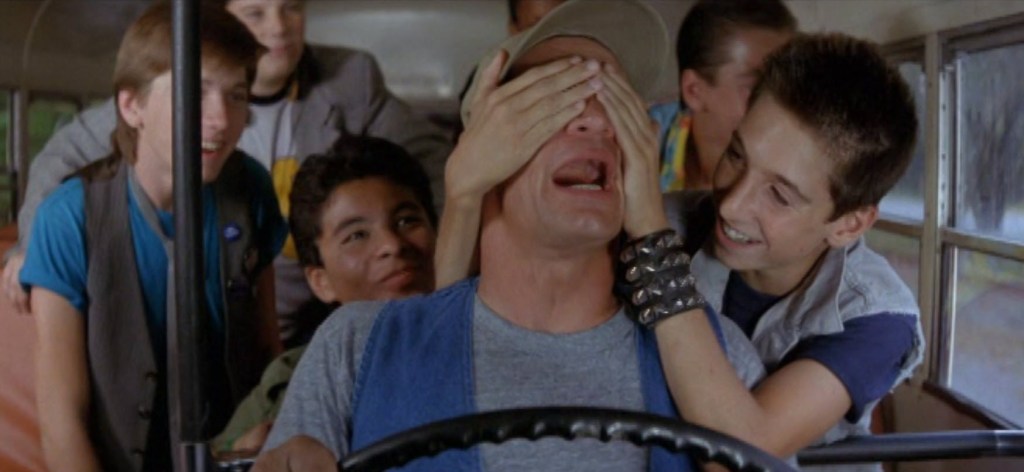
Somehow, Ernest is able to drive the bus all the way back to Kamp Kikakee without incident. When he finally guesses the right kid covering his eyes, he turns around to talk to the kids about how good he really is at this game. This causes him to have to slam on the brakes to avoid running right into the back of another bus. This leads to another incredibly memorable moment when he slams on the brakes, falls forward on the steering wheel, then falls out of the driver’s seat, hitting the door handle on the way by, and falling out of the bus onto the ground. Each one of the Second Chancers steps onto Ernest on the way off the bus.
Tipton scolds Ernest for not being able to complete this one simple task without incident.
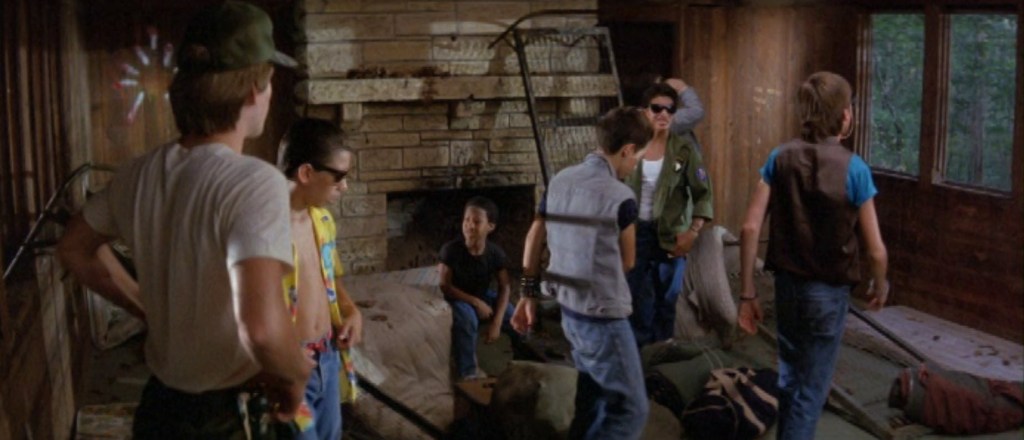
Now, Ross is specifically trying to make the Second Chancers not feel welcome. Despite Tipton being optimistic, Ross, the other counselors, and the campers all look down on the Second Chancers. Ross has even assigned these kids the dirtiest, most rundown cabin. Some of the teenage campers start some shit with the Second Chancers when they target Moose in the mess hall and trip him. This leads to a fight. Ernest tries to break it up, but the kids just attack him with their trays.
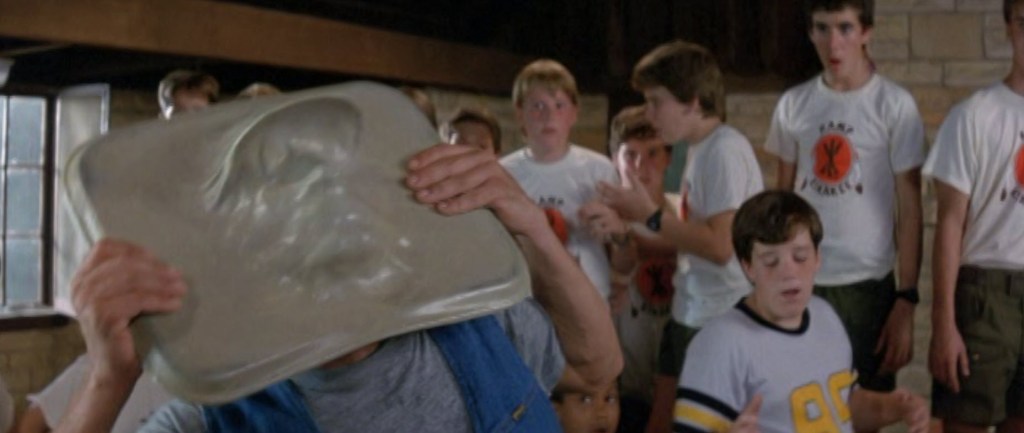
To get Ernest’s face unstuck from the tray, Osgood uses a cast-iron skillet to hit Ernest in the face. This sends him reeling backwards into the Coke machine before falling to the ground. Followed by the Coke machine falling on top of him.
Later, as punishment for starting a fight, even though the other campers technically were the original aggressors by tripping Moose, Ross has the kids dig a trench. But Ross ends up going a bit too far in his poor treatment of the Second Chancers. At the lake, Ross makes the Second Chancers jump into the lake. Moose doesn’t jump in because he can’t swim. So Ross throws him into the water anyway. Seeing that Moose is flailing and drowning, Ernest comes to save him. To get him back for dumping Moose into the lake, the kids push the lifeguard stand backward with Ross on it. It ends up getting his leg broken.
Tipton refuses the request from the other counselors to send the Second Chancers back to the detention facility. They are short-staffed anyway, so there is no counselor who can appropriately look after these kids. One of the counselors comes up with an idea. Ernest wants to be a counselor? Then he can be the Second Chancers’ counselor.
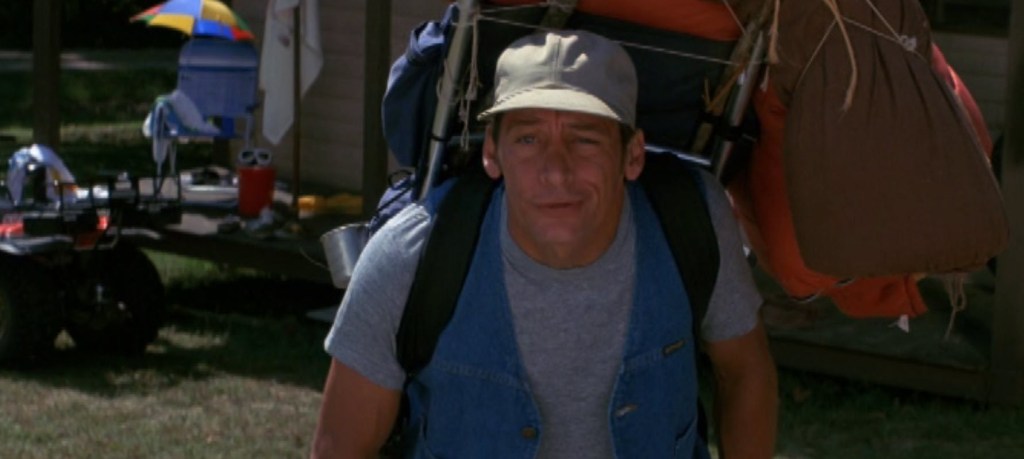
While the older Second Chancers aren’t so sure about Ernest, Moose, because Ernest saved him from drowning, is the first to think he’s not so bad.
Alright, so there’s a second plot going on here. Sure, we’re here for Ernest becoming a counselor and winning these juvenile delinquents over to be better citizens, but there’s a whole other thing going on. Elsewhere, we meet Sherman Krader. Krader (played by 80s stock villain John Vernon) runs a company mining petricite. There is a large deposit of petricite outside of Kamp Kikakee. But there’s an even larger deposit of the stuff AT Kamp Kikakee. This company has been trying to negotiate with Chief St. Cloud, but he will not budge for any price. So Krader is going to come up with some more aggressive plans.
Speaking of aggressive, if there is one thing that this movie is known for, it’s Ernest antagonizing a family of badgers. He takes the Second Chancers on a hike. During the hike, he finds a family of badgers. He tells them that while they look cute and cuddly, they are quite dangerous creatures. You certainly should not get up in their face and do a strange facial expression with a stuttering series of gibberish, like Ernest does to get them to chase him through the woods.
While the Second Chancers initially consistently belittle and prank Ernest, they do eventually warm up to him. If nothing else, he kind of entertains them. He gets hurt. They can do first aid in funny and inventive ways. Sure, they still take him for all he’s worth in a game of poker, but they don’t seem to dislike him like they did Ross or the other campers.
There is another duo at the camp that is good for some silly fun and a few laughs. They are the chefs, Jake and Eddie. Jake is constantly talking about the one dish that has eluded him for years, Eggs Erroneous. While Jake is willing to throw anything together to create a meal, Eddie has the personality of a quiet mad scientist. He can hear an ingredient and figure out what it would do compositionally in the mix with the other foods. They’re making gross stuff and even building a machine that can basically make any meal that they throw ingredients into it. I remember thinking they were also kind of goofy funny when I was a kid. I would almost say they are only here to help fill out the runtime, but I actually remember that a lot of things seen throughout the movie that seem unnecessary to the plot kind of come together in the climax.
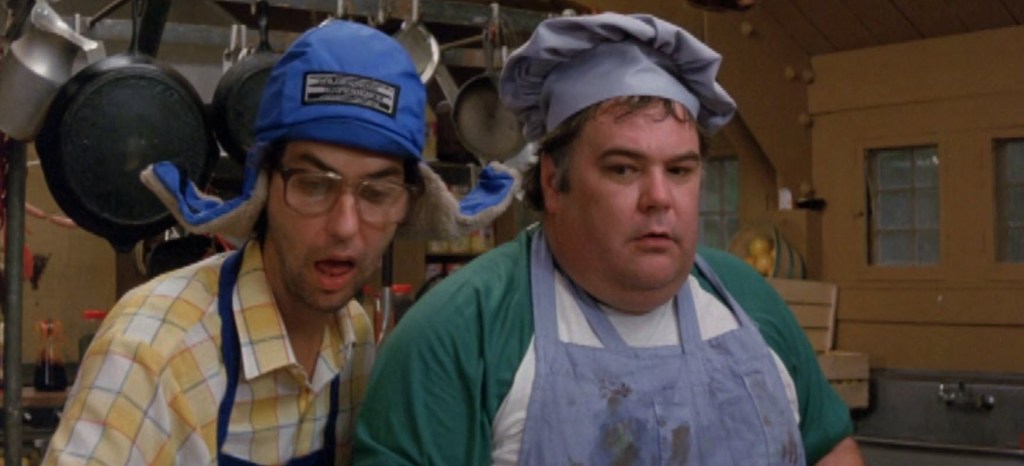
Tipton announces the big summer project. Each cabin will be asked to create something to be judged by the counselors that best represents what Kamp Kikakee stands for. Last year, the winning cabin made a full Indian headdress. Ernest is excited to compete, but the Second Chancers know that they can’t win no matter what because no one wants them there. So why even try? Ernest, not allowing this attitude to get in the way, comes up with an idea to build a full, authentic tepee.
While planning his tepee, Ernest sits for a picnic with Nurse St. Cloud and the Chief. He gets attacked by fire ants. While he recouperates from the bites in the nurse’s station, the Second Chancers bring him a get-well present in the form of a plant. When they leave, Nurse St. Cloud reveals that they gave him poison ivy. Nurse St. Cloud scolds the boys for playing a cruel prank on him.
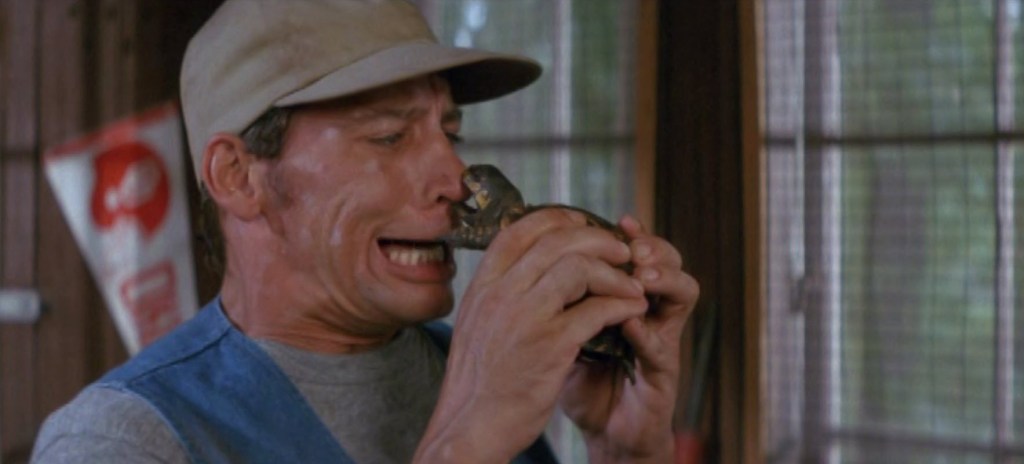
While Ernest is lamenting how he can’t get the Second Chancers to like him, no matter how hard he tries, to his turtle, Pokey, the turtle bites him. The Second Chancers come in to talk to Ernest, and he tells them that the only way to get the turtle off his nose is to sing it to sleep. This is the first of two kind of inexplicable musical moments in the movie when the boys sing The Turtles’ “Happy Together.”
But when the other campers make fun of the Second Chancers for not having anything to enter in the camp contest, they decide now it’s time for them to work with Ernest to build that tepee he suggested. The tepee is really good-looking. It impresses Tipton and Nurse St. Cloud says that all they needed was something to be proud of to help turn things around for them.
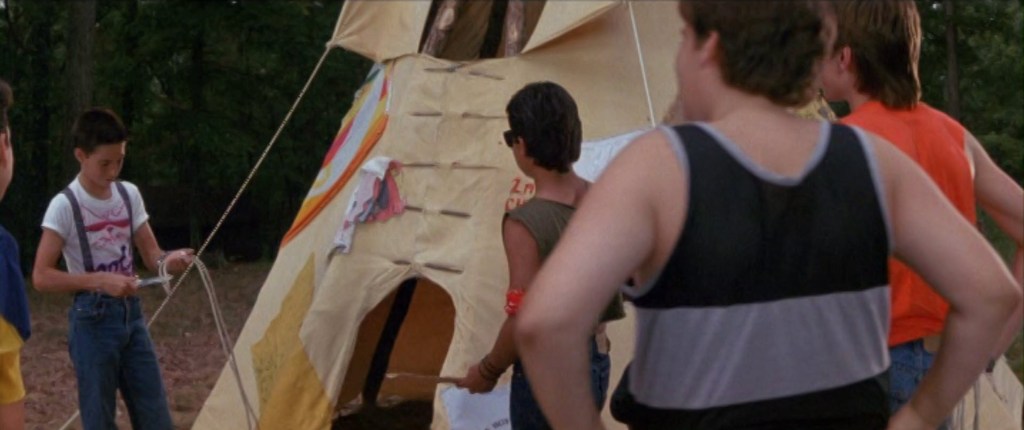
Some of the other campers find out about what the Second Chancers are doing and come up with a plot to sabotage the tepee. Also, Krader is more and more desperate to get Chief St. Cloud to sell the land. If his property lawyer can’t get him to sell and vacate so they can mine the land, then he’ll just have to get more creative.
The other campers burn down the Second Chancers’ tepee. To get back at the kids, they go to their cabin and start a fight. Tipton is ready to send the kids back to the detention center for the sake of the other kids, if for nothing else. Ernest pleads for one final chance. Tipton grants it, but both the Second Chancers and Ernest, as a counselor, are on thin ice.
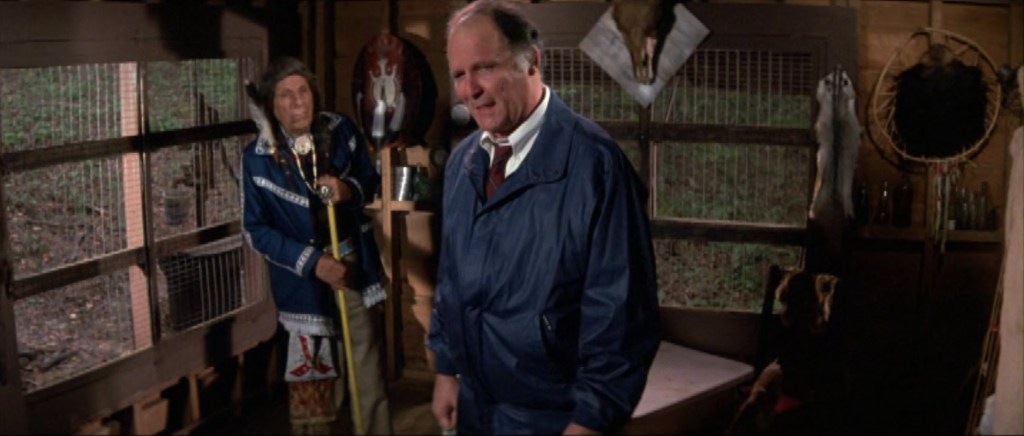
Meanwhile, Krader decides to negotiate with Chief St. Cloud personally. Krader continues to increase the royalties for the petrocite that Krader will mine out of the property. When Ernest stops by, not realizing what Krader is doing there and who he is, Krader realizes this dummy can communicate with the Chief. He tells Ernest that he’s some sort of official and not an evil businessman. He convinces Ernest to convince Chief St. Cloud to sign the lease over to Krader.
Krader moves in pretty much immediately to start mining the land. When Tipton is making the announcement to the campers, he mentions that the only way the Chief would have signed the land over would be if he was fast-talked into it. Nurse St. Cloud realized that it had to have been Ernest since only she and he could communicate with her grandfather. Ernest promises to fix it, but when he tries to rough up the Krader foreman, played by NFL tough guy Lyle Alzado, he gets his ass handed to him.
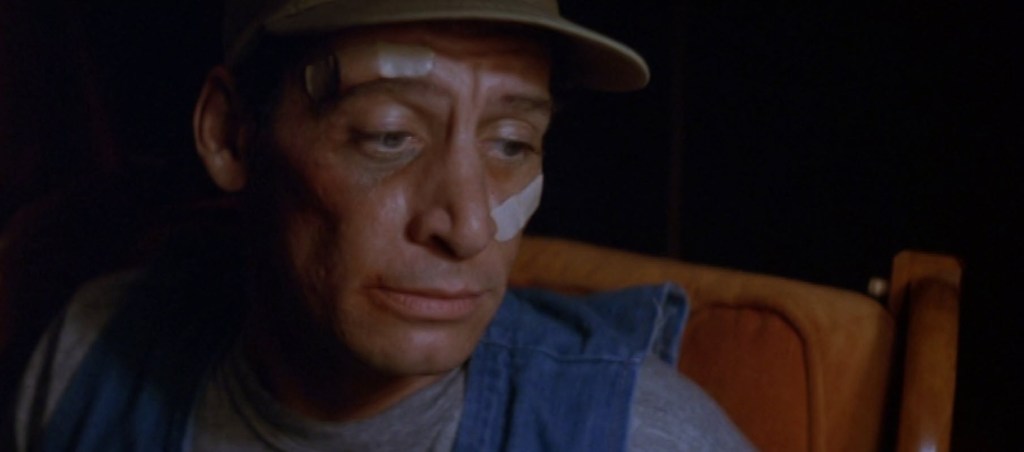
Nurse St. Cloud patches Ernest up, and he tries to be tough, but ultimately breaks down, saying he’s lost everything he ever wanted in an instant. He returns to his cabin for the second musical moment of the movie. Ernest sings a song about how he’s glad it’s raining because no one can see the tears he’s crying. This movie was really shooting for an Oscar.
Nurse St. Cloud sees that the Second Chancers are still in their cabin, refusing to leave. When they comment that Ernest is stupid, she tells them they are the stupid heads because they don’t know that he was the only one in the world who cared for them. They go to see Ernest and convince him to come up with a plan to save the camp.
The plan is to fortify a bus into a rolling fortress. On it, they have a giant catapult. That’s not all, though. They also get help from their rival campers. Even Jake and Eddie bring their food-making contraption to launch stuff at the Krader guys. Chief St. Cloud paints the kids with warpaint while his granddaughter begs him to not put the kids into danger. Ernest tells her there is no way they are going to let Krader have the camp.
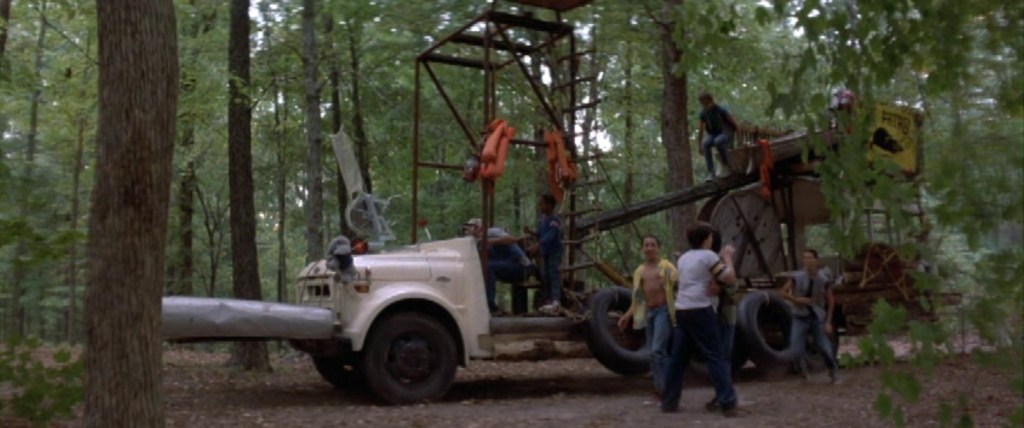
And yeah, all this shit being launched from the cooks’ food machine and the Second Chancers’ catapult creates all sorts of chaos. Maybe not as much as the turtle paratroopers. Yes, Pokey and other turtles are equipped with parachutes and launched to parachute down and bite the faces of the construction workers. Even the toilet from the beginning of the movie makes an appearance as Ernest loads it onto the catapult while Bobby lights the shit in the pot on fire.
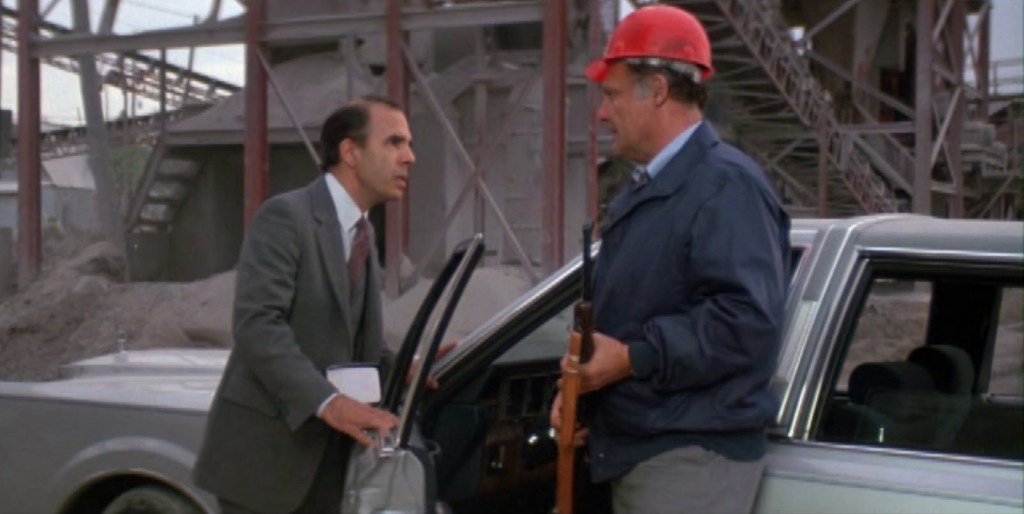
The construction team calls Krader to report the chaos. They especially need to report the turtle paratroopers because those little mouths hurt when they latch onto faces! Anyway, Krader has had enough of this shit. In classic cartoonishly evil capitalist bad guy behavior, he is getting his rifle and ending this, no matter the number of dead children he has to personally put down.
Jake and Eddie are taken out of the battle when Lyle Alzado drives Killdozer through the camp and crushes their food machine. He then begins to demolish cabins. That runaway cart returns, and Bobby gets an idea. They load a bunch of explosive shit onto the back of it, and Ernest uses the vile Eggs Erroneous to light it on fire. He runs the cart into Killdozer, and it explodes. Lyle Alzado climbs down, and Ernest knocks him out.
Krader shows up with this gun. Krader is a sharpshooter. So when he shoots at Ernest, because he believes in the ancient god of the local Indians, much like with the ceremony at the beginning of the movie, he is unharmed by the bullets. Shocked, Krader runs off. Nurse St. Cloud arrives with a judge’s order to reverse the order for them to leave. Soon, it’s all settled, and Krader’s attorney explains that he lied to the Chief to obtain the land, so everything is fixed.
For their part in saving the camp, the Second Chancers are allowed to stay at Kamp Kikakee permanently, and Ernest is now a full-time, year-round counselor.
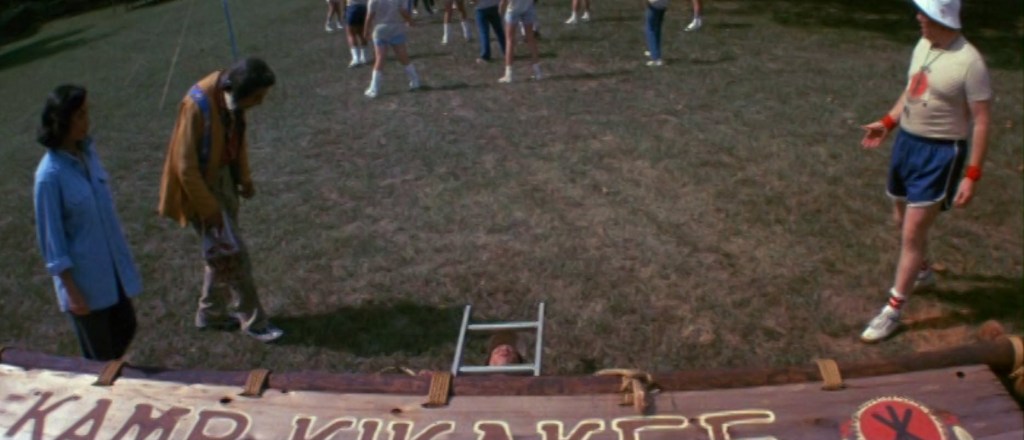
He’s still kind of a bumbling idiot, though.
It might have been three and a half decades since I last saw this movie, but, honestly, it still has a few good laughs left in the tank. We can maybe squabble here and there about the largely white campers and camp counselors being the keepers of an Indian tribe’s traditions… Yeah, that’s not great, but the messaging around this movie isn’t necessarily a bad one. You have troubled kids learning to do something good and being, at least, slightly better citizens. There’s a teamwork element to saving the camp in the climax. It’s not that bad of a movie.
I think how anyone today could possibly feel about this movie will come down to one thing, and one thing alone… Do you find Ernest funny? Forty years ago, I grew up in the thick of his popularity. Would a kid today find him funny? I don’t think you need to understand who Ernest is to get the joke. He’s a bumbling fool. He makes funny faces and has funny ways of saying things. His turtle bites his nose, and he can’t pull it off his face. I think just about anyone would see the humor in what Varney does with Ernest. I think it also kind of helped Varney kind of bridge two generations: Gen X and Millennials.
Still, I think this movie mostly works as a slapstick comedy. It’s not a masterpiece, but it’s actually kind of wholesome for the types of humor it touches upon. There is toilet humor as well as some gross-out humor. Lots and lots of physical comedy is deployed here, but no nut shots or anything like that. It still conjures up some memories of those old sleepovers where I would choose to rent this at Videoland and have it as part of the movies scheduled.
It brought back some pretty good memories.
Next week, we go for another camp comedy. In 1979, Bill Murray was incredibly popular on Saturday Night Live. As he was making people laugh on TV, it was time for him to see if he could do the same on the big screen. In the first of six collaborations between Murray and comedic writer genius Harold Ramis, Ivan Reitman directed Meatballs. And I think that sounds delicious for Camp Crappabuttawipe. So join me in seven days for the first Reitman-Ramis-Murray collab!


As a 90s kid I remember the Ernest commercials on TV and his movies. And of course his voice acting in Toy Story. 4 years ago I was able to get 2 of my friends to watch Ernest Goes To Camp for their first time as adults and they liked it.
LikeLiked by 1 person
I was surprised how the same scenes made me still laugh as hard as I did as a kid. It was a fun one to revisit for sure
LikeLiked by 1 person
I own the 4 Ernest movies that were financed by Disney. Goes to Camp to Scared Stupid
LikeLiked by 1 person