
Looks like we made it!
Every year at B-Movie Enema, you can expect two things. First, October will have a theme. Second, Halloween is a special time of year. So much so, I will throw in a special Halloween review for bonus times. Well, once you realize that I chose October 2026 to be “Rob Zombie’s Spookshow,” you had to know what that meant for this weekend, right now, right here.
Yes, it’s time to talk about Rob Zombie’s Halloween from 2007 (with, of course, the sequel coming tomorrow for the holiday itself).
To say these two movies are divisive is an understatement. I have a mixed opinion myself, which I will get to throughout the course of the review, as well as summarize tomorrow when Halloween II inevitably serves as the Halloween special review. What I do not have mixed feelings about, though, is how I feel about 2002’s Halloween: Resurrection. I hate that movie so much that it became the very first Halloween special review way back ten years ago. It was on AMC Fear Fest. It was the first time I watched the movie in years. It pissed me off.
Bada bing, bada boom… Halloween tradition.
After Resurrection, there were various ideas of how to continue the franchise. In 2003, Dimension Films had an idea to crossover Halloween and Hellraiser. 2003’s Freddy vs. Jason was going to be incredibly popular (both franchise’s highest grossing movie, to be accurate). There was some interest in testing the waters to completely revive the monster mash style of movies from years and decades past, but that fell through. The idea actually fell through BEFORE Freddy vs. Jason came out. The heads of Dimension poo-pooed the idea, believing that the first slasher crossover would bomb. The original idea would have been interesting because the concept would have seen Clive Barker writing the script with the hopes that John Carpenter would be interested in returning to the franchise to direct. After Freddy and Jason hit big, Dimension asked the fans directly. 52% of the fans decided that they were not interested in the concept. Then, Moustapha Akkad, the head of the Halloween franchise, ultimately disapproved of the idea.
Akkad was still interested in a ninth film in the franchise. Ideas were thrown out to potentially bring back characters like Jamie Lloyd or Freddie Harris (played by Busta Rhymes in Resurrection). They also considered going back to the era after Halloween II and before Halloween 4, to fill in that gap in the continuity. However, when Moustapha Akkad was tragically killed in the 2005 Amman hotel bombings in Jordan while he was attending a funeral, his son, Malek, now in charge of the franchise, decided to try something new.
In June 2004, Dimension officially announced that Rob Zombie was now in charge of creating the next installment of the franchise. It wasn’t going to be a sequel. It was going to be a remake. But I would argue it was never intended to be that either. It was uniquely going to be a Rob Zombie reimagining of Halloween. Zombie was going to write, direct, produce, and be the music supervisor. He felt obliged to speak to Carpenter about this remake, and the word is that Carpenter urged him to “make it his own.” Later, Carpenter would have different opinions, but he was not above the idea of someone remaking one of his own unique visions.
The number one thing Zombie wanted to do was to reinvent Michael Myers in such a way that would make the character “scary” again to audiences. He felt Michael, along with other 80s horror icons like Jason, Freddy, and Pinhead, were so recognizable and familiar to audiences that they were no longer inspiring fear. If you think about how Zombie approaches maniacs… I have to say I was in favor of what he might do with this character. The character would need this reinvention to rely more on the terror the character could bring, instead of cheap jump scares.
Zombie also reinvents the characters around Michael. There’s a less archetypal feel to the characters of Laurie Strode, played by Scout Taylor-Compton, and Dr. Sam Loomis, played by Malcolm McDowell. Part of this is likely due to a sliding timescale for the setting of the movie. The original movie begins in 1963 and then picks up the main action of the film in 1978. This movie starts in 1990 and slides up to 2005. What constitutes the average American suburban family and teenage girl has changed. What you might expect the motives of the doctor treating a psychopathic child are going to be different. The circumstances that bred that psychopath were also different when you compare them to the original’s 1963 beginning to this one’s 1990 start. All of it was more cynical and, frankly, kind of unsavory. It’s all part of what makes this movie divisive.
The movie instantly made its budget back (and then some) in the opening weekend of the film’s release. Which, at the time, was also the most successful box office weekend for Labor Day in the history of film. That’s a notoriously weak weekend for the movie business. I think the hope was that this movie would have the legs to stay in theaters through the entirety of the Halloween season, but the wheels came off quickly after reviews and fan reaction came along. There was almost no repeat business for the movie, and the backlash it took from critics didn’t help matters at all.
But I don’t think sitting around talking about the idea, the production, the cast, the box office, or the critical reaction is going to really help try to work through the feelings this movie elicits, so let’s get into Rob Zombie’s vision for Halloween.
It’s almost impossible to talk about Rob Zombie’s new take on the John Carpenter classic without seeing what changes were made to the basis of Michael Myers. In the 1978 original, the movie begins with Michael as a young boy in a middle-class family, killing his sister after witnessing her take her boyfriend upstairs for sexy times. This occurred in the early 60s and then immediately transitioned to 1978 where we see he’s been locked away ever since, but escapes with a pathological need to return to Haddonfield, Illinois, and we meet Laurie Strode and her friends, who will all become Michael’s targets for Halloween.
A lot of the setup focused on a few concepts. First, Michael is a killer hiding in the midst of a “normal” American family that didn’t seem to have any obvious issues or dysfunction. Second, unlike many horror movies that preceded it, Halloween wasn’t a movie set in a rural, out-of-the-way place (like The Texas Chainsaw Massacre) or begin in a dirty, dangerous city where girls were maybe too young and innocent to know how to protect themselves (like The Last House on the Left). Carpenter’s original film told audiences that horror can happen even where white, middle-class families believe they are safe from the dangers of the larger world. He also started the concept of the killer seemingly targeting women who have sex or loose virtues, while also not having a problem with killing anyone who got in his way.
Rob Zombie, like a few others in the 2000s, decided to point more toward what many people thought was an epidemic of the 90s. The dysfunctional family. Since Zombie slides the time scale for his Halloween up to contemporary times, we begin in 1990. This is the era of the decline of the Reagan/Bush reign that brought back the “moral majority” outrage around shows like The Simpsons and Roseanne, featuring families that might bicker or create trouble for themselves. Families had always been portrayed as safe and loving for everyone within the family before that, but times had changed. Money struggles, weighing down middle-class and lower middle-class families, were rising. Divorce was a possibility for nearly half of all married parents. Mixed families and latchkey kids were becoming the norm.
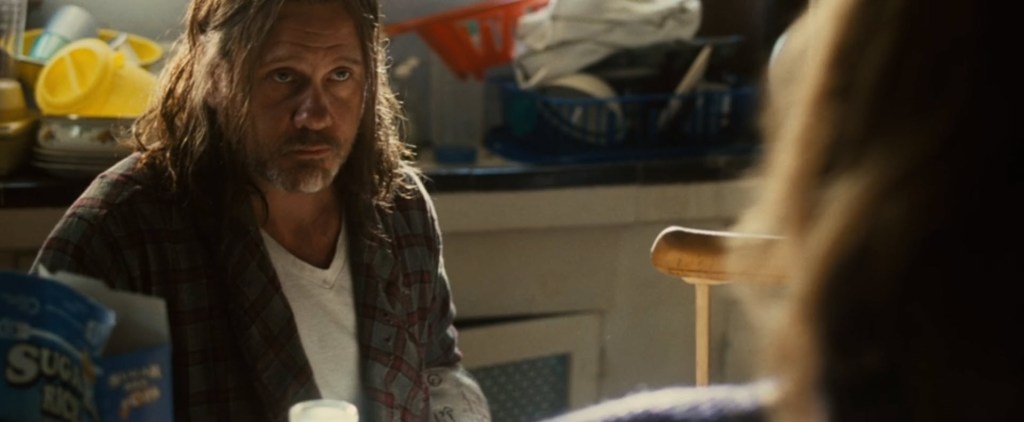
Zombie introduces the Myers family dynamic in a very different way. If Carpenter’s movie was to have a killer hiding within a seemingly normal family, something that the era would not have been prepared to deal with, Zombie introduces this Michael in a family in which the 1990s struggles of Midwest USA families come to the fore. We have Ronnie White, played by William Forsythe, the patriarch in a family where he seemingly is on some sort of disability or workers’ compensation for injuries he’s suffered, being a particularly cruel boyfriend and pseudo-father to Michael and his sister Judith. More on them in a bit. Deborah Myers, played, naturally, by Sheri Moon Zombie, apparently had Michael and Judith in a past relationship (setting up that mixed family thing that was growing more common in 1990), and works to support the family as a dancer at a strip club. She’s suddenly left to make money for the full family while Ronnie is unable to work.
Ronnie and Deborah are not a good couple. They scream at each other, hurling violent insults back and forth at each other, causing the newest member of the family, a baby girl (who, of course, will grow up to be Laurie Strode), to cry often, pissing Ronnie off further. Ronnie is uninterested in being an actual father figure who cares for Deborah’s kids, and Deborah has to pull double duty as a mom who cares for the kids, gets them off to school, and handles all the house stuff while being a dancer who works late nights.
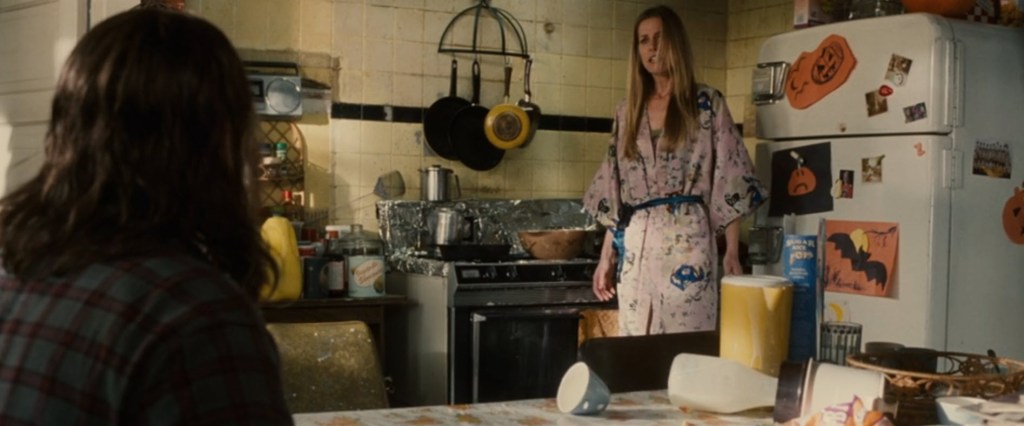
This means that Michael and Judith are largely left to care for themselves. Michael is shown to be an outsider who is often bullied at school and is already showing signs of psychopathic behavior by harming animals. He will also get back at his main bully on Halloween in an exceptionally violent manner. Judith is more mature than she should be for her age and dresses in revealing and sexy ways that would likely get her noticed by boys, whom she will cling to for an escape from a very creepy step-father figure. She’s following the path of her mother, choosing to find some semblance of security in the arms of a man who cares more for her looks and body than for who she is as a person.
So right away, this is going to be the crux of whether or not someone is able to stick with this movie or immediately despise this new direction. The original was almost a supernatural force of evil that just existed inside Michael, where we’d expect a “soul” to be. Instead, we are getting an extremely visceral look at Michael’s upbringing, creating a monster. A family that is dysfunctional, teaching the two older kids to be a skank and a psychopath. There is no innocence here. For many, that was the appeal of the original Halloween film.
Now, frankly, I hate that I’m spending as many paragraphs as I have comparing a newer version of a movie to its classic, often considered to be one of the greatest horror films ever made, version, but I don’t have much of a choice. You see, Carpenter’s original was a slick thriller that kind of buried the creation of Michael Myers under subtext and visual cues. Rob Zombie is not going to just make an uninspired shot-for-shot, scene-for-scene remake of that. Zombie is going to do his thing, and what he specializes in is exploitation horror. He creates worlds that are scuzzier and meaner than what most of us want to imagine or see for ourselves. If that’s not for you, there’s nothing I, any other critic, or Zombie himself can say that will change your opinion. Zombie wants to create a Michael Myers based on the types of characters and worlds he knows best how to create. He wants to spend a lot more time on why Michael Myers is and what makes him tick.
Now, I’m going to reserve most of my larger thoughts about this remake for later. For now, let’s just kind of get back to what is really happening in this movie and proceed through the movie’s plot.
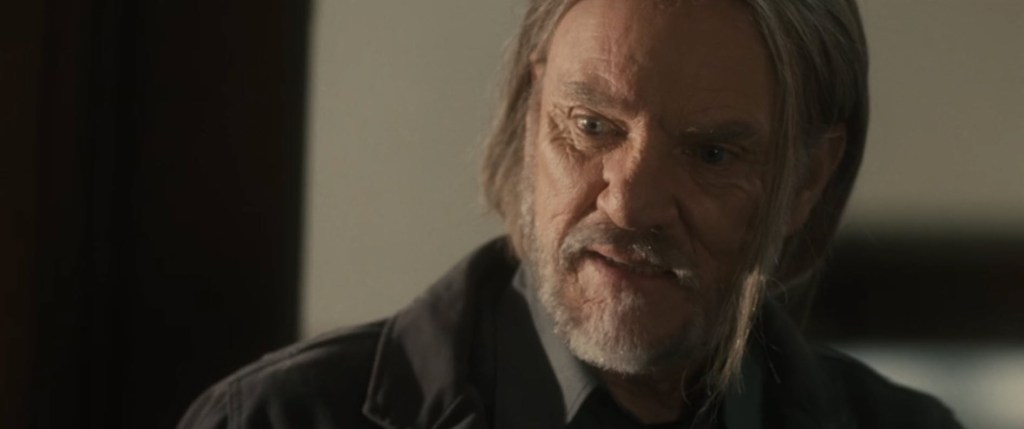
At school, Michael gets cornered by his bully, Wesley. He seemingly is going to be saved by the school principal (played by Richard Lynch), but Michael cusses out the principal. Deborah is called to the school, where she meets Dr. Sam Loomis, sporting fantastic long hair. He and the principal reveal to Deborah that Michael brought a dead cat in his backpack to school and has several photos of dead animals. Loomis explains he’s showing the early signs of psychopathic behavior, and he wants to interview Michael with her permission.
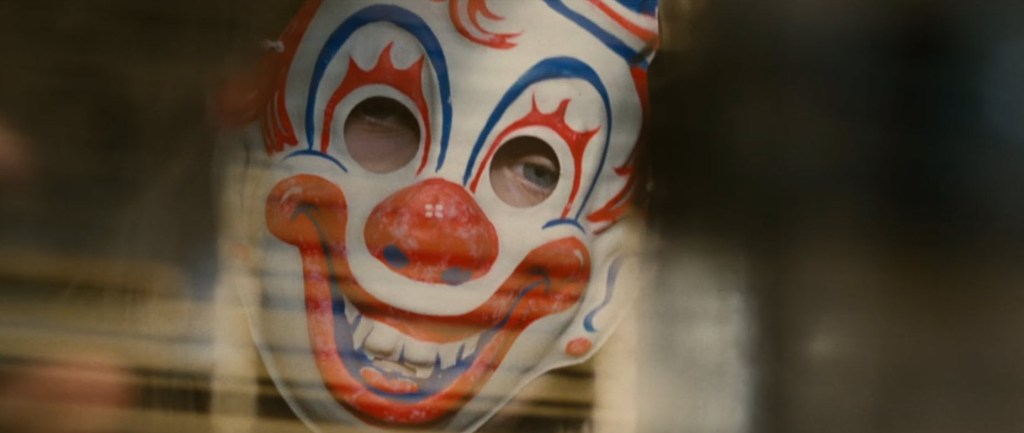
Michael runs away from the school when he overhears this talk from Loomis. He decides to use this opportunity to ambush Wesley. In a wooded area near the school, Michael, wearing his clown Halloween mask, beats the kid to death with a tree branch while Wesley pleads for his life.
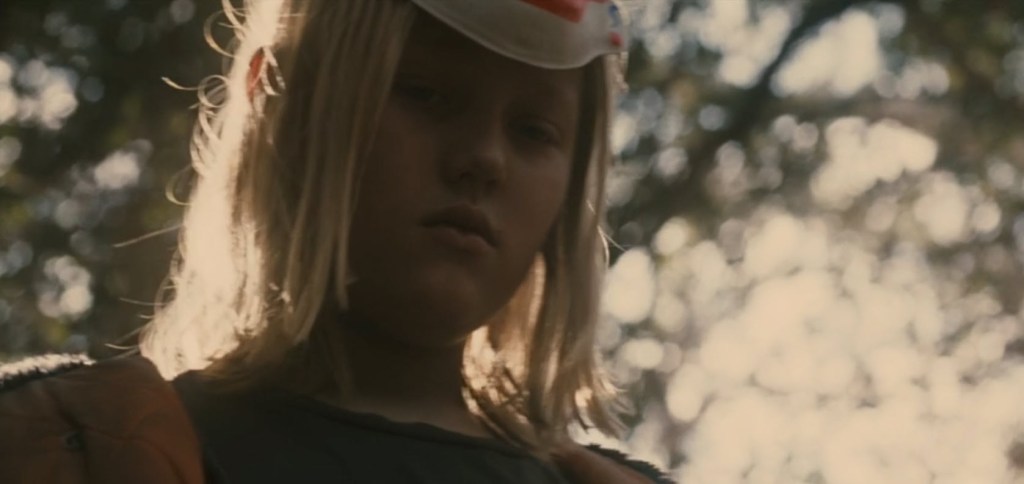
It’s an effective scene. In one way, we like the idea of a kid as nasty as Wesley was to Michael getting some comeuppance, but Michael has the will and the strength to brutally murder someone. The breaking point has come. He practiced on animals, including his own pet rat that very morning, when he cut it up with a scalpel. This isn’t the Michael Myers we’re used to, but we are seeing what he’s capable of, even as a 10-year-old.
Michael isn’t totally without love. That’s another interesting element that has already shown itself. He hates Ronnie. He doesn’t get along with Judith. However, he loves his little sister, actually wanting to kiss her good morning when he came down for school. He also has love for his mother, the only person who can actually show him affection and attention. When his mom goes to work at the strip club, Judith is supposed to take him trick-or-treating, but the moment her boyfriend comes over, she basically tells Michael to take himself while she fucks him. If the breaking point has come, making Michael willing and capable of killing Wesley, the last straw has broken his back, and he’s ready to rid himself of everyone but his mother and baby sister.
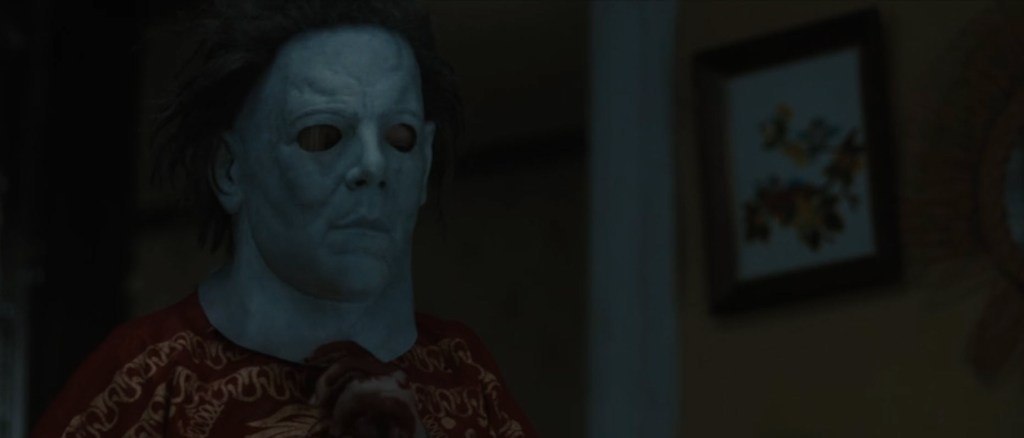
Michael returns home with a plan. He’s going to use duct tape to strap Ronnie to the chair he’s passed out drunk in, slit his throat, then beat his sister’s boyfriend to death with an aluminum baseball bat, and then go upstairs with a butcher knife to kill Judith. He then sweetly wishes his baby sister a happy Halloween. But, you know what? He can’t hate his sister’s boyfriend that much. That dude had the Shatner mask that Michael Myers is famous for. He’ll gladly take that off the dude’s hands and get a lot of use out of it for years to come!
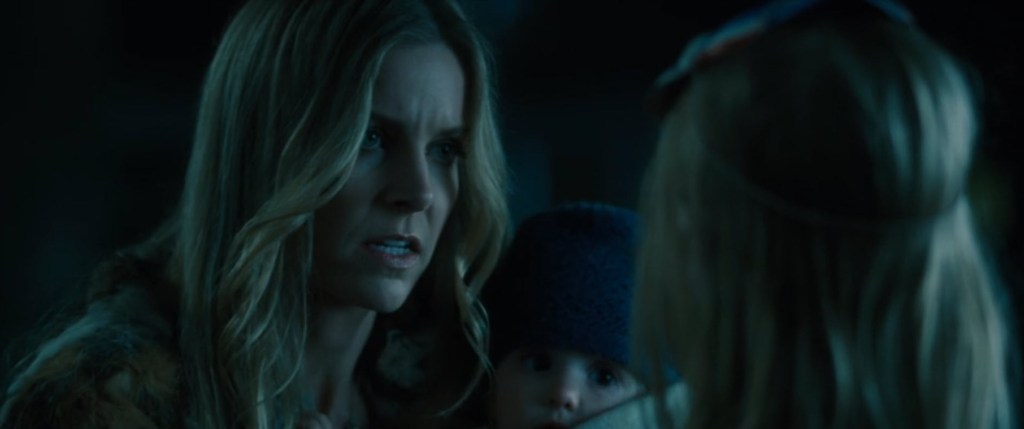
When Deborah comes home, she finds Michael on the front step to the house with the baby. She asks him what’s going on, but he won’t answer. She will soon discover what’s going on when she goes inside the house. So, yeah… We’re now at the point where Michael needs to be arrested for his murders and put into a psychiatric hospital.
Eleven months later, after Michael Myers is convicted of first-degree murder, he is sent to Smith’s Grove Sanitarium. There, he is put under the care of Dr. Loomis. Initially, he is rather talkative to Loomis. He claims he didn’t do the murders. He has no memory outside of trick or treating and eating candy. Deborah comes to visit him, and Michael asks questions about when he can go home and how everyone is doing at home.
It seems that Michael and Loomis have a good rapport with one another. He also seems nearly angelic and sweet when his mother comes to visit. However, there is something wrong with him. A kindly orderly (played by Danny Trejo) tries to talk to Michael and lift his spirits, but Michael doesn’t respond to him, only stares. It’s hard to believe that he’s dissociated himself from that night a year ago. Is he acting a particular way in a sociopathic way to get freed to be with his mother and little sister, or is he really snapped?
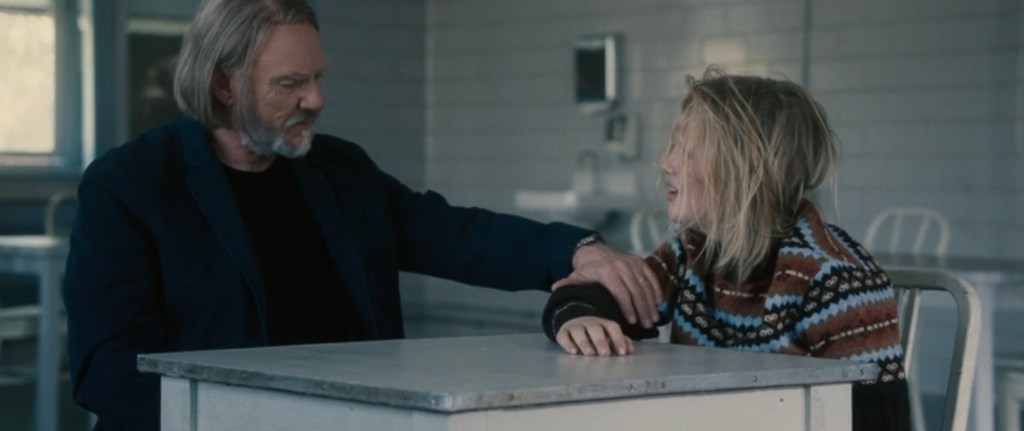
Another sign that he’s lacking something in his personality is that he shows Loomis a mask he’s made. It’s black, which is his favorite color. Loomis tries to say that black isn’t a color, it’s an absence of color. He constantly makes masks. He tells his mother that he makes the masks to cover his face because he thinks he’s ugly. Despite Deborah telling him he isn’t ugly and she doesn’t like him covering his face, everything is deteriorating for Michael. He begins to scream at Loomis, demanding to go home.
Michael isn’t eating. He’s withdrawing even from Deborah. She visits one last time to give him a picture of him with his baby sister. When she leaves, Loomis walks her out to talk to her, leaving a nurse to watch after Michael while Loomis explains that Michael may need shock treatment for how withdrawn and nonverbal he’s become. Michael kills the nurse (played very briefly by Sybil Danning). Realizing Michael will never be released, Deborah is no longer able to handle the pain of everything and kills herself.
Fifteen years later, Michael no longer speaks. He’s a hulking beast of a man who always hides his face behind one of his dozens of papier mache masks. Ismael, the orderly played by Trejo, is still kindly toward Michael. However, after all these years, Loomis can do nothing more for Michael. He tells Michael this is his last day.
Loomis has written a book about Michael called The Devil’s Eyes. He promotes the book and does speaking engagements about Michael’s psychopathic behavior. He says that Michael was created by the perfect combination of internal and external forces that went violently bad. Meanwhile, Michael is in the process of being transferred to a higher security prison by correctional officers. Naturally, this is the night he decides to come home.
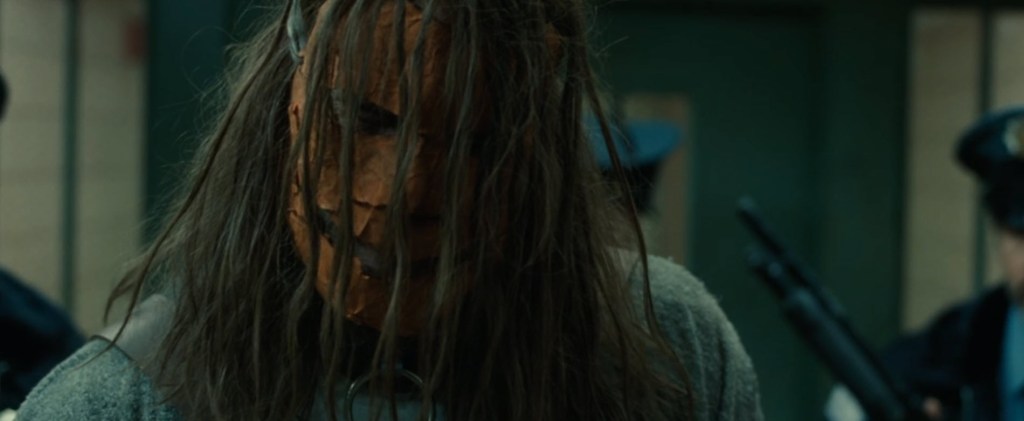
He breaks the heavy chains he’s bound by and brutally massacres all the officers. For good measure, he kills everyone at the hospital, including Ismael, who discovered the bodies of all the officers when he arrived for work. Poor Ismael gets it worse than anyone we’ve seen Michael kill thus far. He first tries to drown the orderly, but later decides to drop a TV onto him to crush the poor guy’s head.
Michael leaves the hospital and goes to a truck stop to kill a truck driver played by Ken Foree. That provides him with coveralls to wear. While Loomis goes to Smith’s Grove to learn more about Michael’s escape, Michael makes his way home to Haddonfield. There, in his old home, he has his favorite Shatner mask and the butcher knife he used years before. It also just so happens to be Halloween.
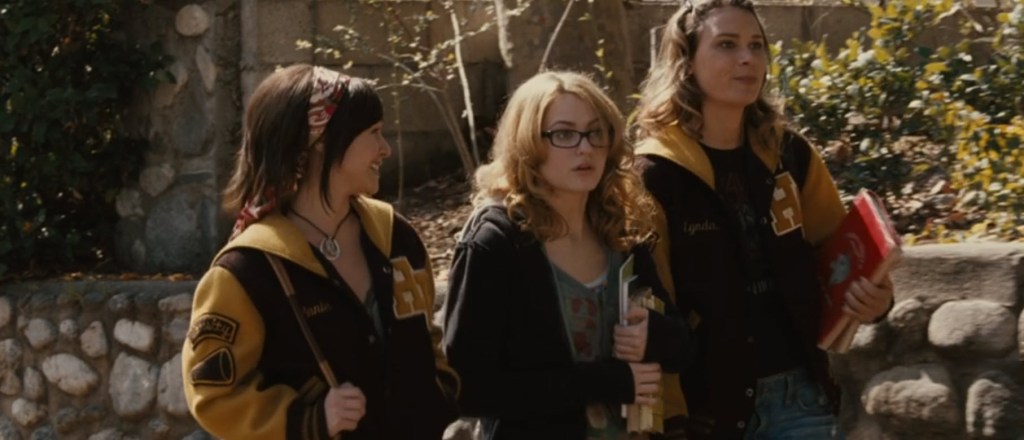
So now, we largely pick up the story of the original Halloween, albeit a truncated retelling. Laurie Strode, while not as “mousy” as she was in the original, is the adopted daughter of Dee Wallace and a real estate agent father. Her father is selling the old Myers place. Laurie often babysits Tommy Doyle, who warns her about the Myers place being haunted. While Laurie is being talked into helping her friend Annie (Danielle Harris) watch Lindsay Wallace, the girl Annie babysits, so Annie can get laid by her boyfriend, Laurie sees a masked man watching her through the school library’s window from across the street. Michael stalks Laurie, Annie, and the third friend of this group, Lynda, throughout the afternoon. Elsewhere, Loomis knows where Michael escaped to and heads to Haddonfield.
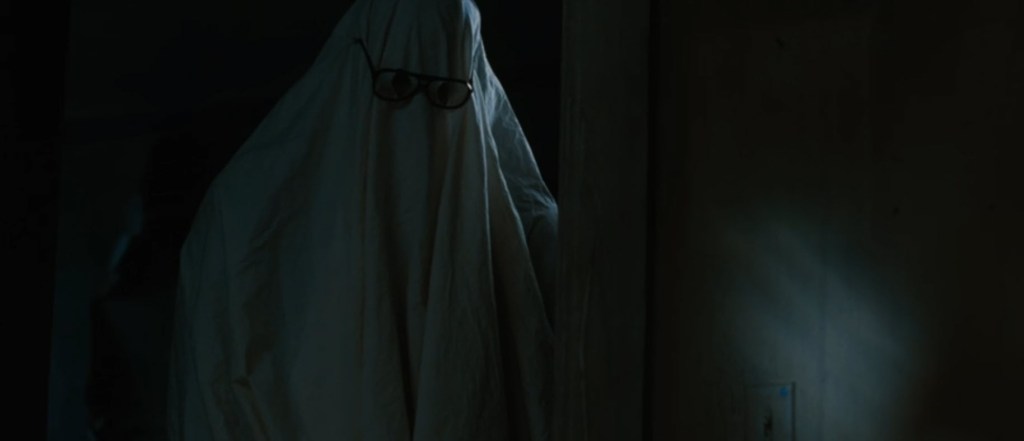
Minor changes from the original plot of 1978’s Halloween crop up here in this portion of the movie. Lynda and her boyfriend, Bob, still get together to have a roll in the hay. However, they don’t do this at the Wallace house. Instead, they go to the Myers house one last time before Laurie’s dad sells the house. Lynda is killed first, instead of after Annie, for reasons that will be made clear shortly. Also, Lynda isn’t on the phone with Laurie when she is killed by Michael. Michael still takes Judith’s headstone, but replaces it with a skinned and crucified coyote he caught and killed.
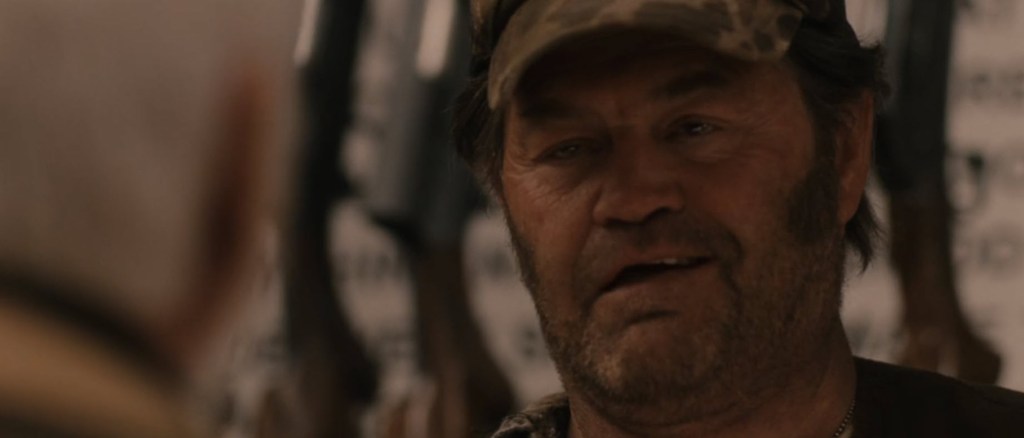
The one thing the original Halloween didn’t have that it definitely needed, which Rob Zombie really comes through on, is how Loomis secures his revolver for his eventual encounter with Michael. I mean, we really only need to know who Loomis bought it from. This version of Halloween has 100% more Micky Dolenz, playing the gun shop owner, and that gives this movie at least that advantage over the original.
(Seriously, I think I actually said, “Hey, Hey it’s a Monkee!” when I saw this movie in the theater on opening night.)
While the plot follows the original pretty closely in this last hour of the movie, one thing that is added is a relationship between Laurie and her parents. The original largely used Annie and Lynda to give the exposition about Laurie’s good, smart head on her shoulders. This version actually shows Laurie interacting with her parents, characters pretty much totally left out of the entire series. The moment Laurie leaves for the Doyle house to babysit Lindsey and Tommy, Michael attacks and brutally murders the Strodes.
Loomis tries to convince Sheriff Brackett, Annie’s father, that evil has arrived in Haddonfield. Brackett doesn’t really believe in what Loomis is selling about the danger of Michael Myers. Brackett, as well as many people in Haddonfield, doesn’t care much for Loomis over the book he wrote about Michael. Loomis tries to appeal to Brackett that Michael has returned for his baby sister. Brackett knows the Strodes adopted the orphaned baby of Deborah Myers. He tries calling them, but they’ve already been killed.
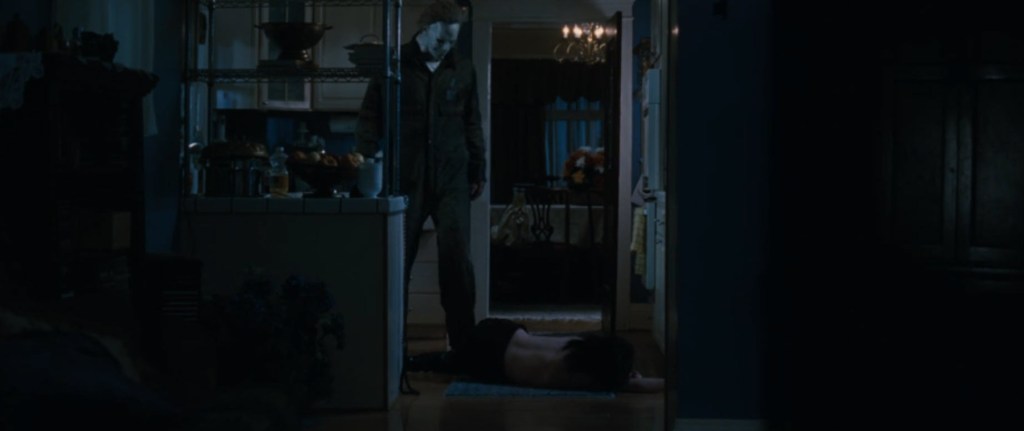
Elsewhere, Paul and Annie are getting it on at the Wallace place. Michael followed them there. He quickly kills Paul and brutally attacks Annie. However, in a twist from the original, he stabs her often, but she doesn’t die. It’s a more realistically terrifying scene too. She tries to fight back, but Michael drags her off, screaming and crying for help.
Laurie finds Paul and the still living Annie when she brings Lindsey back, but Michael is still inside the Wallace house. Luckily, Laurie calls 911 for help, which gets the word out to Sheriff Brackett, who is with Loomis. So this sets up the climax. Michael injures Laurie, who escapes into the street screaming for help and manages to get back inside the Doyle house before Michael gets to her. Brackett, knowing what’s going on, allows for police to get to the area sooner too, but the police who come to help Laurie, Tommy, and Lindsey are killed. Michael manages to get to Laurie and takes her to the Myers house. Lindsay and Tommy tell Loomis that “the boogeyman” took Laurie.
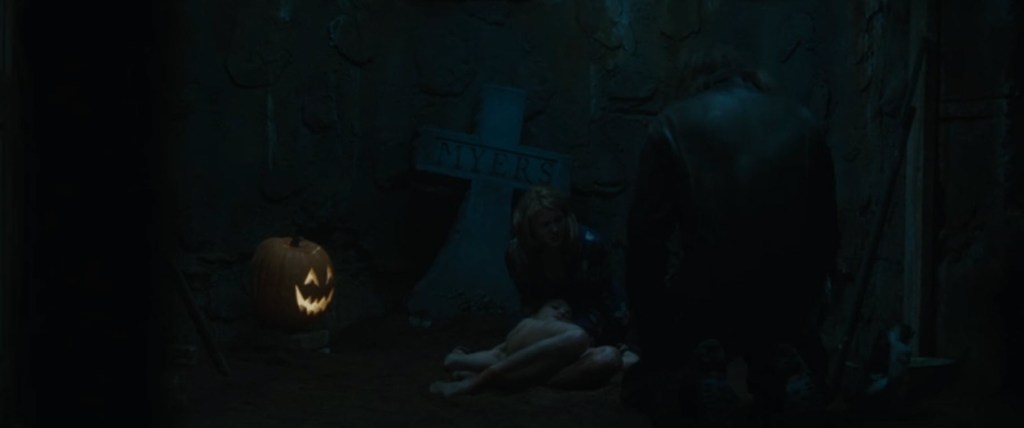
Laurie sees Lynda’s body in the Myers house and thinks the approaching Michael is going to kill her too. He drops the knife and shows her the picture of him and her when they were younger. When Michael takes off his mask and kneels in front of her, she realizes there’s something about her, but she’s not fully understanding what this mute guy is getting at. She tells Michael she’s going to help him, but uses that to pick up his knife and stab him. She manages to escape the house with Michael hot on her tail.
Before he can kill Laurie, Loomis arrives to try to stop him. When Michael pays no attention to him, Loomis tries to shoot him to death. Loomis believes he’s killed Michael and takes Laurie to the police car he came in. But guess what? Bullets don’t hurt Michael Myers. He comes back to get Laurie after she asks if that guy was the boogeyman. Loomis tells Michael it’s not Laurie’s fault for anything. He failed him, so Michael tries to gauge Loomis’ eyes out. Michael seemingly succeeds and drags him into the house while Laurie tries to hide. When Michael finds her, Laurie has to escape the house again, but sees the gun Loomis bought from Micky Dolenz and takes it with her.
After a brutal game of cat and mouse, Michael tackles Laurie out through the upstairs window, throwing them to the ground outside the house. Laurie picks up the gun and shoots Michael in the face, and screams in traumatic terror as the police arrive.
Alright… So here’s the skinny from my point of view. For almost 20 years, I’ve said two things. First, I never exactly cared for anything about this movie. Second, I still prefer Rob Zombie to try to make his own Halloween rather than just do a generic retelling of Carpenter’s and make it bland as shit. So with the second thing I used to always say, he succeeded. This is undeniably his version of this movie – for better or worse.
I never once, though, railed on this film like many others did. Typically, I would have said, eh… I don’t know if the sheer brutality of this hulking Michael Myers was palatable to me. I don’t think I wanted 45 minutes of Michael’s origin, let alone half of that time being spent with a family of white trash people who are a hell of a long way away from Laurie Strode and her friends. But I didn’t just consistently shit on this movie. It was a remake that wasn’t cookie-cutter, even when it followed some of the same story beats as the original. I could appreciate the effort.
But, I don’t know. 20 years later, and some more critical maturity, I looked at this movie for, I think, the third time, but with fresh eyes. Maybe it’s a little Stockholm Syndrome after spending a whole bunch of weeks with other Rob Zombie movies, but I actually can say I think this is a better movie today, right now, than it ever was before. It’s got problems. But… Zombie is really trying to put together a frightening horror movie from potentially compelling ideas.
Here’s what I can say I do like. First, I think McDowell is a fantastic Loomis. He’s perfect. Second, I really like the sequence of Michael, his mother, and Loomis, while Loomis is really trying to help Michael that first year or so after his incarceration. There is a sadness there that a little boy is basically a monster, but no one can break through that and reach him to try to keep him from the much worse monster he’ll ultimately become. Third, I do appreciate trying to figure out a way to modernize the horror elements and, yeah, sure, the character elements. Laurie’s cheeky sex jokes are kinda off putting, but that’s my problem, not the movie’s. More on that in a bit.
What don’t I like? Well, I absolutely understand Zombie taking the focus from it being entirely on Laurie Strode and having some of this movie come from Michael’s perspective. After all, most of the Halloween films that count in the franchise are a tale of Laurie Strode vs. Michael Myers (for better or worse). If the movie has two leads, we should get something from the other somewhere. I appreciate that, but this movie is a tale of two halves. The first half focuses specifically on Michael and the second on Laurie, and it’s not exactly a smooth transition. We don’t fully understand Michael’s need to get to Laurie or to try to harm her once she tells him she doesn’t understand and tries to defend herself. There’s not a lot backing up the idea that he feels abandoned by her. There’s not a lot to explain how he knows who she is. The transition between the two perspectives from Michael to Laurie is wonky, and this movie’s biggest downfall.
That’s just me, though. Today, looking at this as separate as much as I can from the original source material, I like this movie more than I ever did before. I could watch it again, and maybe even happily. I know that is NOT the case for most people, though. I, for one, kind of like what Rob Zombie does with genre. He’s an exploitation filmmaker. I like exploitation films. I know they are not for everyone. I also know that remakes are VERY hard to accept and watch without comparing to the original.
Shiiiit… Look at the first several paragraphs of the actual review of the movie above. I did that. Successful remakes are the movies that are almost great but need to be reworked into being great, or movies that don’t have a large following to begin with, and therefore allow for people to watch without a lot of baggage. A great example of that is Cape Fear. Scorsese remade that movie that you could go and rent from Blockbuster, but, at that point in time, despite major stars in the movie, it mostly existed for three decades in obscurity. The new version was beloved, and people went back and rediscovered the original. While most people don’t have the same connection to it that I do, I bet a remake of One Flew Over the Cuckoo’s Nest (the greatest movie ever made, in my opinion) could work. I wouldn’t be able to accept it for my own personal love of the original, which is why I was really not interested in the Nurse Ratched show from some years ago, but there are people who are not as connected to that as I am.
But 1978’s Halloween is ubiquitous with the genre to horror fans. It’s often the first slasher movie people see. It’s loaded with Halloween atmosphere. It’s legitimately scary and plays on your nerves. It’s got a massive fanbase, even 20 years ago. It was such a tall order for this to be accepted by fans; it was probably impossible. But I’m happy to say that I don’t think it’s that bad. It’s not going to be for everyone, but it doesn’t deserve the deep vitriol it gets from horror people. Sadly, it also immediately spent all of Rob Zombie’s goodwill with the horror community, but hold that thought for tomorrow.
Wait… Tomorrow? What’s that about? Don’t I normally end each of these reviews by saying you should come back next week? Usually that’s the case, but we do Halloween (the day on the calendar, not the many movies named that) differently around here. For years, B-Movie Enema has had a Halloween tradition – a new review ON the day of Halloween. Sometimes that means that October 31st falls on a Saturday, giving my fine Enemaniacs two consecutive days of B-Movie Enema goodness.
Hell fuckin’ yeah, brothers and sisters! Come back tomorrow for the final entry in Rob Zombie’s Spookshow, and the Halloween 2026 special release… My review of 2009’s Halloween II. Until then…
TO BE CONTINUED…

